Hijet Deck Van: The Kei Truck With a Back Seat
Most kei trucks seat two. The Daihatsu Hijet Deck Van seats four and still has a bed, as long as you do not ask much of the bed. Chassis codes, import eligibility by year, three 1990s recalls, and who should actually buy one.

Advertisement
Most kei trucks seat two people and a thermos. In 1988 Daihatsu took a Hijet van and cut everything behind the rear seat off. The leftover floor became a bed. The result is the Deck Van: four seats, a roof over your head, and a very small place to put things. It was built for appliance shops, but it works for any crew of three or four. You will see it written Deck Van and DeckVan; Daihatsu's own English name, per Japanese Wikipedia, is HIJET DECKVAN.
On June 27, 2026, Carscoops spotted one at a South Carolina dealer, asking $12,950 for a four wheel drive truck with around 69,000 miles. The writer called it "the smallest crew cab truck we've ever seen" and noted it offers less bed per buck than other used trucks on sale in America. True, and also the wrong way to judge it. The Deck Van is a people hauler that happens to have a deck. Shop it like one.
Our take after digging through the Japanese record on these: the eighth generation is the one to buy, the ninth is a fine second choice with a shorter deck, and nobody should pay extra for the bed.
A Hijet Van With the Back Cut Off
Daihatsu did not draw the Deck Van on a clean sheet. According to Japanese Wikipedia's Deck Van article, it began as a joint project with Matsushita, now Panasonic, so electronics shops could carry a refrigerator standing upright. Take the Daihatsu Hijet van, remove the body behind the C pillar, swap the back door for a drop down gate, and you get a four seat truck. Current trucks add a guard frame behind the cabin and guard bars on the gates for tying loads down, though the same article says the guard frame only became standard equipment in 2017, so check whether an older truck has one. The same article says it found a following well beyond electronics shops, with florists, construction crews, hunters, and surfers, and that Tohatsu built portable pump fire trucks on it for volunteer fire brigades.
Mechanically it is that van. Carscoops notes the three cylinder engine sits under the front seats. Daihatsu's passenger van sibling, the Atrai, even got its own Atrai Deck as a limited edition during the first Deck Van generation, with a glass sunroof and swivel seats.
One detail matters more than the trivia. Japanese Wikipedia's Hijet article says Deck Vans were hand built by cutting up van body shells before paint, and the Deck Van article says that through the ninth generation they were not type approved and were registered in Japan as modified vehicles, the so called maru kai. That requirement ended with the tenth generation in 2004. We have not checked how that notation reads on US import paperwork, so ask your importer to show you the Japanese documents before you pay.
Chassis Codes and Years: Which Deck Van Is Which
Shop by chassis code. A Deck Van carries its Hijet van's code with the last letter changed from V to W. The second digit tells you the drive: S100W is two wheel drive and S110W is four wheel drive, and the same pattern holds for S200W and S210W.
| Generation | Chassis codes | Built | What changed | US import status |
|---|---|---|---|---|
| 7th | S80W/S81W (550cc), S82W/S83W (660cc) | Oct 1988 to 1993 (series ran to Jan 1994) | The original. An April 1990 update moved it to the new kei rules, 100mm longer with the 659cc EF engine replacing the 547cc EB | Eligible |
| 8th | S100W (2WD), S110W (4WD) | 1994 to 1998 (series ran to Jan 1999) | Cab over layout. A GX trim added a passenger style interior | Eligible |
| 9th | S200W (2WD), S210W (4WD) | 1999 to 2004 | Semi cab body with a crush zone, a shorter deck, fabric rear seat | Rolling: 1999 builds clear, 2001 builds clearing now, 2004 builds not until 2029 |
| 10th | S320W/S321W (2WD), S330W/S331W (4WD) | 2004 to 2021 | Bigger cargo area, no modified vehicle registration needed | Not before 2029 |
The generation numbers follow the Hijet series count that Wikipedia and Carscoops use, where S100 is the eighth Hijet. Quote the chassis code when you talk to a seller. The ordinal is a reference convention, not something on the truck. The build ranges for the first two rows differ between sources: Japanese Wikipedia's Deck Van article dates them 1988 to 1993 and 1994 to 1998, while its Hijet article runs the whole series to January 1994 and January 1999. Every truck in both rows is past 25 years either way.
The eligibility math is where the ninth generation gets interesting. The NHTSA import rule exempts vehicles 25 years after their manufacture date, and it counts from the month of manufacture, not the model year. Every eighth generation Deck Van is already past the line. Ninth generation trucks built in 1999 have been eligible since 2024, the ones built in 2001 are clearing month by month this year, 2002 builds follow in 2027, and the last 2004 trucks do not clear until 2029. Our 25 year rule guide walks through the month by month counting so you do not buy a truck that is two months short.
Subaru sold Daihatsu's tenth generation truck as the Sambar Open Deck from July 2012 until January 2022, so you will see that name on forums. No Sambar Open Deck is import eligible before July 2037, since Subaru sales began in July 2012. Daihatsu's own tenth generation Deck Vans start clearing in 2029.
Power, Size, and the Bed Nobody Should Quote
The truck in the Carscoops listing runs a 660cc three cylinder making around 44 hp through a five speed manual to all four wheels. Kei rules capped length at 3.3 m (130 inches) and engines at 660cc starting in 1990, and Carscoops lists the truck at 130 inches, right on that limit. Per Wikipedia's kei car history, the length limit rose to 3.4 m in October 1998, which is the world the ninth generation lives in. On the ninth generation, Japanese Wikipedia says every three speed automatic and the top manual grade got the EF-VE engine, and the rest of the manuals got the EF-SE.
Now the bed. Carscoops' headline says 34 inches, but read the article: Carscoops says outright it has no dimensions for the 1998 truck, borrows the 34 inch figure from the 2010s model, and bets the older bed is just as small. Japanese Wikipedia tells the real story. The ninth generation's move to a semi cab body with a crush zone shortened the deck, and the 2004 redesign made it bigger again. So the eighth generation has a longer deck than the ninth. We have no verified figure for it, so we are not going to hand you one. Bring a tape measure.
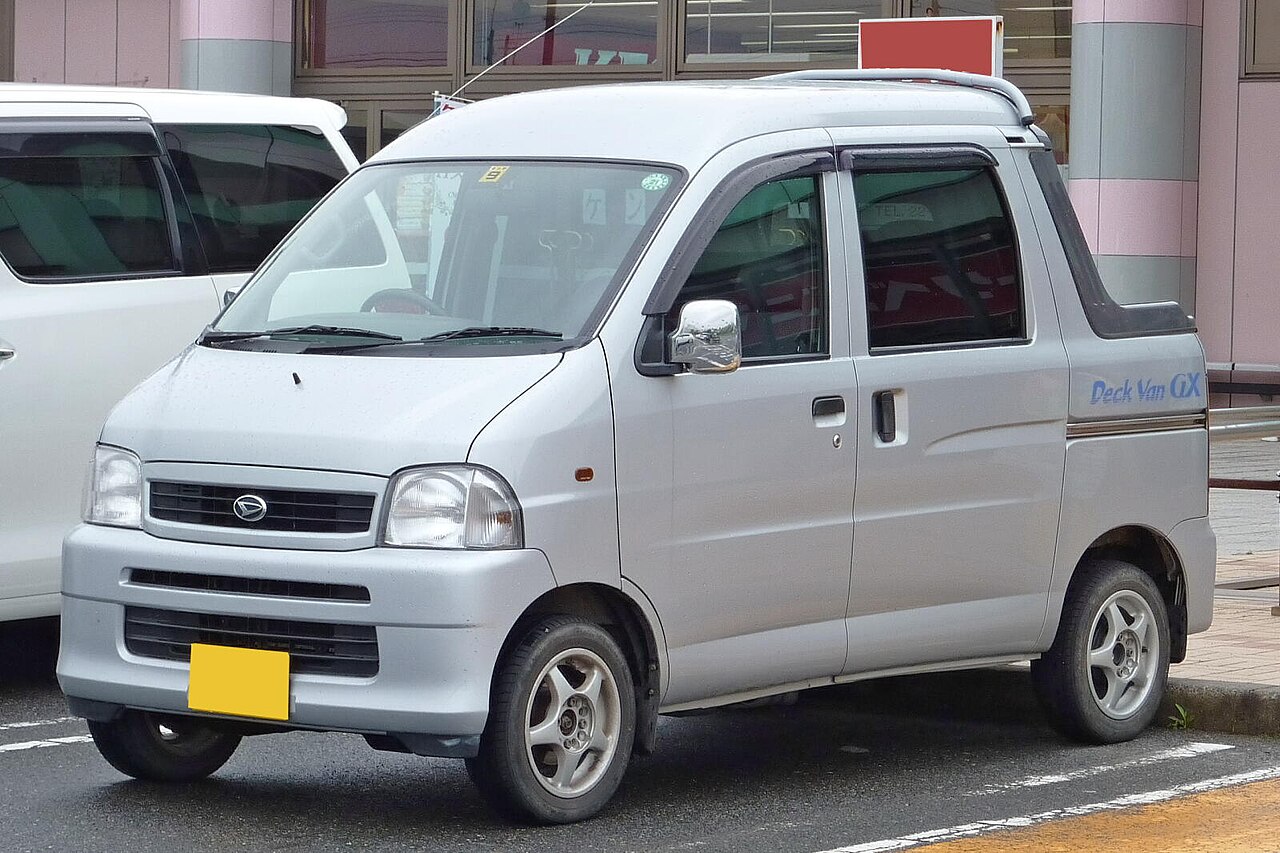
Two more bed facts. On the Carscoops truck the rear bench backrest folds down, but there is no pass through flap in the rear bulkhead, so anything longer than the deck stays outside. And tie down points vary by truck: Japanese Wikipedia says the guard frame became standard equipment only in the November 2017 update, and the owner quoted below reported that a Deck Van without the rear window guard has extremely limited vertical tie down points. Plan on ratchet straps either way.
For an owner's view of living with one, Micah Wright bought a 2013 four wheel drive Deck Van and wrote up the first fixes for Offroad Xtreme in 2023. Storage, ground clearance, and grip topped the problem list, along with 12 by 4 inch steel wheels, stock tires described as awful, and forward lighting described as horrific. That truck is a tenth generation that cannot be imported yet, so treat it as a clue about the layout, not a spec sheet for the older ones.
Who Should Buy a Deck Van, and Who Should Pick Something Else
A conventional kei truck puts two seats up front and spends every remaining inch behind them on bed. The Deck Van trades most of that bed for a second row. Buy one if the answer to "who rides along" is a crew, and the cargo is tall, muddy, or wet, the kind of loads Japanese Wikipedia says florists, construction crews, hunters, and surfers carried. The open deck is a better home for dirty loads than the inside of a van, and a guard frame, if the truck has one, gives you something to lash to.
Skip it if you move lumber, sheet goods, or anything long. A standard Hijet truck gives you the entire back half of the vehicle as bed, and no amount of clever folding turns a Deck Van into that.
If four seats matter more than the Daihatsu badge, there are other options. Japanese Wikipedia says Mitsubishi and Nissan added similar Double Cab versions of the Mitsubishi Minicab and Nissan Clipper around the same period, built by Marubun. We have not seen one in person, so treat that as a lead to search, not a recommendation.
Buying One: Price, Three Recalls, and What to Check
The only price we can source is the Carscoops listing: $12,950 in June 2026 for a four wheel drive five speed with about 69,000 miles. Carscoops itself said it is not the cheapest kei import you will find. One listing is not a market, and that one may be gone by the time you read this, so compare several dealers and watch how long trucks sit. Carscoops also spotted a tear in the seat under the aftermarket covers while the dealer described the interior as free of major wear, which is your reminder to lift every seat cover.
Then there is the recall history. According to the recall section of Japanese Wikipedia's Hijet article, which cites the filings, Daihatsu made three recall filings with Japan's transport ministry that cover eighth generation Deck Vans.
| Filed | Problem | Built | Units |
|---|---|---|---|
| June 1996 | Rubber coolant plug for the rear heater port, on top of the engine, could crack and leak, risking overheating. Vehicles with a rear heater fitted were excluded from the fix | Jan 1994 to Nov 1995 | 64,831 |
| January 1999 | Shift cable mounting could make shifting heavy, and a broken cable core could leave you unable to shift | Jan 1994 to Feb 1997 | 53,008 |
| April 1999 | Headlight switch contacts in the turn signal switch unit could wear, raising resistance until the switch melted and smoked, with fire risk. Filed after the ministry said in March 1999 that Daihatsu knew of the defect and had not filed a recall | Jan 1994 to Feb 1998 | 496,126 |
Unit counts cover every affected model, not Deck Vans alone. The January 1999 recall names vans, Deck Vans, and Atrai, while the other two also include the trucks. None of the production windows run past February 1998, so a truck built after that month falls outside all three. Whether a given import ever had the work done is a question for the seller. Ask for service records, then have a mechanic look at the cooling system, the shifter linkage, and the switchgear.
Because these bodies were cut by hand, we would look hardest at where the cabin meets the deck. That is our read of how they were built, not a known failure point. Run the rest through our pre purchase checklist, and if you are buying from Japan instead of a US dealer, our import guide covers the process. Four seats do not change what your state allows either, so check the state by state guide before you commit.
Parts are the open question. Oiwa Garage lists parts for S100 and S110 era Hijets, and the Deck Van is mechanically a van underneath, so confirm fitment against your chassis code before you order. The deck pieces, the guard frame, the gate, and the rear glass, are what we would worry about, and we have not priced them.
The Bottom Line
Buy an eighth generation S110W if you want the best Deck Van you can legally import today, and buy it for the four seats, not the bed. The ninth generation S200W gets more interesting every month as new builds clear the 25 year line, but its deck is shorter, and the 2004 trucks are three years out. Do not pay a premium for cargo space the truck does not have, and check the build month against the three recall windows before you talk price. If you want a second opinion from people who own these, r/keitruck is where to ask.
Advertisement


