Best Kei Trucks to Import in 2026: The Fuel Injected Generation Has Arrived
2001 model year kei trucks are now import eligible, and they are the best generation yet. Fuel injection, power steering, AC, and timing chains. Here is every model worth buying at auction right now.

Advertisement
TL;DR: The 2001 model year kei trucks crossing the 25 year import threshold in 2026 represent the best generation ever offered to US buyers. Every truck on this list has electronic fuel injection, most offer power steering and AC, and the Suzuki Carry DA62T runs a timing chain instead of a belt. If you have been waiting for the right time to import, this is it. Prices at Japanese auctions currently run ¥200,000 to ¥600,000 ($1,300 to $4,000) before shipping, with landed costs of $5,500 to $8,500. For a full breakdown of every cost involved, see our complete pricing guide.
For years, the kei trucks arriving on American shores were carbureted machines from the early to mid 1990s. Cold starts were finicky. Fuel economy suffered at altitude. Vacuum lines cracked and left you chasing idle problems on a Saturday morning. Those trucks were still great. They built the entire US kei truck movement. But the generation that just became import eligible is meaningfully better in every way that matters for daily use.
The 25 year rule works on a rolling basis, calculated from the month of manufacture. That means kei trucks built in January 2001 became eligible in January 2026, February 2001 builds in February 2026, and so on through the calendar. By the end of this year, every 2001 build will be legal to import under NHTSA's exemption for vehicles 25 years or older. The EPA gives a parallel exemption at 21 years, so emissions clearance is not an issue either.
Here are the five trucks worth targeting at auction right now, what separates them from each other, and what you should pay.
Suzuki Carry DA62T: The Default Choice
The DA62T Carry is the truck to beat. Suzuki introduced this chassis code in 2001 with one crucial upgrade over the outgoing DA52T: the K6A engine now runs a timing chain instead of a timing belt. That single change eliminates the most expensive scheduled maintenance item on any kei truck. No more $300 to $500 belt replacements every 60,000 km. The chain lasts the life of the engine if you keep oil in it.
The K6A is a 657cc inline three making 50 hp at 5,900 rpm and 63 Nm of torque at 3,500 rpm. It uses multi point fuel injection managed by a Suzuki ECU, and it starts first crank in any weather. The r/keitruck community consistently ranks the DA62T as the most reliable kei truck platform available to US importers.
Transmission options are a five speed manual or a three speed automatic. Four wheel drive models use a part time system engaged via a floor lever, with a low range option on some trims. Payload capacity is 350 kg (772 lbs), the kei truck legal maximum.
The Suzuki Carry has dominated US import numbers for good reason: parts are everywhere. Oiwa Garage stocks DA62T specific parts, Amayama can source OEM components by chassis code, and the aftermarket support from the Carry's popularity means you will never be stuck waiting on a part.
What to pay: ¥150,000 to ¥400,000 ($1,000 to $2,700) at Japanese auction for a clean, low mileage 4WD manual. Add $3,500 to $5,000 for export, shipping, customs, and US port fees. Total landed cost: $5,000 to $8,000.
Watch out for: Rust on the frame crossmembers behind the cab. The DA62T body is more corrosion resistant than the DA52T, but trucks from Hokkaido and Tohoku still get hammered by road salt. Check our pre purchase checklist before bidding.
Honda Acty HA6/HA7: The Mid Engine Oddball
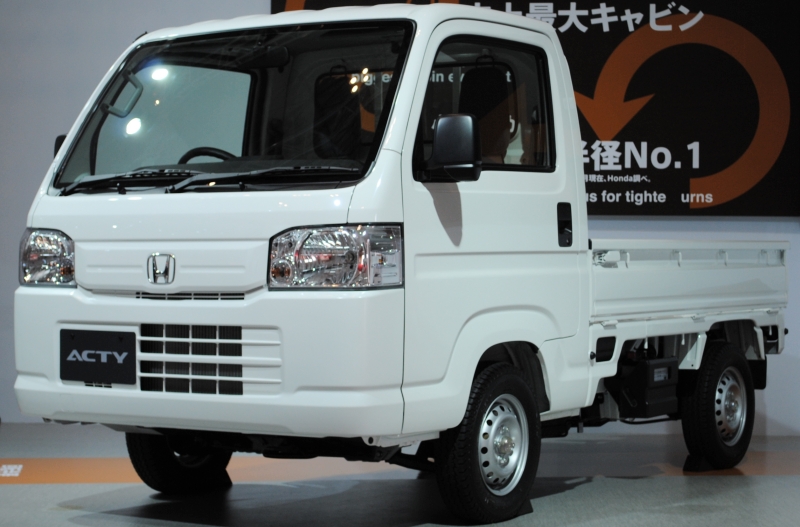
The Honda Acty does things differently. While every other kei truck puts the engine under the cab, Honda mounts the E07Z behind the rear axle, giving the Acty a rear mid engine layout. That engineering choice delivers noticeably better weight distribution, a quieter cab, and more predictable handling than any front engine competitor. The downside: engine access requires dropping the bed or working from underneath.
The E07Z is a 656cc inline three producing 45 hp at 5,500 rpm in naturally aspirated form. Honda used their PGM-FI multi point fuel injection system, which is proven across millions of Civic and Fit engines. The HA6 designation covers two wheel drive models. The HA7 is four wheel drive with a real time system that engages automatically when it detects slip.
Honda's real time 4WD is the most sophisticated system in this class. It uses a viscous coupling to distribute torque to the front wheels without driver input. For buyers who want 4WD without thinking about transfer case levers, the HA7 is the only game in town.
Production of the fourth generation Acty ran from 1999 to 2009, which means Hagerty and other enthusiast outlets expect supply to remain strong at Japanese auctions for years. Honda discontinued the Acty entirely in 2021, and that end of production badge has already started pushing collector interest upward.
What to pay: ¥200,000 to ¥500,000 ($1,300 to $3,400) at auction. The Acty commands a small premium over the Carry because of Honda's reputation and the real time 4WD system. Landed cost: $5,500 to $8,500.
Watch out for: The mid engine layout means coolant lines run the length of the truck. Check for leaks at every connection point. Also inspect the bed mounting bolts, as corrosion there makes engine access a nightmare. Our maintenance guide covers the Acty's specific service requirements.
Daihatsu Hijet S200P/S210P: The Configuration King
The ninth generation Daihatsu Hijet runs the EF-SE engine, a 659cc inline three with electronic fuel injection producing 46 hp. The S200P is two wheel drive. The S210P is four wheel drive with a part time system and optional rear differential lock.
What sets the Hijet apart from every competitor is the sheer number of factory body configurations. Daihatsu offered the S200P/S210P platform in standard bed, high side, dump truck, refrigerated box, panel van, and flat deck variants. If you need a specific truck for a specific job, the Hijet catalog almost certainly has a factory configuration for it. That variety extends to the cab: standard and Jumbo (extended cab with a taller roof) are both available. The Duncan Imports inventory regularly includes Hijet dump trucks and panel vans in addition to standard beds.
The EF-SE runs a timing belt with a recommended replacement interval of 100,000 km. That is the Hijet's biggest maintenance disadvantage compared to the timing chain Carry. Budget $300 to $500 for the replacement, and verify whether it has been done before bidding on any truck over 80,000 km.
Transmission options are a five speed manual or CVT. The CVT equipped Hijets are popular with delivery companies in Japan, which means low mileage CVT models are harder to find at auction. Manual trucks are plentiful.
What to pay: ¥100,000 to ¥350,000 ($700 to $2,400) at auction. The Hijet is consistently the cheapest option because Daihatsu produced enormous volumes. Standard bed 4WD manuals are the sweet spot. Landed cost: $4,500 to $7,500.
Watch out for: The Daihatsu certification fraud scandal did not affect 2001 era trucks directly, but it tanked Daihatsu's reputation and temporarily depressed auction prices. That scandal discount is already fading. Check our rust prevention guide as the Hijet's flat bed floor is particularly prone to corrosion at the edges.
Subaru Sambar TT1/TT2: The Supercharged Dark Horse
The sixth generation Subaru Sambar is the only kei truck on this list that Subaru actually engineered from scratch. Starting with the seventh generation in 2012, the Sambar became a rebadged Daihatsu Hijet. The 2026 Sambar update makes that clear: same Smart Assist safety tech as the Hijet, same cabin, same engine, no turbo option. But the TT1/TT2 generation from 1999 to 2012 is a genuine Subaru product, complete with the company's signature engineering quirks.
The EN07 is a 658cc inline four. Read that again: four cylinders, not three. Every other kei truck engine on this list is a three cylinder. The extra cylinder gives the EN07 a smoother power delivery, less vibration at idle, and a more refined sound under load. Naturally aspirated versions produce 46 hp, but the real prize is the supercharged EN07Y, which puts out 58 hp. The supercharged TT2 is the fastest kei truck you can legally import in 2026.
The Sambar's four wheel drive system is full time with a viscous center differential, making it the most capable off road platform in the kei truck class. It also includes a Hi/Lo range selector and rear differential lock on manual transmission models. For buyers planning to use their truck on farms, trails, or rough terrain, the Sambar's drivetrain is unmatched. Check our off road mods guide for lift kit and tire options.
The TT1 is two wheel drive. The TT2 is four wheel drive. Both use an independent rear suspension, another Subaru exclusive in this class. Every competitor rides on a solid rear axle with leaf springs. The Sambar's independent setup delivers meaningfully better ride quality on pavement.
What to pay: ¥200,000 to ¥600,000 ($1,300 to $4,000) at auction. Supercharged TT2 models command the highest prices of any kei truck at auction. Naturally aspirated models are comparable to the Carry. Landed cost: $5,500 to $9,000.
Watch out for: The EN07 uses a timing belt, and replacement is more labor intensive than on three cylinder engines because of the four cylinder layout. The supercharger adds another maintenance item: supercharger oil changes every 50,000 km. Goo-net Exchange listings often include service history, so check whether the belt and supercharger oil have been addressed.
Mitsubishi Minicab U61T/U62T: The Budget Pick
The Mitsubishi Minicab runs the 3G83 engine, a 657cc SOHC inline three with electronic fuel injection. The U61T is two wheel drive. The U62T is four wheel drive with a part time system. Power output is 48 hp in naturally aspirated form, with a turbocharged version available on some trims.
The Minicab's strength is value. It is consistently the second cheapest kei truck at Japanese auctions after the Hijet, often by a meaningful margin. Mitsubishi produced the U61T/U62T from 1999 to 2013, so supply is deep. Japan Car Direct notes that Minicab trucks frequently sell for less than equivalent Carry or Acty models despite having comparable specs.
The transmission choices are a five speed manual or a three speed automatic. Four wheel drive engagement is via a floor mounted lever with high and low range on the manual models. The cabin layout is conventional: engine under the seat, manual HVAC controls, and a basic but functional dashboard.
Parts availability is the Minicab's main weakness relative to the Carry and Hijet. Mitsubishi's kei truck market share in Japan trails Suzuki and Daihatsu, which means fewer parts on shelves at Megazip and other OEM parts suppliers. The 3G83 engine is shared with several Mitsubishi models, so engine parts are available, but body panels and trim pieces can require longer lead times.
What to pay: ¥100,000 to ¥300,000 ($700 to $2,000) at auction. The Minicab offers the lowest entry point into a fuel injected kei truck. Landed cost: $4,500 to $7,000.
Watch out for: The 3G83 uses a timing belt with replacement recommended at 60,000 km. Mitsubishi's suggested interval is more conservative than Daihatsu's, and the 3G83 is an interference engine, so a snapped belt means a destroyed engine. Verify belt service history before bidding. For a full rundown of Minicab failure points alongside the other four models, see the common problems guide.
Why Fuel Injection Changes Everything
Carbureted kei trucks (pre 1999 models) struggle with altitude. The fixed jet sizes cannot compensate for thinner air above 3,000 feet, resulting in rich running, fouled plugs, and reduced power. If you live in Colorado, Utah, Montana, or anywhere in the mountain West, a carbureted truck needs rejetting. Fuel injected models adjust automatically via the O2 sensor and ECU. Drive them off the trailer and they run correctly at any elevation.
Cold starts are transformed. A carbureted kei truck in a Minnesota winter needs a functioning choke, a warm battery, and sometimes a prayer. Fuel injected models fire on the first crank at any temperature. No manual choke. No pumping the throttle.
Fuel economy improves by 10% to 15% because the ECU maintains optimal air fuel ratios across the entire operating range. Emissions are cleaner too, which matters in states with inspection requirements. The EPA exemption at 21 years means federal testing is not required, but a fuel injected truck with a functioning catalytic converter passes state emissions testing without modifications.
Diagnostics also improve. Fuel injected kei trucks have basic OBD systems that output trouble codes. Carbureted trucks give you a rough idle and hours of troubleshooting. Our parts sourcing guide covers where to find sensors and fuel system components for all five models.
Which Truck Should You Buy?
The right answer depends on what you plan to do with it.
Best all around: Suzuki Carry DA62T. The timing chain, parts availability, and resale value make it the default recommendation. If you do not have a specific reason to choose another model, buy the Carry.
Best for off road and farm work: Subaru Sambar TT2 (supercharged). The full time 4WD, independent rear suspension, and extra power make it the most capable platform on rough terrain. See our farming guide for setup recommendations.
Best for budget buyers: Daihatsu Hijet S210P or Mitsubishi Minicab U62T. Both consistently sell for less than the Carry and Acty at auction, and both are perfectly competent trucks.
Best for Honda loyalists: Honda Acty HA7. The real time 4WD and Honda engineering pedigree attract buyers who want something different from the Suzuki/Daihatsu mainstream. Bring a Trailer listings show that clean Actys are holding their value better than any other kei truck.
Best for specialized work: Daihatsu Hijet S200P/S210P in dump, refrigerated, or panel van configuration. No other manufacturer matches Daihatsu's factory body variety. Check our dump bed guide if that is the direction you are heading.
No matter which truck you choose, read the import guide before you start the process. The paperwork, logistics, and timeline are the same regardless of model. And check your state's legality status before spending any money, because registration requirements vary dramatically. The dealer directory can connect you with importers and dealers in your area who handle the entire process.
The Bottom Line
The fuel injected generation of kei trucks is the best thing that has happened to the US import market since the 25 year rule opened the floodgates. Every truck on this list starts reliably in cold weather, runs correctly at altitude, and costs less to maintain than the carbureted models that came before it. The DA62T Carry's timing chain is the single biggest quality of life improvement in the entire kei truck lineup.
Auction prices for 2001 era trucks are still reasonable, but they will climb as word spreads and the import boom continues to accelerate. The 300% increase in kei truck imports since 2019 shows no sign of slowing, and fuel injected models are the most desirable trucks in that wave. The Drive and other automotive outlets have covered the kei truck surge extensively, and that mainstream attention keeps pushing prices upward. If you have been on the fence, 2026 is the year to pull the trigger.
Advertisement


