Kei Truck MPG: Brochure vs Real World Numbers
Kei trucks are sold as 40 to 50 mpg machines. The official ratings for the trucks you can import say 34 to 39, independent research says real driving lands lower, and gas just hit $4.47. Here is the math against a 38 mpg Maverick Hybrid.

Advertisement
TL;DR: The 40 to 50 mpg figure attached to kei trucks is a Japanese lab number, and for the late 1990s trucks you can actually import, even the lab number works out to 34 to 39 mpg. Independent research says real driving lands lower than the lab figure. Plan on about 30 mpg in mixed use and treat 39 as the reward for holding 55 mph with an empty bed. At $4.465 a gallon, that puts a kei truck about 27 percent above the fuel use of a 38 mpg Ford Maverick Hybrid. The kei truck still wins on price by $18,000 or more. It does not win at the pump.
Regular gasoline averaged $4.465 a gallon for the week ending September 28, according to the federal Energy Information Administration. A year earlier it was about $3.12. Fuel economy stopped being a footnote for anyone who runs a truck, and it is the first thing every kei truck listing wants to talk about.
The listings, the dealer pages, and plenty of owners repeat the same claim: 40 to 50 miles per gallon from a 660cc engine. Some older pages on this site quote 35 to 45 mpg. That was the brochure talking, and this post is the corrected version. We pulled the actual numbers: the official Japanese ratings for the trucks you can import, the peer reviewed research on how far those ratings drift from reality, the few measured figures that exist, and EPA's ratings for the truck most people cross shop against. Then we ran the math at today's gas price.
What the Brochure Says About Kei Truck MPG
Trucks in the 25 year import window were rated on Japan's 10-15 mode test, an old lab cycle. Here are the official figures for the late 1990s Suzuki Carry and Daihatsu Hijet, converted at 2.352 mpg per km/L.
| Truck | Years | Drivetrain | Rating (km/L) | US mpg |
|---|---|---|---|---|
| Suzuki Carry | 1997 to 1999 | 2WD, 5 speed manual | 16.2 | 38.1 |
| Suzuki Carry | 1997 to 1999 | 4WD, 5 speed manual | 15.4 | 36.2 |
| Suzuki Carry | 1997 to 1999 | 2WD, 3 speed automatic | 14.4 | 33.9 |
| Suzuki Carry Turbo | 1997 to 1999 | 2WD, 5 speed manual | 16.4 | 38.6 |
| Daihatsu Hijet S210P | Jan 1999 to Feb 2000 | Part time 4WD, 5 speed manual | 16.0 | 37.6 |
Those figures come from Japanese catalog listings, the Carry Truck listing and the Hijet Truck listing. They are third party catalog data, not the manufacturers' own archive, so check any specific grade before you quote it.
That is the whole range: 34 to 39 mpg, with the manual two wheel drive trucks at the top. Fifty mpg works out to 21.3 km/L. The best official figure in the table is 16.4. No Japanese rating we found for these trucks gets within sight of 50. We did not find clean official figures for the Honda Acty or Subaru Sambar, so they are left out rather than guessed.
Why the Lab Number Runs High
A rating is a result from a dynamometer, not a drive to the feed store. Japan has used three lab cycles over the years: the 10-15 mode, then JC08, then WLTC. A 2021 study in the journal Vehicles by Masayoshi Tanishita and Takashi Kobayashi at Chuo University compared those ratings with what drivers actually got. For JC08, "more than a 30% discrepancy" showed up between test and actual fuel economy. For WLTC, the newer test, the deviation was 19% and held steady regardless of the rating. The study drew on 182 to 1,035 drivers and 19 to 52 vehicle models, and found that average speed and temperature explain only about 8% of the gap. You can read the paper at doi.org/10.3390/vehicles3020010.
Be fair about what that study is. It covers Japanese drivers in Japanese vehicles, not a 27 year old Carry on a county road in Texas. It tells you how far to trust a brochure number, not what your truck will do. Still, run the arithmetic. Take the 36 to 38 mpg trucks in the table, knock off 19 to 30 percent, and you land at roughly 25 to 31 mpg. The trucks in the table were rated on the oldest of the three cycles, the one Japan moved away from because it drifted so far from real driving.
Real World Kei Truck MPG: What Owners and Importers Report
The public record is thin. We found no government ratings for imported kei trucks and no public dataset of logged tanks for them. What exists is a few measurements and a lot of repetition.
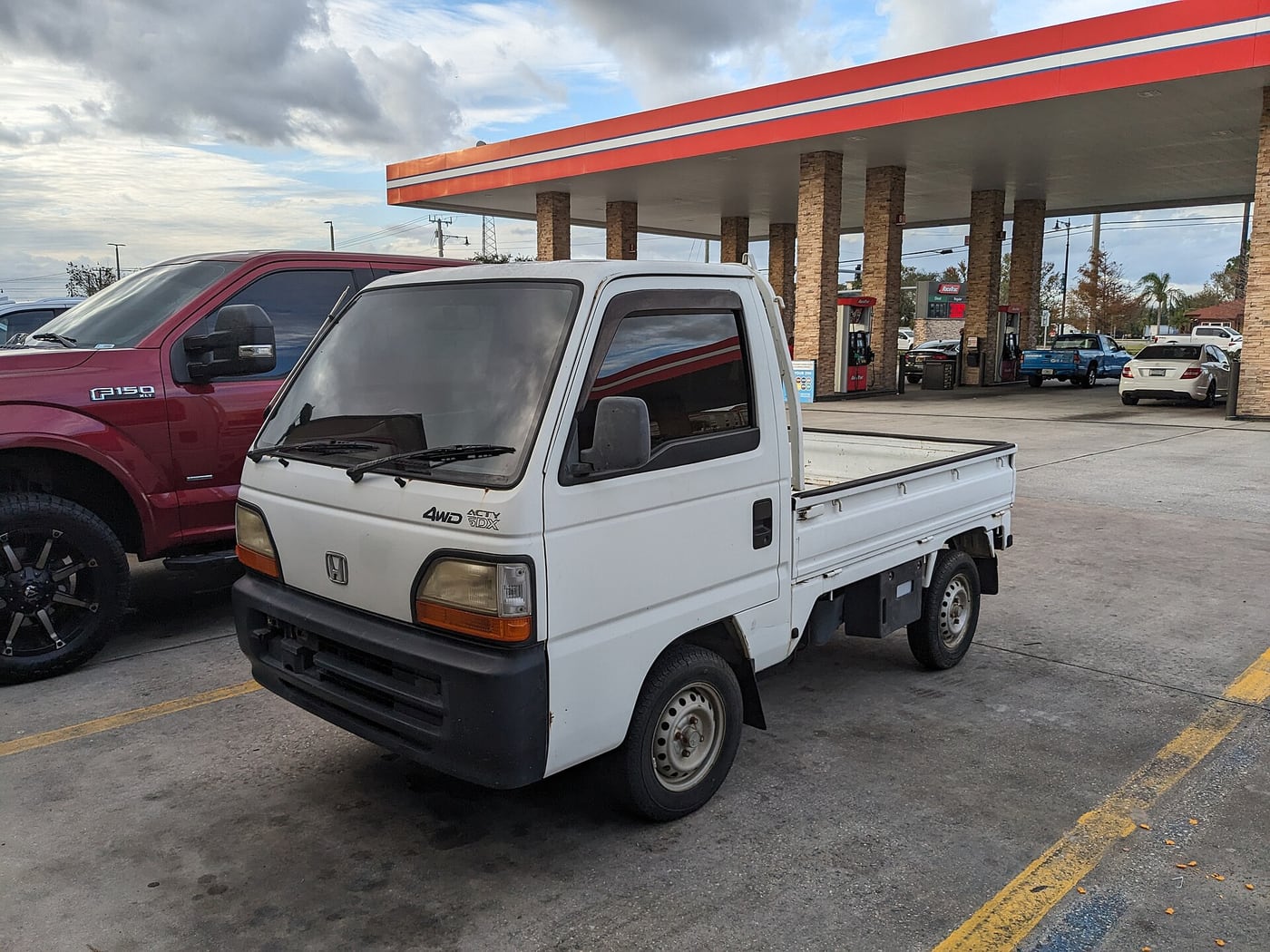
The best single measurement came from a road trip. Jalopnik's Justin Hughes drove a 1995 Honda Acty and wrote in January 2026 that it "gets a consistent 39 miles per gallon," in a story about road tripping a kei truck. Look at the conditions. The same story describes a truck with a top speed around 55 mph that behaves like a rolling roadblock on American highways. A light truck running flat out at 55 is the best case, which is exactly what 39 looks like.
At the other end, importer Oiwa Garage puts typical US mixed driving at 25 to 30 mpg, with 35 or more as the best case, and says the 40 to 50 mpg figures are typically a lab or manufacturer number only. It also says 4WD or an automatic can cost 5 to 10 mpg. Treat that as an informed estimate. The article, written in March 2026, gives no testing method and no measured data.
Put the two side by side and they agree with the arithmetic above. Light, slow, steady driving gets you to the brochure. Everything else lands near 30, and sometimes lower. How fast a kei truck can go matters here, because most of these trucks cruise comfortably at 50 to 55 mph and drink fuel above that.
Our planning number is 30 mpg. It sits between the importer's range and the haircut math, and a truck that beats it becomes a pleasant surprise instead of a budgeting error.
What 30 MPG Costs at $4.47 a Gallon
The Energy Information Administration put regular gasoline at $4.465 a gallon for the week ending September 28, 2026, up from $4.319 two weeks earlier. Its table shows a $1.347 jump from a year ago, which puts last September near $3.12. At 12,000 miles a year and 30 mpg, that increase alone costs about $539 more than the same driving did a year ago. Fuel is one line in the full cost of owning a kei truck, but it is the line that just moved the most.
This table runs the annual fuel bill at $4.465 for two kinds of use. At 5,000 miles you have a property truck, a farm hauler, or a second vehicle. At 12,000 you have a daily driver.
| Truck | MPG | 5,000 miles a year | 12,000 miles a year |
|---|---|---|---|
| Kei truck, light and slow | 39 | $572 | $1,374 |
| Kei truck, 35 mpg | 35 | $638 | $1,531 |
| Kei truck, planning number | 30 | $744 | $1,786 |
| Kei truck, low end of importer range | 25 | $893 | $2,143 |
| 2026 Maverick Hybrid FWD (EPA) | 38 | $587 | $1,410 |
| 2026 Maverick 2.0T AWD (EPA) | 25 | $893 | $2,143 |
Read down the columns and the story is not what the listings promise. A kei truck at 39 mpg roughly ties the Maverick Hybrid. At the planning number of 30, it costs $157 more per year at 5,000 miles and $376 more at 12,000.
Kei Truck vs Maverick Hybrid at the Pump
The Maverick is the comparison that matters because it is the cheap new truck people actually cross shop. EPA's fueleconomy.gov listings rate the 2026 Maverick Hybrid FWD at 38 mpg combined (42 city, 35 highway), the AWD at 37, and the Lariat AWD at 36. The gas 2.0 liter turbo is far thirstier: 26 mpg combined with front wheel drive, 25 with AWD, 24 for the Lobo, and 23 for the Tremor.
That splits the matchup in two. Against the all wheel drive turbo gas Maverick, rated 25 mpg, a 30 mpg kei truck wins: 80 fewer gallons a year at 12,000 miles, about $357. Against the Hybrid it loses: 84 more gallons, about $376, or 27 percent more fuel. The fuel case for a kei truck is a case against a gas pickup, not against a hybrid.
Where the kei truck wins is the sticker. The 2026 Maverick starts at $27,145 for the gas XL and the Hybrid costs more, while a clean imported kei truck runs $5,000 to $9,000, as we break down in kei truck vs Ford Maverick. Take the cheapest Maverick and the priciest kei truck and the gap is $18,145. At $376 a year, the Hybrid's fuel advantage needs at least 48 years to pay that back. The money argument for a kei truck is real, but it lives in the purchase price, the insurance, and the simplicity, not in the gas tank. For the full size pickup matchup, see kei truck vs pickup.
How to Pull Real MPG Closer to the Brochure
Slow Down
EPA says "gas mileage usually decreases rapidly at speeds above 50 mph," and that each 5 mph you drive over 50 mph is like paying an additional $0.31 per gallon for gas. A kei truck is a small engine pushing a box, so the penalty arrives early. Hold 50 to 55 and you are driving the way these trucks were designed to be driven.
Skip the Cargo You Do Not Need
The same EPA page says a large, blunt roof top cargo box can cut fuel economy by 2% to 8% in city driving and 6% to 17% on the highway. A ladder rack with a stack of lumber on a kei truck is the same physics at a smaller scale, so haul the load, not the rack, when you can.
Use the Right Drivetrain
The official ratings show what the drivetrain costs. The 4WD Carry rates 15.4 km/L against 16.2 for the 2WD, a gap of about 2 mpg. The 3 speed automatic rates 14.4, about 4 mpg below the manual. If your truck has part time 4WD, leave it in two wheel drive until the ground makes you change your mind.
Keep the Engine Honest
A tired plug set, a dirty air filter, and soft tires all cost mileage quietly, and all three are cheap to fix. The maintenance guide lays out the intervals.
Do the Conversion Right and Log Three Tanks
Many imported trucks show kilometers on the odometer and km/h on the speedometer. Multiply kilometers by 0.621 to get miles, fill to the first click, and divide miles by gallons. To compare a result against a Japanese rating, multiply km/L by 2.352. Log three tanks before you believe any number, including the ones in this post.
Frequently Asked Questions
Owners compare their trucks at r/keitruck, and it is worth reading a few threads before you trust any single number.
The Bottom Line
A kei truck gets about 30 mpg in mixed driving, 39 if you baby it, and the 40 to 50 mpg numbers belong on a dynamometer. That is still decent. It is also no longer a reason to buy one, not with gas at $4.465 and a 38 mpg hybrid pickup on the market.
Buy a kei truck because it costs $5,000 to $9,000, because you can fix it in a weekend, and because it fits where a pickup does not, once it clears the NHTSA 25 year import rule. Budget fuel at 30 mpg, treat anything better as a gift, and log your first three tanks. If your numbers differ from ours, believe yours.
Advertisement


