How to Vet a Kei Truck Dealer Before You Pay
Is that kei truck dealer legit? Before you wire a deposit, spend one afternoon checking the domain age, the dealer license, the business filing, the chassis number, and the price. Here is every check, the free public tool behind it, and how to pay so you can get your money back.
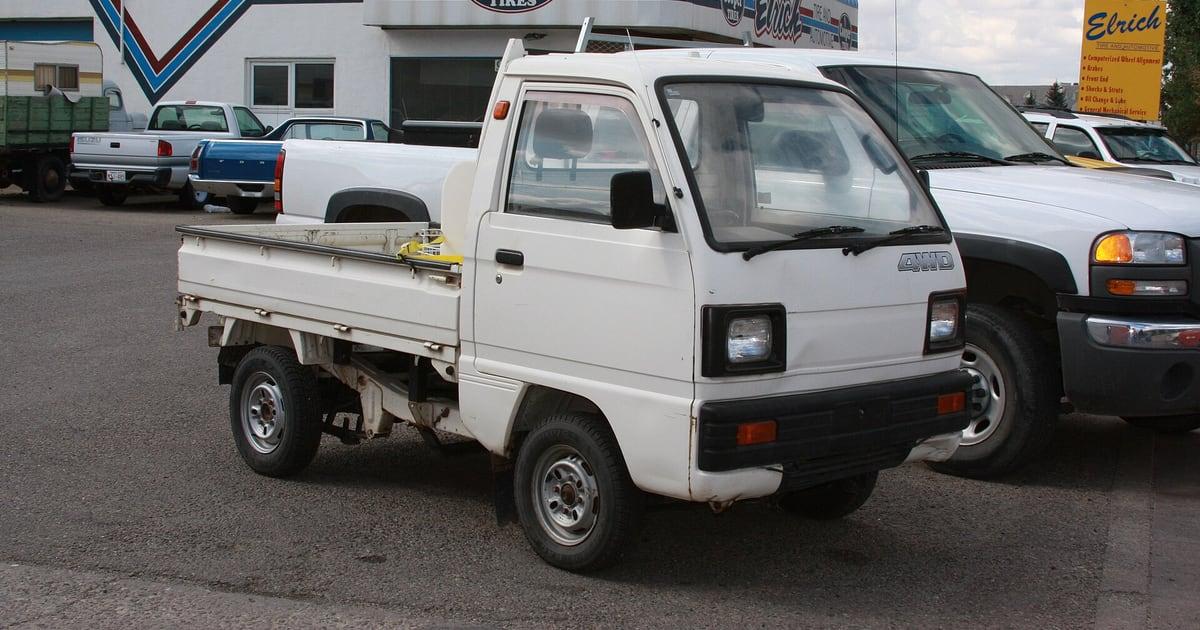
Photo: Suzuki Carry kei truck (illustrative photo, not a dealer endorsement). dave_7 / Wikimedia Commons, CC BY-SA 2.0. Cropped and resized.
TL;DR: Before you send a kei truck dealer or importer a dime, check five things: how old the website's domain is (ICANN Lookup), whether the business holds a dealer license and an active state filing, whether the address and phone number fit the place it claims to be, whether the chassis number and Japanese paperwork match the truck being sold, and whether the price makes sense against real asking and auction data. Then pay with something that has a dispute process. The FTC's rule of thumb is blunt: walk away if the dealer insists on an upfront payment by wire transfer only.
You found the truck. A clean four wheel drive Carry, nice photos, a price a couple grand under everything else you have seen, free delivery to your driveway, and a seller who answers email within minutes. The site ranks near the top of the search results and looks more polished than half the real importers out there. All they need is a bank transfer to hold it.
That polish proves nothing. Search rankings are not a background check, and polish is cheap. A kei truck is a cash heavy, long distance purchase that most buyers make before they ever see the truck, which is exactly the kind of deal the FBI and FTC warnings below describe. Carries alone listed for $7,600 to $12,999 at the US importers we tracked this year, so a single mistake costs real money.
The good news is that vetting a seller costs nothing but time. Every check below uses a free public tool, and you can run all of them in one afternoon before you send a deposit.
Check the Website and the Business Behind It
Start with the domain. Paste the seller's web address into ICANN's registration data lookup, which uses RDAP, the protocol built to replace the old WHOIS system. Look for the registration date in the results. A dealer that says it has been importing trucks for ten years, on a domain registered a few months ago, owes you an explanation. A young domain is not proof of fraud on its own, because real businesses rebrand and launch new sites, but it is the first thread to pull.
Next, find the legal business. In most states the Secretary of State's office registers corporations and keeps a searchable database of them, and the National Association of Secretaries of State keeps a state by state directory of business registration pages and corporate name databases. Search the exact name on the website and the name on the invoice. You want an active entity in the state the seller claims, with a filing history that fits the story. A company that claims a decade of imports but filed its paperwork this year deserves hard questions. A business you cannot find at all deserves no money.
Then put the address on a map. Open it in Google Maps and drop into Street View. A real importer has a lot, a shop, or a warehouse, and usually some trucks sitting outside. A residential cul de sac, a mailbox store, or an empty field changes the conversation. Also look at who else lives at that address. Scammers clone real dealers: the FTC warned in September 2026 that fake dealer sites copy a genuine dealer's logos, listings, and photos, sometimes with AI. If the address on the site turns out to be another established dealer's lot, call that dealer directly using a number from its own website and ask whether the two businesses are related.
Finally, check the phone number. The North American Numbering Plan Administrator publishes area code maps by state, and a seller claiming a lot in one state with a phone number from another is worth a question. A mismatch can have an innocent explanation, such as a cell number kept after a move, so treat it as something to ask about, not a verdict.
Confirm the Dealer License
States license vehicle dealers. Florida, for example, says dealers must meet its licensing requirements to conduct business in the state, and many states let you look a license up for free. The tools vary, so here is what three of them look like.
In Texas, the Department of Motor Vehicles publishes a licensee list for motor vehicle dealers, along with a separate search for closed licenses. TxDMV says you can search by business name, assumed name or DBA, license number, city, or county, and that the list updates daily. The basic used dealer license there is the general distinguishing number, or GDN, which TxDMV describes as allowing the holder to buy, sell, or exchange used vehicles of the type it covers.
In Pennsylvania, the Department of State's Pennsylvania Licensing System verification search covers the State Board of Vehicle Manufacturers, Dealers, and Salespersons. The state calls PALS a primary source for verifying license credentials, and it has a Facility search for businesses plus a Disciplinary search that can show suspensions, fines, or other penalties.
In Florida, the Department of Highway Safety and Motor Vehicles posts its list of licensed independent, wholesale, auction, and salvage dealers as a set of alphabetical pages on its website rather than a search box.
If the seller claims a lot in another state, search that state's DMV or dealer licensing board site for "dealer license lookup." Licensing rules differ by state and by what a business actually does, so a missing license is a question to ask, not automatic proof of fraud. Ask the seller for its license number. A licensed dealer can give it to you in one sentence, and a dodge is an answer too.
One more place to start: our kei truck dealer directory. We review each dealer before listing it, no dealer pays to be listed, and none is ranked above another. A listing is still not an endorsement and not a guarantee about any specific truck. Stock, staff, and paperwork change fast, so run these same checks on anyone you find there.
Make the Seller Prove the Truck Exists
A real truck leaves a paper trail on both sides of the Pacific, and a real seller can show it to you before you pay.
Start with the chassis number. Japanese kei trucks do not carry a 17 character North American VIN. A Japanese market vehicle's chassis number is usually the model code, a hyphen, and a five to seven digit serial number. The model code tells you which truck it is, and our model pages list the codes and their dates. On the Suzuki Carry, the DC51T and DD51T were built from September 1991 to January 1999, the DA52T and DB52T replaced them in January 1999, and the DA62T arrived in September 2001. The DA63T only started in May 2002, so its first trucks do not turn 25 until May 2027. On the Honda Acty, the HA3 and HA4 ran from 1990 to 1999 and the HA6 and HA7 took over in May 1999. If a listing calls a truck a 1997 Carry and the chassis number starts with DA63T, the story and the steel disagree. Ask for a photo of the stamped number on the truck, not a typed one in an email.
Then ask for the Japanese registration paperwork. For kei vehicles, the export paperwork goes through Japan's Light Motor Vehicle Inspection Organization. Its export document is the 輸出予定届出証明書, a certificate of notice of planned export, which costs ¥500 to issue. To get one, the owner hands in either the original vehicle inspection certificate (車検証) or, for a truck already taken off the road, the certificate showing that inspection record was returned (自動車検査証返納証明書). So a truck sitting in Japan should have one of those two documents, and a truck that already left should have the export certificate. Ask for clear photos of whichever document applies, and compare the chassis number on it with the number stamped on the truck.
For a truck already in the US, ask for the import file. CBP's guide to importing a car lists the shipper's or carrier's original bill of lading, the bill of sale, the foreign registration, and EPA Form 3520-1 and DOT Form HS-7. The customs entry itself is summarized on CBP Form 7501, the entry summary CBP uses to determine things like appraisement, classification, and origin. The HS-7 is not a formality: NHTSA notes that knowingly making a false declaration on it can bring a fine of up to $10,000, up to five years in prison, or both. Our import guide explains which boxes get checked on each form, and the delivery day checklist walks through matching every document to the truck when it arrives.
A seller who cannot produce a chassis number, a photo of the Japanese papers, or the US entry documents for a truck it says is in stock is not selling you that truck. If it all checks out but you still cannot see the truck in person, the FTC suggests telling the dealer you want to hire a mobile inspection service, and our pre purchase checklist tells the inspector what to look at.
Run the Price Against Real Numbers
The FBI's Internet Crime Complaint Center put it plainly in a warning about fraudulent online vehicle sales: be cautious of items advertised well below their market value, because if the deal appears too good to be true, it probably is. That warning described sellers advertising vehicles they never owned and steering buyers to a fake buyer protection program with its own fraudulent toll free number. IC3 counted about 26,967 complaints with adjusted losses of $54,032,396 from May 2014 through December 2017.
So know the market before you look at a listing. We tracked asking prices at four US importers from March to November 2026. Carries listed for $7,600 to $12,999, with a median of $9,845 across 18 listings. Acties had a median of $9,499 across 30 listings, Sambars $10,450 across 18, and Hijets $11,999 across 16. A November 7, 2026 check of eight dealers found 38 Minicab listings from $4,700 to $17,900, with a median of $8,125, and the cheapest asks came from high volume importers. A low price alone is not fraud. A clean Carry at half the cheapest Carry ask we saw is a reason to slow down.
The Japanese side tells you where the floor is. In our breakdown of 1,948 Japanese auction sales from this summer, the median kei truck hammered for ¥124,000, about $810 at ¥153 to the dollar, and the median Carry went for ¥117,000, about $765. That is before auction fees, export, ocean freight, the 25 percent duty, brokerage, and transport, which our kei truck cost guide adds up to $2,675 to $6,150 on top of the hammer price. The same guide puts port to door transport at $300 to $1,200. When a seller promises free nationwide delivery on a truck already priced under the market, somebody is paying for that freight. Ask who.
Pay in a Way You Can Claw Back
The single most useful sentence in the FTC's September 2026 alert on spoofed car dealership websites is this one: walk away if the dealer insists on an upfront payment by wire transfer only. The same alert tells you to search the dealer's name with words like "scam," "review," or "complaint," and to ask to see the car, and the dealership, in person.
A July 22, 2026 FTC consumer alert widened the list. When someone says the only way to pay is by bank transfer, wire transfer, cryptocurrency, payment app, or gift card, reports to the FTC show that is a scam. The same alert notes that credit cards offer more protections and give you the option to dispute charges.
Be precise about what the warning sign is. A wire transfer by itself does not make a dealer crooked: at least one dealer in our own directory takes a PayPal deposit and the balance by wire, certified check, or cash. The red flag is wire only, up front, before you have verified the business or seen the truck or its papers. A reasonable pattern is a modest deposit on a credit card, the balance after the checks above come back clean, and everything in writing with the chassis number on the invoice.
Escrow deserves its own warning, because scammers fake that too. California's Department of Financial Protection and Innovation, which checks escrow licenses in that state, publishes ten tips to avoid online escrow fraud. Its third tip is the one that matters here: a buyer or seller who insists on using a particular online escrow company is probably trying to steer you to a fraudulent one. DFPI also says to watch for escrow sites with no address or phone number, to call and make sure you reach a live person, and to remember that legitimate escrow companies do not use person to person money transfers like Western Union or MoneyGram. Fake escrow sites also borrow trust logos, so a badge on the page proves nothing. If you use escrow at all, pick the company yourself and check its license before you share a single account number.
The Bottom Line
The truck in the photos might be real and the price might be fair. The point of these checks is that you find out before your money moves, not after. Here is the afternoon, in order:
- Look up the domain's registration date with ICANN Lookup.
- Find the business in the state's entity database and confirm it is active.
- Check the address in Street View and make sure it is not another dealer's lot.
- Ask for the dealer license number and verify it with the state.
- Get the chassis number, a photo of it stamped on the truck, and the Japanese paperwork, and confirm the model code fits the year.
- For a truck already here, ask for the bill of lading, HS-7, 3520-1, and CBP entry paperwork.
- Compare the price with real asking and auction data, and ask who pays for any free delivery.
- Refuse wire only deals, choose any escrow company yourself, and keep a deposit on a credit card.
If you already paid and something feels wrong, move fast. The FTC says to report it immediately to whoever moved the money, whether that is your credit card issuer, your bank, or a wire transfer company, and ask them to refund or reverse the payment. Then report the seller at ReportFraud.ftc.gov, file a complaint with the FBI's Internet Crime Complaint Center at ic3.gov, which describes itself as the main intake form for a variety of complaints and says to file even if you are unsure yours qualifies, and contact your state attorney general's office. Then start the search again with this list in hand. The right truck is still out there, sold by someone who is happy to answer every one of these questions.