Best Kei Trucks to Import in 2027: DA63T Carry Turns 25
2002 kei trucks start turning 25 in January 2027, but the one everyone wants, the DA63T Suzuki Carry with its longer separate bed, is not legal until mid May. Here is the month by month calendar and what is actually worth buying.
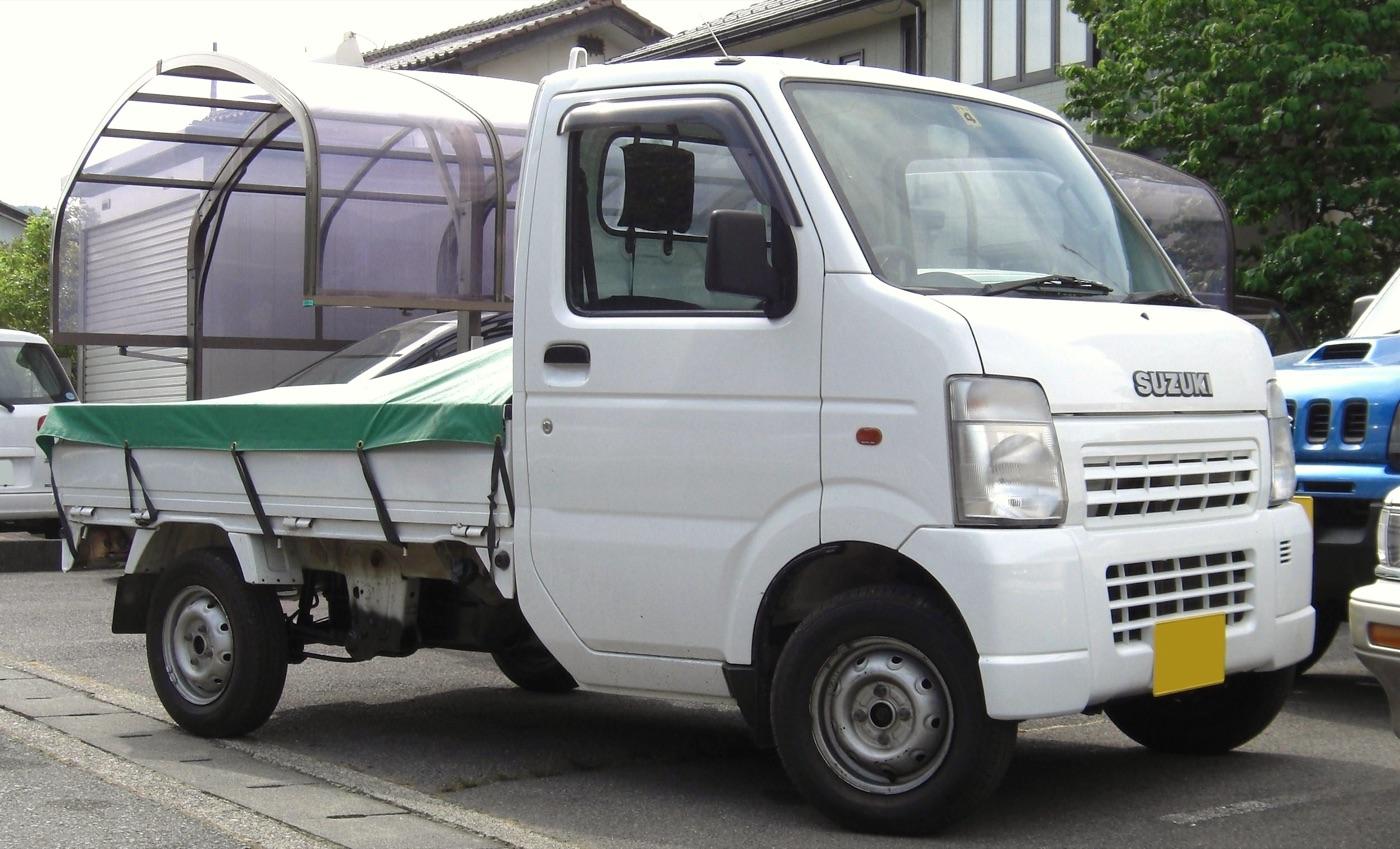
TL;DR: Kei trucks built in 2002 become legal to import during 2027, but the clock runs from each truck's build month, not the calendar year. From January through mid May, the newly eligible Suzuki Carry is the short run DA62T. Suzuki put the reworked DA63T on sale on May 16, 2002, so the truck with the 2,030 mm separate bed, the bigger rear window, and the redesigned cab starts turning 25 around May 2027, with its Mazda Scrum twin right behind it. Almost everything else from 2002 is a carryover, apart from a September facelift on the Subaru Sambar. If you want a DA63T, research now, bid in late spring, and plan on a summer delivery.
Every January the kei truck world acts like a new model year just dropped. In 2027 that is only half true. The truck that matters most in the 2002 class does not show up on New Year's Day. It shows up in the middle of May, and if you understand why, you can avoid paying a premium for a 2002 truck that is really a 2001 truck with a newer date on the paperwork.
Our 2026 import guide covered the fuel injected trucks that crossed the line this year. Most of that advice still holds, because most of the 2002 class is the same hardware. The Carry is the exception, and it is a big one.
How the 2027 Import Window Really Opens
Federal law does not care about model years. The exemption that makes every kei truck import possible, written into 49 U.S.C. 30112(b)(9), covers "a motor vehicle that is at least 25 years old." That age runs from the day the truck was built. A truck built in March 2002 turns 25 in March 2027. A truck built in October 2002 waits until October 2027. A good importer confirms the build month before the truck leaves Japan, because a truck that arrives before its 25th birthday does not qualify for the exemption.
So the 2002 class arrives on a calendar, not all at once. Here is how it lays out for the trucks American buyers actually chase:
| When it turns 25 | What becomes eligible | Why it matters |
|---|---|---|
| January to mid May 2027 | Suzuki Carry DA62T and Mazda Scrum DG62T built January to May 2002 | The tail end of a short production run |
| From mid May 2027 | Suzuki Carry DA63T (on sale May 16, 2002) | New bed, new cab, same engine |
| From late May 2027 | Mazda Scrum DG63T (on sale May 21, 2002) | The same truck with a Mazda badge |
| From June 2027 | Daihatsu Copen L880K (on sale June 19, 2002) | Not a truck, but a kei roadster plenty of people have waited for |
| From September 2027 | Facelifted Subaru Sambar TT1/TT2 (on sale September 4, 2002) | New face, same mechanicals |
| All year | Daihatsu Hijet S200P/S210P, Honda Acty HA6/HA7, Mitsubishi Minicab U61T/U62T | Same generations that are already eligible |
One caution on that table: those are showroom dates. The first trucks off the line were built before they went on sale, and the only date that counts is the one tied to your specific truck. Our 2027 import eligibility page lists every generation in play by model. The emissions side is a separate filing under the EPA's vehicle import rules, and your broker handles it alongside the safety declaration.
The DA63T Carry: Why May 2002 Matters
Suzuki did not call the May 2002 change a new generation. Its own May 16, 2002 press release calls it a major improvement to the Carry, and the chassis is still the tenth generation that launched in 1999. The K6A all aluminum DOHC three cylinder carried straight over from the DA62T. But from the cab back, nearly everything you touch on a working day changed.
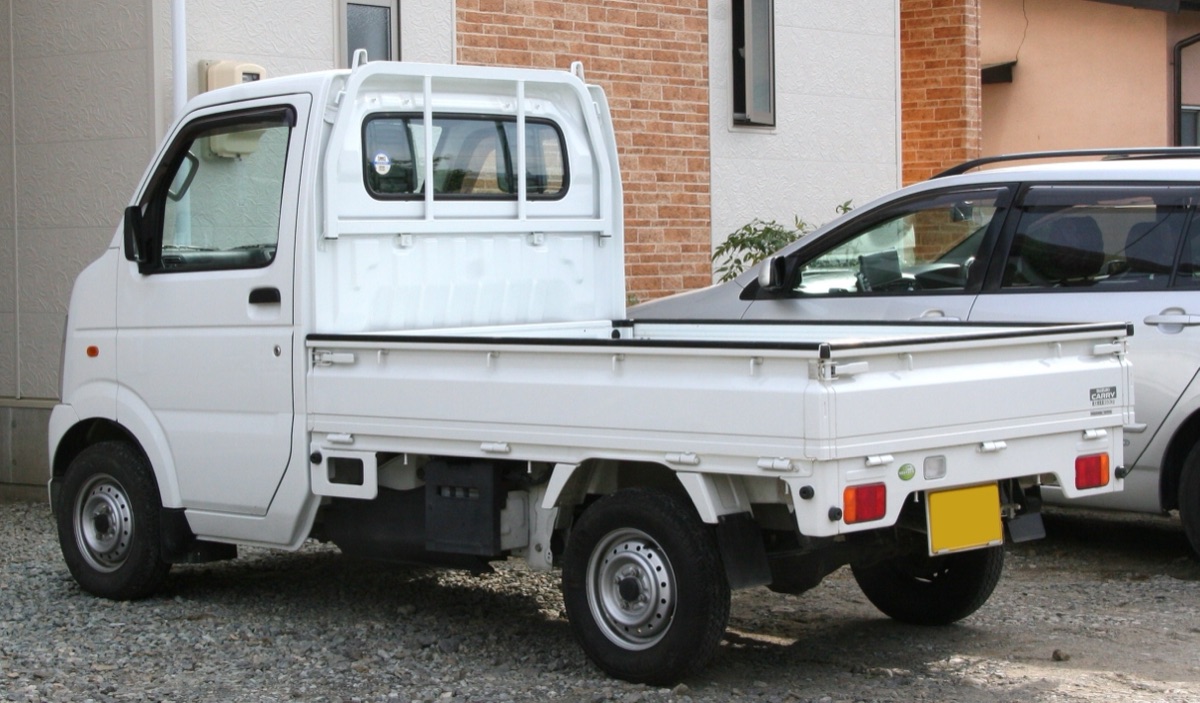
The bed is the headline. Suzuki redesigned it with a floor length of 2,030 mm, about 79.9 inches from the front panel to the tailgate, and claimed that was the longest floor of any kei truck on sale as of April 2002. The floor sits 640 mm off the ground, roughly 25.2 inches, and one two wheel drive manual trim got a low floor version at 605 mm. Every DA63T got a tailgate with hooks for loading ramps, so loading a tiller or a bicycle up a pair of planks gets a lot less sketchy.
The detail American buyers should care about most is buried in the middle of the release: the bed is a separate unit from the cab, and Suzuki said at the time that no other kei truck did it that way. The point was easier replacement after damage. For an importer, that means a rotted or crunched bed is a parts swap, not a body shop project. Given how many Japanese farm trucks spend their lives in salted snow country, that is not a small thing.
The cab got real attention too. The driver's seat slides 90 mm, the bottom edge of the windshield dropped for a better view over the nose, the rear window got bigger, and both seats got large headrests. The dash picked up a big glovebox, extra trays, a pen and card holder on the driver's pillar, and a console that holds two 500 ml bottles. None of it is exciting. All of it is the difference between a truck you tolerate and a truck you drive every day.
Rust protection carried over from the 2001 update, with rust resistant steel on about 90 percent of the body surface. Suzuki also sold a heavy rust proofing package on the KC trim, backed by a five year perforation and three year surface rust warranty. If an auction sheet or a dealer listing mentions that package, it is worth a closer look.
Two less flattering details from the same price list. Driver and passenger airbags were a ¥25,000 option, and they were not offered at all on the base KU, the farm spec, the heavy rust spec, or the low floor trucks, so check the listing rather than assume a DA63T has them. And pricing ran from ¥555,000 for a KU two wheel drive manual to ¥946,000 for a KC with air conditioning, power steering, four wheel drive, and the three speed automatic, before tax. These were cheap tools built to be used hard, and Suzuki planned to sell 8,000 of them a month.
DA62T or DA63T?
The DA62T is not a bad truck. Suzuki's September 2001 release shows it already had the K6A all aluminum DOHC engine, a tighter turning radius that dropped from 4.1 m to 3.8 m, a redesigned dash with dial climate controls, and a seamless one piece galvanized bed floor. It also introduced a farm package on the KU with a differential lock. Mechanically it is close to the DA63T.
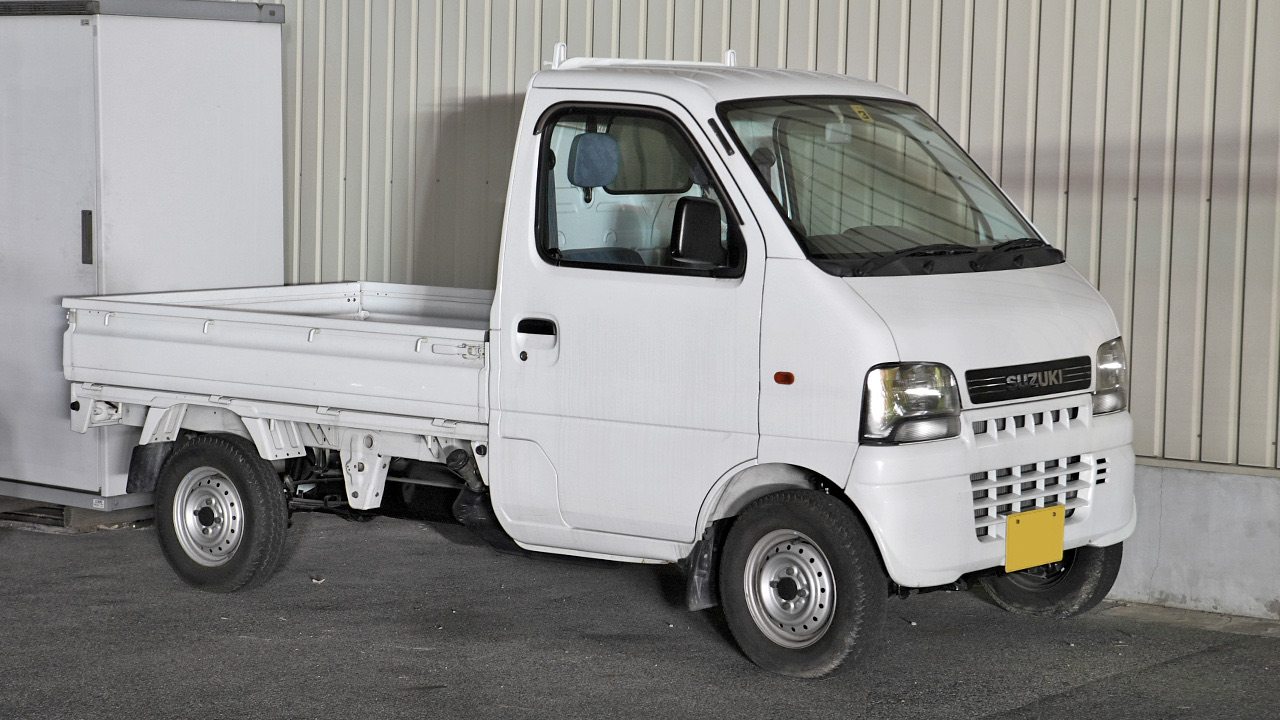
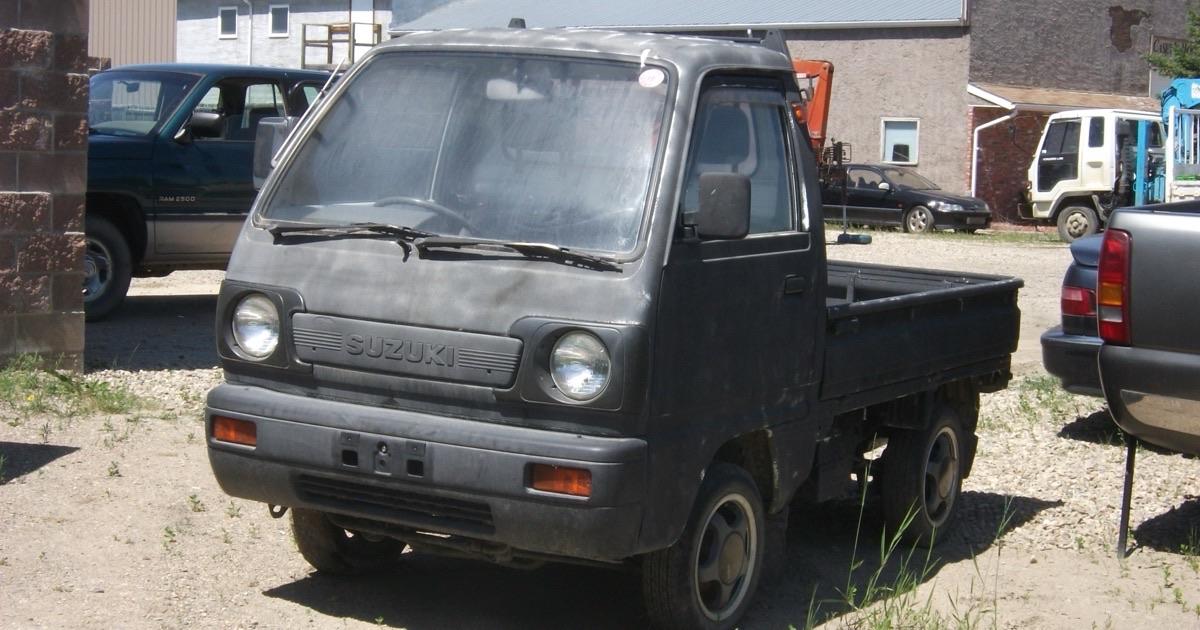
What it lacks is the separate bed, the longer floor, and the reworked cab. And because it ran only from September 2001 to May 2002, there are not many of them. My take: if you need a truck in the spring and a clean four wheel drive DA62T turns up, buy it and enjoy the head start. If the bed and cab matter to you, wait for May and do not let anyone charge you DA63T money for a DA62T. The quick visual check is the bed: on a DA63T it is clearly its own assembly behind the cab, and the rear window is noticeably larger.
The Mazda Scrum DG63T: Same Truck, Smaller Crowd
Five days after Suzuki, Mazda announced the same update for its badged version. The Mazda release from May 21, 2002 lists the identical package: 2,030 mm bed floor, 640 mm floor height with a 605 mm low floor option, a bed separated from the cab for easier repair, the ramp hook tailgate, the 90 mm seat slide, and bigger windows front and rear.
The interesting number is volume. Mazda planned 800 sales a month across the entire Scrum series. Suzuki planned 8,000 a month for the Carry truck alone. So for every Scrum truck at auction, expect to see a stack of Carrys. Under the badge the Mazda Scrum is a Carry, built by Suzuki, so parts interchange and any Carry mechanic can work on it.
That rarity cuts both ways. A buyer searching only for "Carry" will never see a DG63T, which is an argument for putting both chassis codes in your saved searches. On the other hand, a smaller pool means you will wait longer for the exact color, trim, and transmission you want. If you are flexible, add the Scrum to the list. If you are picky, the Carry's numbers work in your favor.
The Rest of the 2002 Class: Mostly Carryovers
The Subaru Sambar is the other truck with a real 2002 change, and it is cosmetic. The September 4, 2002 Subaru release introduced a new grille carrying the six star emblem, a redesigned front bumper and front panel, and multi reflector headlights that widen the beam for night driving. Subaru also cleaned up the supercharged truck so every gasoline Sambar qualified as a low emission vehicle. Underneath, it is the same TT1/TT2 rear engine platform our 2026 guide covered, so a January 2002 Sambar and an October 2002 Sambar drive the same. Buy the face you like, but pay for condition.
The Daihatsu Hijet S200P/S210P, Honda Acty HA6/HA7, and Mitsubishi Minicab U61T/U62T are simpler. Their 2002 builds belong to the same generations as the 2000 and 2001 trucks already eligible today. A 2002 Acty is not a better truck than a 2001 Acty because of its year. It is better only if it has fewer miles, less rust, and a better service history. Bid accordingly.
The Copen Wildcard
Not a truck, but it belongs on the 2027 calendar. Daihatsu launched the Copen on June 19, 2002, and the original Daihatsu announcement describes a turbocharged twin cam engine and a power folding hard top that Daihatsu called a first for a kei car. First year L880K builds start turning 25 in mid 2027. It is a passenger car, so it lands under different duty rules than the trucks in the next section, and it will draw a very different crowd at auction.
What a 2002 Truck Costs to Land
Start with the federal duty, because it is the line people forget. CBP's import guidance lists the general rates as 2.5 percent for autos and 25 percent for trucks, calculated on the price paid. Every truck in this guide falls in the 25 percent bucket. The Copen is the one car on the calendar.
For the purchase price, our fall 2026 auction price report is the best starting point we have. It found the Carry trading in the tightest, most predictable band of the five major makes, with a model median of ¥117,000 across all years in the dataset. That figure mixes 1990s farm beaters with late trucks, so treat it as a floor, not a target. Clean, low mileage four wheel drive trucks from the newest eligible year trade well above the median.
My bet, and it is only a bet: the first clean DA63T trucks in May and June 2027 draw more export bidding than a typical Carry, simply because a lot of US buyers have been waiting for that body. If you can tolerate a later build month, a DA63T built in the fall of 2002 should face less competition than one from May. Run your own numbers through the import cost calculator before you bid, so the duty and freight do not surprise you after the hammer falls.
What the DA63T Does Not Fix
The 2002 rework did not make the Carry a smaller truck. The Suzuki Carry reference entry lists the whole tenth generation, DA63T included, at 3,395 mm long, which is 133.7 inches. That matters in any state whose kei law includes a length cap. Vermont is the cautionary tale: its definition stops at 130 inches, and our breakdown of the Vermont 130 inch problem explains why a 1999 or newer Carry does not fit it. A DA63T does not change that math.
It also does not fix registration in states that will not title a kei truck at all, and state rules are moving fast enough that you should check the state legality guide the week you bid, not the month you start shopping. Several states changed status this year alone. A beautiful DA63T with nowhere to register it is a very expensive yard ornament.
And it is still a 25 year old truck. Airbags were optional rather than standard, a three speed automatic as the only alternative to the manual, and rubber bushings, hoses, and seals that have aged whether the odometer moved or not. Budget for a round of fresh fluids, belts, and tires the week it arrives.
The Bottom Line
The 2027 import year has one real story: the DA63T Suzuki Carry, with its 2,030 mm separate bed and its much more livable cab, starts turning 25 in mid May. That is the version of the Carry that stayed in production until 2013, and it is the one most American buyers will picture when they think "Carry" for the next decade.
Everything else in the 2002 class is a carryover. Buy those trucks on condition, mileage, and rust, not on the year printed in the listing. If you would rather buy now than wait for May, our best kei truck buying guide ranks the trucks that are already eligible by job and by what dealers are asking. If you want a DA63T, spend the winter learning the auction sheets, ask the owners on r/keitruck who have imported recently what their landed costs really looked like, put both the Carry and the Mazda Scrum in your searches, confirm your state will register it, and do not let a seller dress up a DA62T as the new body. The trucks will be there in May. Be ready for them.