Kei Truck & Kei Car Laws in South Carolina (2026)
LegalSouth Carolina titles and registers kei trucks with no annual safety inspection and no posted speed restrictions on kei vehicles statewide.
South Carolina is one of the most kei friendly states in the southeastern United States. The state allows kei trucks and kei cars to be titled and registered for road use with minimal hassle. There is no annual safety or emissions inspection requirement, the registration process is straightforward, and the state does not impose specific speed or road-type restrictions on kei vehicles. These factors combine to make South Carolina an excellent state for owning a Suzuki Carry, Honda Acty, or any other kei vehicle.
Disclaimer: Laws and regulations change frequently. Always verify current requirements with your local South Carolina DMV office or the South Carolina Department of Motor Vehicles (SCDMV) before purchasing or registering a kei vehicle. Be sure to review our pre-purchase inspection checklist.
Overview
South Carolina treats kei vehicles that meet the 25-year federal FMVSS import exemption the same as other imported vehicles. For more details, check our complete guide to importing a kei truck from Japan. Once properly imported and documented, a kei truck or kei car can be titled and registered at any SCDMV office. The state's lack of an inspection program means there is no technical hurdle beyond having the correct paperwork and insurance.
This permissive environment has attracted a significant number of kei vehicle owners to the state, both residents and out-of-state buyers looking for a straightforward registration path. South Carolina's relatively low cost of living and vehicle-related fees further enhance its appeal.
Kei trucks are particularly popular in South Carolina's rural areas, where they serve as farm vehicles, property maintenance trucks, and short-distance haulers. Wondering how they compare to a side-by-side? Read our kei truck vs UTV comparison. Kei cars, while less common, are also registered and driven on South Carolina roads.
Registration Process and Requirements
To register a kei vehicle in South Carolina, you will need:
- Title: A valid title from another U.S. state or, for first-time titling, the Japanese export certificate with certified English translation along with customs documentation. South Carolina uses Form 400 for title and registration applications.
- Bill of Sale: Showing the purchase price, vehicle details, and buyer/seller information.
- Customs Documentation: CBP Form 7501, EPA Form 3520-1, and DOT Form HS-7 demonstrating the 25-year exemption (for imported vehicles).
- Proof of Insurance: South Carolina requires minimum liability insurance of 25/50/25 ($25,000 per person, $50,000 per accident for bodily injury, $25,000 for property damage).
- VIN Verification: May be required for vehicles not previously titled in the U.S. The SCDMV or a law enforcement officer can perform this verification.
Step-by-Step Registration
- Gather all import and customs documentation.
- Obtain South Carolina auto insurance meeting state minimums.
- Visit your local SCDMV office with all documents.
- Complete a VIN verification if required.
- Submit the title and registration application (Form 400) with supporting documents.
- Pay applicable fees and taxes.
- Receive your South Carolina title and license plate.
The entire process can often be completed in a single visit to the DMV, assuming all documentation is in order. Many owners report the process taking 30 to 60 minutes.
Restrictions
- No Annual Inspection: South Carolina does not require a safety or emissions inspection for private vehicles. This is one of the biggest advantages for kei vehicle owners.
- Standard Traffic Laws: Kei vehicles must comply with all South Carolina traffic laws, including equipment requirements for headlights, taillights, turn signals, mirrors, seatbelts, and a horn.
- No Specific Speed Restrictions: South Carolina does not impose speed restrictions targeting kei vehicles. Standard speed limits and traffic laws apply. However, if a kei truck cannot safely maintain highway speeds, common sense dictates avoiding high-speed roads.
- Equipment Compliance: While there is no inspection, your vehicle must still have proper equipment to be street legal. Law enforcement can cite vehicles with non-functional lights, missing mirrors, or other equipment deficiencies during traffic stops.
Cost Breakdown
| Item | Estimated Cost |
|---|---|
| Title | $15.00 |
| Registration (biennial) | $40.00 (every 2 years) |
| License Plate | $6.00 |
| Infrastructure Maintenance Fee (IMF) | 5% of purchase price, capped at $500, paid once at titling |
| Insurance (annual) | $300 - $700 (varies) |
A note on that IMF line, because it trips people up: South Carolina does not charge sales tax on vehicle purchases anymore. Since July 2017 the state collects an Infrastructure Maintenance Fee instead, and that fee IS the 5% of purchase price capped at $500. You pay it one time when you title the vehicle, not every renewal cycle. The biennial $60 and $120 road use fees you may have heard about apply only to hybrids and electric vehicles, so your gas burning kei truck skips them entirely. Standard registration runs $40 for two years per the current SCDMV fee schedule.
The $500 cap is a genuine advantage for buyers of higher value kei vehicles: whether you spend $8,000 on a clean Carry or $20,000 on a restored fire truck, the state takes the same $500 maximum. Total first year costs excluding insurance and the purchase price typically land between $200 and $560 depending on what you paid for the truck.
Recent Legislative Changes
South Carolina has not passed specific legislation targeting kei vehicles in recent years. The state's existing motor vehicle code accommodates kei vehicles through the standard registration process, and no special provisions or restrictions have been proposed.
The $500 cap on the Infrastructure Maintenance Fee has been in place since the IMF replaced vehicle sales tax in July 2017 and continues to benefit kei vehicle buyers. There have been periodic discussions about raising or removing the cap, but no changes have been enacted as of July 2026, and a search of the current legislative session turns up no kei related bills at all. If you're near the border, you may also want to check kei truck laws in North Carolina and Georgia.
Tips from Local Owners
- South Carolina is a top-tier state for kei vehicles. The combination of no inspection, easy registration, capped sales tax, and low fees makes SC one of the best states in the country for kei vehicle ownership.
- One trip to the DMV. Come prepared with all your documents organized and you can likely complete the entire titling and registration process in a single visit. Call ahead to confirm what the specific SCDMV office needs.
- Insurance is easy. Most major insurance companies will write policies for kei vehicles in South Carolina. For more guidance, see our kei truck insurance guide. Progressive, State Farm, and Hagerty are commonly used. Get quotes before your DMV visit so you have proof of insurance ready.
- Popular in the Lowcountry and Upstate. Kei trucks are especially popular in South Carolina's rural areas, including the Lowcountry, Upstate, and Midlands regions. Models like the Daihatsu Hijet are commonly used for hunting, farming, and property maintenance.
- Beach and island use. South Carolina's barrier islands and beach communities have embraced kei trucks as alternatives to golf carts for local transportation. They offer more utility and weather protection while remaining small and easy to park.
- Out-of-state buyers welcome. South Carolina's easy registration has attracted some out-of-state buyers who register in SC and then transfer to their home state. Be aware that your home state's laws still apply if you reside elsewhere. Registering in SC does not guarantee your home state will accept a transfer.
- Growing community. The Carolinas have an active and growing kei vehicle community. Joint meetups with North Carolina owners are common, and online groups provide excellent resources for parts, maintenance, and registration advice.
Where to actually buy one in South Carolina
1 verified kei truck dealer in South Carolina. Most handle import, titling, and delivery.
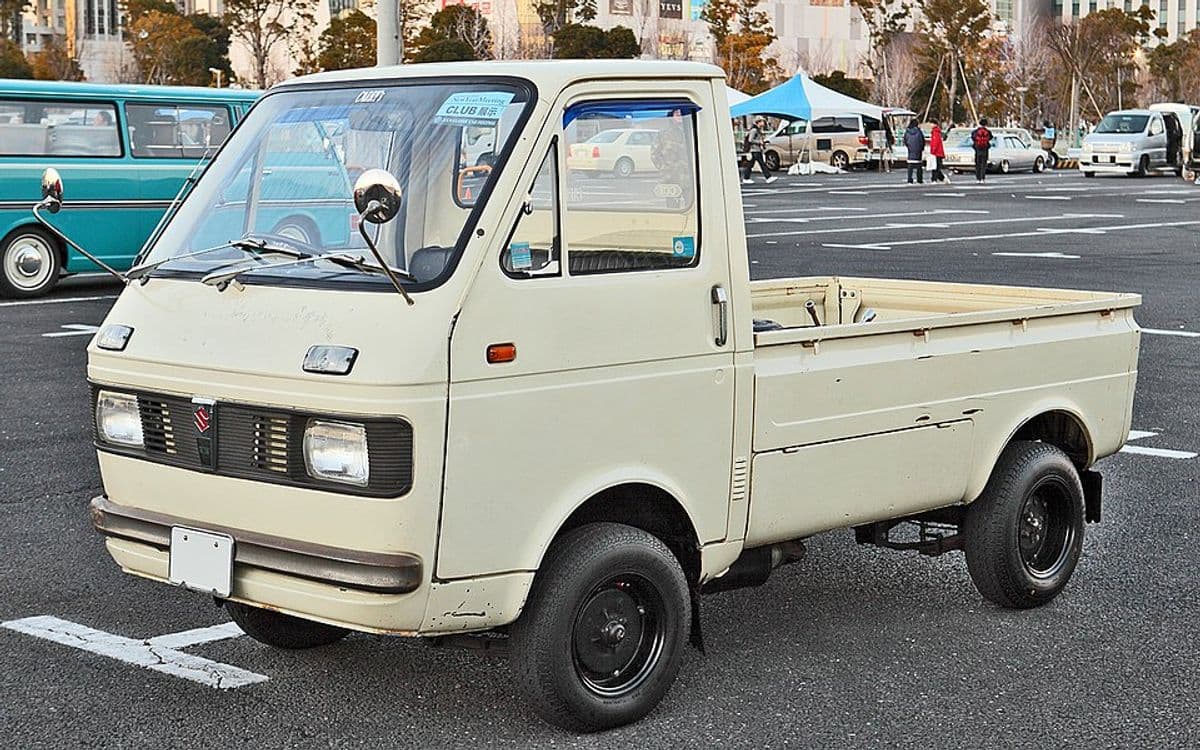
Suzuki Carry
1969-Present
Charleston humidity and Lowcountry heat reward the kei truck with the strongest parts pipeline. The Carry has the most US import volume of any kei truck, so AC compressors, radiators, and coolant lines are easy to find. Cheapest factory dump bed in kei makes it a hauler year round.
Across the state line
Get the weekly kei truck brief
Law changes, price drops, new models, and build inspiration. One email a week.