Kei Trucks for Landscaping and Small Business: Honest Pros, Cons, and What Nobody Tells You
A kei truck costs a third of an F-150 and sips gas. But can it actually handle commercial landscaping work? Here's the honest answer from real business owners.

Advertisement
TL;DR: A kei truck can absolutely work for a solo landscaping operation or a small crew doing residential maintenance. You will save $30,000+ versus a full size pickup, burn half the fuel, and fit into backyards and gated communities no F-150 could touch. But the 770 lb rated payload means you are making two trips where a half ton makes one. If your business depends on hauling 2+ yards of mulch or towing a 60 inch zero turn, you will outgrow a kei truck fast. The sweet spot is residential lawn care, estate maintenance, nursery work, and campus grounds. Budget $6,000 to $12,000 for the truck.
Three landscapers walk into a truck dealership. One walks out with a $55,000 F-150. One walks out with a $35,000 Tacoma. The third drives off in a 1998 Suzuki Carry he bought for $7,500, and he is the only one who can actually fit through the backyard gate at Mrs. Henderson's McMansion.
That is the pitch for a kei truck in landscaping, and it is not wrong. But it is not the whole story. Forums like r/keitruck and LawnSite are full of landscapers singing kei truck praises, and they are also full of people who bought one, tried to run a commercial operation on it, and hit the wall. The truth sits somewhere in the middle, and where exactly depends on what kind of landscaping you do.
The Real Numbers: What a Kei Truck Costs Versus a Work Truck
Let's start with the money because that is what drives most landscapers to even consider a kei truck. The comparison is brutal.
| Factor | Kei Truck (4WD) | F-150 XL Work Truck | Toyota Tacoma |
|---|---|---|---|
| Purchase price | $6,000 to $12,000 | $40,000 to $55,000 | $30,000 to $40,000 |
| Fuel economy | 35 to 47 mpg | 20 to 24 mpg | 19 to 24 mpg |
| Annual fuel cost (15,000 mi) | $1,200 to $1,600 | $2,500 to $3,000 | $2,500 to $3,200 |
| Insurance (annual) | $200 to $500 | $1,500 to $2,500 | $1,200 to $2,000 |
| Payload capacity | 770 lbs rated | 1,800 to 2,300 lbs | 1,400 to 1,700 lbs |
| Towing capacity | 1,000 to 1,500 lbs | 10,000+ lbs | 6,000+ lbs |
| Bed size | 78" x 54" | 67" x 50" (5.5 ft) | 60" x 41" (5 ft) |
Read that bed size line again. A kei truck bed is actually wider and longer than a short bed F-150 or Tacoma. That surprises everyone. The three way drop down sides on a Daihatsu Hijet or Carry make loading and unloading rakes, shovels, and edgers from the side possible instead of reaching over the tailgate. For a landscaper loading and unloading hand tools 20 times a day, that is not a luxury. It is a back saver.
The five year total cost of ownership gap is staggering. Including purchase, fuel, insurance, and basic maintenance, you are looking at roughly $25,000 for a kei truck versus $65,000 to $80,000 for a new F-150. A landscaping startup can buy two kei trucks for the price of one base model pickup, run them both for five years, and still come out ahead. Our kei truck vs pickup comparison breaks down the full math.
Where Kei Trucks Dominate in Landscaping
Not every landscaping gig is the same. Some jobs are perfect for a kei truck. Others will expose every limitation. Here is where the little trucks genuinely shine.
Residential Lawn Maintenance
This is the sweet spot. A solo operator or two person crew running a route of 10 to 15 residential lawns per day needs to transport two walk behind mowers, a string trimmer, a blower, an edger, fuel cans, and hand tools. All of that fits in a kei truck bed with room to spare. On MiniTruckTalk, one owner described fitting two walking mowers, clipping buckets, and all accessories into the bed alongside ramps for loading. The truck did not flinch.
The fuel savings on a mowing route are real. If you are hitting 15 stops across 40 to 60 miles of suburban driving, you are burning 1 to 1.5 gallons in a kei truck versus 2.5 to 3 gallons in an F-150. Over a 200 day mowing season, that difference adds up to $1,000 or more.
Estate and Property Maintenance
Large private properties, HOA common areas, apartment complexes, and campus grounds: this is where kei trucks have carved out a genuine niche. Golf courses across the country already use them. The Asian Turfgrass Center documented their use as course maintenance vehicles, and grounds crews love them because they are lighter than a Gator, carry more, and do not tear up turf as badly.
The narrow 58 inch width lets you drive through pedestrian gates, between closely spaced buildings, and down garden paths that would stop a full size truck cold. If you manage a property where access is restricted, this alone can justify the purchase.
Mulch, Soil, and Material Delivery (Small Loads)
Here is where honesty matters. A kei truck bed holds roughly one cubic yard of material. One yard of mulch weighs 400 to 800 lbs depending on moisture content. One yard of topsoil weighs 1,800 to 2,200 lbs. You can haul a yard of mulch. You cannot safely haul a yard of soil, not without blowing past the rated payload by a wide margin.
Owners on r/minitrucks regularly report hauling well beyond the 770 lb rating. One poster described hauling mulch to areas of properties where wheelbarrows were not an option, calling the truck "perfect" for that role. These are overbuilt platforms designed for Japanese construction sites, and the suspension can physically handle more than the rating suggests. But you should know the official number and make your own decision.
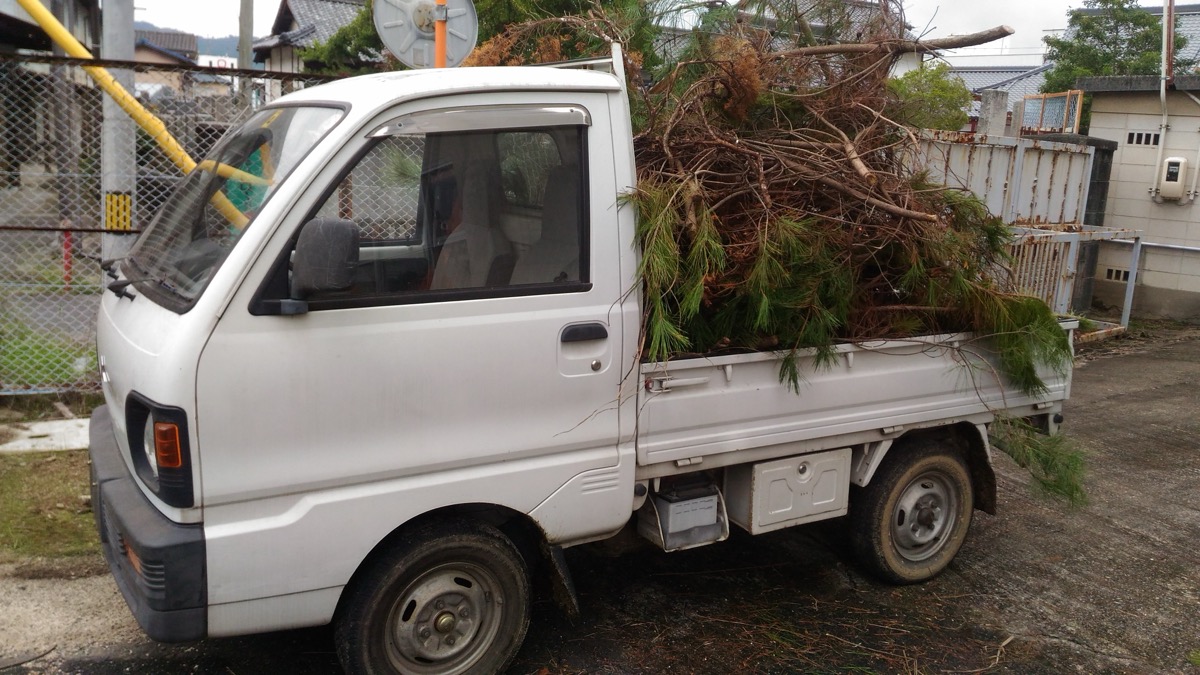
For small material deliveries, a kei truck with a dump bed is genuinely fantastic. The hydraulic dump makes unloading a one person job. No shoveling mulch out of a pickup bed for 20 minutes. Hit the switch, the bed tilts, material slides out. Our kei truck dump bed guide covers the options and pricing.
Nursery and Garden Center Work
Moving plants, pots, bags of soil, and supplies around a nursery is basically what kei trucks were built for in Japan. Short runs, light loads, constant loading and unloading. The low bed height (roughly 24 inches versus 34 inches on an F-150) means you are not dead lifting 50 lb bags of potting mix over your head. The three way drop sides let you load flat trays of plants from any angle.
Where Kei Trucks Fall Short (Be Honest With Yourself)
If you are going to make a business decision, you need the ugly truth too. Here is where the kei truck pitch falls apart.
Heavy Commercial Landscaping
If your work involves hauling stone, gravel, or pavers in volume, a kei truck is the wrong tool. Two yards of gravel weighs 5,000+ lbs. That is not "exceeding the payload." That is asking a 660cc engine to do the work of a diesel dump truck. You need a proper landscape truck for hardscape work. Period. That said, contractors running lighter material deliveries between sites can still make a kei truck work as a runaround vehicle.
Towing Larger Equipment
A zero turn mower weighs 800 to 1,200 lbs. Put it on a single axle trailer (another 300 to 500 lbs) and you are looking at 1,100 to 1,700 lbs of towing weight. Kei trucks are rated for 1,000 to 1,500 lbs of towing capacity, depending on the model. You can tow a 36 inch walk behind on a small trailer. Towing a 52 or 60 inch zero turn is pushing limits or exceeding them entirely. If your business runs zero turns, you need a bigger tow vehicle.
Highway Driving Between Job Sites
This is the dealbreaker that nobody mentions in the enthusiast forums. Most kei trucks top out at 60 to 70 mph, and getting there takes a while. The 660cc three cylinder engine makes 33 to 50 horsepower. On surface streets and rural roads, this is fine. On a highway at 65 mph, you are at full throttle, the engine is screaming, and every semi that passes you feels like a near death experience.
If your route keeps you on 35 to 45 mph roads, no problem. If you need to take the interstate between job sites, think carefully. Check our state legality guide because many states restrict kei trucks from highways entirely, which solves that decision for you.
Parts and Downtime
When your F-150 needs a water pump, you drive to AutoZone. When your 1998 Carry needs a water pump, you order it from Amayama or Oiwa Garage and wait for shipping. Parts availability has improved dramatically in the last few years, but you still cannot get same day parts for most repairs. For a business that depends on the truck running every day, having a backup plan matters. Some owners keep two kei trucks specifically for this reason: at their price point, a spare truck costs less than a week of lost revenue.
Insurance, Registration, and the Legal Reality
Here is the part that trips up business owners more than anything else. Kei truck insurance is cheaper than a full size truck, typically $200 to $500 per year for basic coverage. But getting commercial insurance on a kei truck is harder. Many insurers do not know how to classify them. You may need to call specialty insurers or work with an agent who handles imported vehicles.
Registration varies wildly by state. Some states title and register kei trucks just like any other vehicle. Others restrict them to off highway use only, which means you legally cannot drive them on public roads between job sites. A handful of states have banned them outright. Check the specific rules for your state before you buy. Our state by state guide covers all 50.
If you plan to finance a kei truck, know that most banks will not write a loan on a 25+ year old imported vehicle. You are likely paying cash or using a personal loan. Budget accordingly.
The Fleet Play: Kei Trucks as Your Second and Third Vehicle
The smartest landscaping operations using kei trucks are not replacing their F-150s. They are supplementing them. The strategy looks like this:
One full size truck handles the heavy work: towing the zero turn trailer, hauling bulk materials from the supply yard, and highway driving between distant job sites. Two or three kei trucks handle the daily residential route work, property maintenance contracts, and small material deliveries.
At $7,000 to $10,000 per truck from a dealer like Duncan Imports or Japanese Classics, you can build a three truck fleet for less than the cost of one new Tacoma. Each truck sips fuel, is cheap to insure, and puts a crew member in a vehicle instead of riding along in the cab. Landscaping is just one of several viable kei truck business models that leverage this low cost fleet advantage.
Browse our dealer directory to find importers in your state.
What to Buy: Best Models for Landscaping
Not all kei trucks are equal for commercial work. Here is what to look for.
The Suzuki Carry is the most popular choice for a reason. The largest aftermarket parts supply in the US, a proven 4WD system with Hi/Lo transfer case, and the most common model on the used market means you can find one faster and fix it cheaper. The DA63T generation (1999 to 2013) is the sweet spot for reliability and parts availability.
The Daihatsu Hijet is the best option if you want a dump bed. Daihatsu sold more factory dump configurations than any other manufacturer. The Hijet Dump and Hijet Jumbo (extended cab) are both common on the import market. If you are doing material delivery or debris removal, start here.
For 4WD capability on rough property terrain, the Subaru Sambar has the highest ground clearance in the class and a unique Extra Low gear that is genuinely useful for navigating steep, muddy landscapes.
Expect to pay $6,000 to $8,000 for a clean, running example with 4WD. Dump bed models command a premium: $8,000 to $12,000 depending on condition. Budget another $500 to $1,000 for import, registration, and inspection costs if you are buying sight unseen from Japan.
Real Talk: Who Should and Should Not Buy One
Buy a kei truck if you:
- Run a solo or two person residential lawn care operation
- Do property maintenance, estate care, or campus grounds work
- Need to access gated communities, narrow driveways, or tight spaces
- Deliver small loads of mulch, plants, or supplies
- Want a second or third fleet vehicle that costs less per month than your phone bill
Do not buy a kei truck if you:
- Haul stone, gravel, or pavers in volume
- Tow zero turn mowers on trailers daily
- Drive 30+ miles on highways between job sites
- Need to pass DOT commercial vehicle inspections
- Operate in a state that restricts kei trucks to off highway use
The Bottom Line
A kei truck will not replace a work truck for a full service commercial landscaping company. Anyone telling you otherwise is selling something. But for residential lawn care, property maintenance, nursery work, and small material delivery, a kei truck at $7,000 does the job at a fraction of the cost, with better fuel economy, a bigger bed than most pickups, and the ability to go places no full size truck can reach.
The operators getting the most out of these trucks are the ones who understand what they are: a specialized tool, not a universal replacement. Use them where they shine. Keep your full size truck for what it does better. And when Mrs. Henderson calls because her landscaper's F-150 crushed her driveway pavers again, you drive your little Carry right through the backyard gate and steal the account.
That is how you build a business.
Advertisement


