Best Kei Truck Mods for Off-Road Use
Turn your kei truck into an off-road capable workhorse with these proven modifications. From lift kits and tires to skid plates and lighting upgrades.

Advertisement
TL;DR: The highest impact mods in order: 2-inch lift kit ($300-$600), aggressive ATV tires on stock rims ($400-$600), skid plate ($150-$300), LED light bar ($100-$200), and a snorkel for water crossings ($200-$400). Total budget for a seriously capable off-road kei truck: under $2,000. Start with the lift and tires. Everything else is optional.
Stock kei trucks are more capable off road than most people expect. Four wheel drive with low range, light curb weight, and a compact footprint mean they can go places that full size trucks cannot. But with a few targeted modifications, you can transform a stock kei truck from "surprisingly capable" to "genuinely impressive" on trails, farm roads, and rough terrain. The proof: a 1992 Suzuki Carry with this exact mod list finished Colorado's Alpine Loop at 12,800 feet. The Drive and other outlets have documented the growing off road kei truck scene extensively.
This guide covers the most effective off road modifications in order of impact, starting with the changes that deliver the biggest capability improvement per dollar spent.
1. Tires: The Single Best Upgrade
If you do one modification and nothing else, upgrade your tires. The stock tires on most kei trucks are narrow, road focused, economy tires in 12-inch sizes. They are designed for fuel efficiency and pavement grip, not mud, gravel, or loose soil.
What to run:
- Stock size upgrade: 145/80R12 or 155/80R13 all terrain tires fit most kei trucks without modification. Brands like Yokohama Geolandar, Toyo Open Country, and Maxxis Buckshot offer options in these sizes. Specialty suppliers like Oiwa Garage and Minitrucks.net stock confirmed fitments.
- With a lift kit: 165/65R14 or 175/65R14 all terrain tires become an option with a 2-3 inch lift, providing a larger contact patch and more aggressive tread.
- Aggressive options: For trucks used primarily off road, knobbier tires in the 145/80R12 or 155/80R13 range from Maxxis or Kenda deliver excellent traction in mud and loose soil.
Impact: Upgraded tires improve traction in every off road condition: mud, gravel, grass, sand, and snow. The difference between stock economy tires and a proper all terrain is dramatic and immediately noticeable.
Cost: $150-$400 for a set of four, depending on size and brand.
2. Lift Kit: Ground Clearance Matters
Stock kei trucks sit low. Ground clearance is typically 6-7 inches, which is adequate for graded farm roads but insufficient for rutted trails, rocks, or uneven terrain. A lift kit raises the body and provides room for larger tires.
Options:
- 2-inch lift: The most common and practical lift height. Typically uses spacers on the front struts and add-a-leaf or spacers on the rear leaf springs. Maintains relatively stock driving characteristics while meaningfully improving clearance.
- 3-inch lift: Achievable with extended shackles in the rear and taller spacers up front. This is the practical maximum for most kei trucks before driveline angle issues and handling degradation become concerns.
- 4-inch and beyond: Possible but requires more extensive modification (drop brackets, extended brake lines, driveshaft modifications on 4WD models). At this height, you are entering diminishing returns territory and creating new problems. JDub Adventures' 30 inch tire Hijet build is a useful watch on what actually breaks when you push a kei truck past the 3 inch ceiling.
Recommended brands: Catuned, Kei Truck Garage, and various Japanese aftermarket suppliers offer bolt on lift kits for all major kei truck models. Suzuki Carry kits are the most widely available; Subaru Sambar and Honda Acty kits are less common but available. The r/keitruck community maintains recommendations on which kits offer the best value for each model.
Installation: A 2-inch lift is a straightforward garage job that takes 3-5 hours with basic hand tools and a jack. Larger lifts benefit from professional installation to ensure proper alignment and driveline angles.
Impact: A 2-inch lift combined with slightly larger tires gives you 8-9 inches of ground clearance, enough to clear most rocks, ruts, and trail obstacles you will encounter on a farm or property.
Cost: $300-$800 for a complete bolt on kit.
3. Skid Plates and Underbody Protection
The underside of a kei truck is exposed. The oil pan, transmission, transfer case (on 4WD models), and fuel lines are all vulnerable to rock strikes on rough trails. Factory underbody protection is minimal or nonexistent.
What to protect:
- Engine/oil pan skid plate: The most critical piece. A single rock strike to the oil pan can end your day (and potentially your engine). Steel or aluminum skid plates that bolt to the frame rails in front of the engine are available for most models.
- Transmission/transfer case plate: For trucks that see regular off road use, protecting the transmission and transfer case is worthwhile.
- Fuel tank guard: The fuel tank is typically exposed on the underside. A light aluminum guard prevents puncture from trail debris.
DIY option: Many kei truck owners fabricate their own skid plates from 1/8-inch steel or 3/16-inch aluminum. The flat frame rails and simple undercarriage geometry make custom fabrication accessible for anyone with a welder.
Impact: Skid plates do not improve performance, but they prevent catastrophic damage. One avoided oil pan puncture justifies the entire investment.
Cost: $100-$400 for commercial plates, or $50-$100 in materials for DIY fabrication.
4. Lighting: See and Be Seen
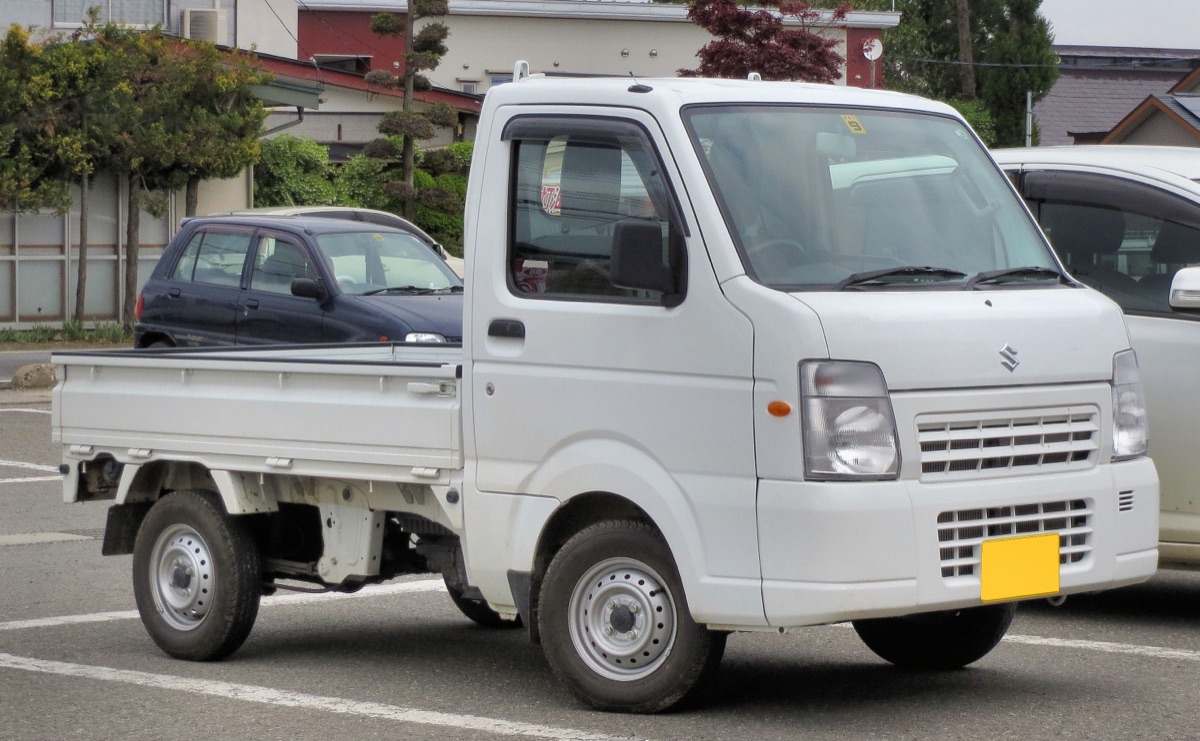
Stock kei truck headlights are sealed beam units from the 1990s. They produce minimal light output and are inadequate for nighttime trail driving or early morning farm work. Upgrading lighting is one of the highest value modifications for safety and usability.
Headlights: LED headlight bulb conversions are available for all kei truck models. A quality LED conversion (Hikari, Auxbeam, or similar) replaces the stock sealed beam and provides dramatically more light with a proper beam pattern. Budget $40-$80 for a quality set.
Auxiliary lights:
- Light bar: A small LED light bar (20-30 inches) mounted on the roof or above the windshield provides massive illumination for nighttime trail driving or work. Wiring is simple: a relay, a switch, and power from the battery.
- Work lights: LED flood lights mounted on the rear of the cab or on the bed sides illuminate the work area behind the truck. Invaluable for early morning or late evening farm work.
- Rock lights: Small LED pods mounted under the frame illuminate the ground around the tires, helping with trail obstacle visibility at night.
Impact: LED headlights alone transform nighttime driving. Add a light bar and work lights, and you can safely operate the truck around the clock.
Cost: $40-$80 for headlight conversion, $50-$200 for a light bar, $30-$80 for work lights.
5. Front Bumper and Winch
A steel front bumper with an integrated winch mount serves two purposes: it protects the cab and radiator from trail obstacles, and it provides self recovery capability when you get stuck.
Bumper options:
- Full replacement bumper: Steel tube or plate bumpers that replace the stock plastic bumper entirely. These typically include a winch mount and may incorporate a brush guard to protect the headlights.
- Bolt on brush guard: A lighter option that adds frontal protection without the weight and cost of a full bumper replacement.
Winch: A small 2,500-3,500 lb electric winch is appropriately sized for a kei truck. The truck weighs 1,500-1,800 lbs, so a 3,000 lb winch provides adequate pulling force with a safety margin. Brands like Warn, Smittybilt, and Badland (Harbor Freight) all offer compact winches in this range. Clean examples of well built off road kei trucks regularly sell on Bring a Trailer at premiums that justify the modification investment. A front receiver hitch makes winch mounting much simpler, and we cover that along with other must have kei truck accessories in a separate guide.
Mount considerations: Kei trucks have light duty frames. A winch mount must distribute the load across the frame rails, not concentrate it on a single point. Commercial mounts designed specifically for kei trucks account for this. If fabricating your own, use a plate that spans both frame rails.
Impact: A winch is insurance. You may not need it often, but when you do (stuck in mud, high centered on a rut, or pulling a fallen branch off a trail) it is priceless.
For inspiration on full overlanding builds, Suzuki itself just showed an X Limited dressed in the Hard Cargo accessory kit at the 2026 Japan Truck Show, complete with a roof rack that bridges from the cab over the bed.
Cost: $200-$500 for a bumper, $150-$400 for a winch, $50-$150 for mounting hardware.
6. Differential Breather Extension
This is a small, cheap modification that prevents an expensive failure. The stock differential breather vent on most kei trucks is located low on the axle housing. When the truck drives through water or deep mud, water can be drawn into the differential through this vent as the axle cools and contracts, contaminating the gear oil and causing premature differential failure.
The fix: Run a small diameter hose from the differential breather vent to a higher point on the frame or inside the bed. This keeps the breather above water level during crossings.
Impact: Prevents water intrusion into the differential during water crossings and deep mud. A 15-minute modification that can save a $500+ differential rebuild.
Cost: $5-$15 in hose and fittings.
7. Snorkel or Cold Air Intake Reroute
For trucks that regularly ford water or operate in extremely dusty conditions, raising the air intake prevents hydrolocking (water entering the engine through the intake) and provides cleaner air in dusty environments.
Options:
- Snorkel kit: A few aftermarket snorkel kits exist for the Suzuki Carry. For other models, custom fabrication using universal snorkel kits is the route.
- Intake reroute: A simpler option is to reroute the stock air intake from its low position to a higher point in the engine bay using flexible intake tubing and a relocatable air filter.
Impact: Critical for water crossings deeper than bumper height. If you do not cross water regularly, this modification is unnecessary.
Cost: $50-$200 depending on approach.
Build Priority Order
If you are building an off road kei truck on a budget, here is the recommended order of modifications based on impact per dollar:
- Tires ($150-$400): Immediate, transformative traction improvement
- Differential breather extension ($5-$15): Cheap insurance against expensive damage
- LED headlights ($40-$80): Safety and usability, night and day difference
- Lift kit ($300-$800): Ground clearance for rougher terrain
- Skid plates ($100-$400): Underbody protection for rocky trails
- Auxiliary lighting ($50-$200): Work capability in low light
- Bumper and winch ($350-$900): Self recovery and frontal protection
- Snorkel ($50-$200): Only if water crossings are in your future
A complete off road build can be done for $1,000-$2,500, which is remarkable when compared to the cost of accessorizing a full size truck or UTV. See our kei truck vs pickup comparison for the full cost breakdown. Hagerty has noted that well modified kei trucks are holding their value better than stock examples, making tasteful mods a solid investment. The kei truck's small size means less material, smaller components, and lower costs across the board. For sourcing all of these parts, check our kei truck parts guide. For a deep dive on tire sizes and upgrade paths, see our complete kei truck tire guide.
Beyond off road mods, there are several other popular modification categories worth exploring: engine swaps for those who want dramatic power gains (from bolt on turbo mods through Hayabusa and LS V8 conversions), dump bed conversions for hauling and dumping loose materials, snow plow setups for turning your kei truck into the cheapest plow rig money can buy, air conditioning if you want to stay comfortable during summer trail runs, and EV conversions if you want to ditch the gas engine entirely for silent, torquey electric power. If you are building a truck for farm use, combining a lift, all terrain tires, and a dump bed creates an incredibly capable workhorse for under $15,000 all in. Make sure your insurance policy covers modifications because standard policies often exclude aftermarket upgrades.
If you want factory off road capability without modifications, the Suzuki Jimny is a body on frame kei 4x4 with solid axles and low range from the factory, and the Mitsubishi Pajero Mini offers a more road friendly alternative with independent front suspension and a turbocharged four cylinder.
Start with tires, add modifications as your needs and budget allow, and enjoy the absurd capability to cost ratio that makes kei trucks so compelling. For those who want to see how far the platform can really be pushed, watch the 550 HP twin Tesla Suzuki Carry roll cage build or the time attack Mitsubishi Minicab that made it onto Top Gear with full race suspension and APR Performance aero. Both are extreme, but they prove these trucks can handle serious fabrication work. For something closer to a real world trail build, Forged 4x4's Sambar build walks through a complete lift, tire, and skid plate setup on a Subaru Sambar. If aesthetic mods are more your speed than trail mods, the Acty vs Carry widebody build comparison covers how Hello Special body kits, BC Racing coilovers, and aggressive wheel offsets differ between the two platforms. For a budget walkthrough on the smallest aftermarket platform in the kei segment, the Mitsubishi Minicab full build covers radio, bed paint, and custom fabrication on the underdog kei truck. And if you're feeling adventurous, check out our guide to kei truck camper builds for ideas on turning your modded truck into a micro overlander, or read how hunters are using these same mods for backcountry hunting access.
Advertisement


