Daily Driving a Kei Truck: What It's Actually Like
What it's really like to use a kei truck as your daily driver. Speed, comfort, safety, insurance, and honest advice from owners who do it every day.

Advertisement
TL;DR: Daily driving a kei truck works for short commutes under 20 miles, errands, and town driving. Highway speeds above 55 mph are miserable. Insurance runs $30-$60/month. Fuel economy is 35-45 mpg. The real trade-off is comfort and safety: no airbags, no crash structure, and a cabin that gets loud above 40 mph. Great second vehicle, risky only vehicle.
Daily driving a kei truck is not like daily driving anything else on American roads. There is no pretending otherwise. These are 660cc vehicles designed for narrow Japanese streets, and using one as your primary transportation in the US means accepting a specific set of trade offs that most automotive journalism glosses over.
I have been daily driving a kei truck for over two years. Before that, I drove a mid size pickup. The difference is enormous in ways both good and bad, and if you are considering making the switch, you deserve a straight answer about what that actually looks like. If you are brand new to the concept, start with our overview of what a kei truck is before diving in here. For a real world data point at higher mileage, see Peter Heng's Subaru Sambar 30,000 mile ownership review covering 18 months of US street legal use.
The Reality of Daily Driving: Speed, Comfort, and Noise
The kei vehicle class was built around strict Japanese regulations, with engines capped at 660cc, vehicle dimensions kept deliberately compact. That engineering context matters because it defines every aspect of the daily driving experience.
Speed. Most kei trucks top out somewhere between 60 and 75 mph depending on the model, engine condition, and whether you are going uphill. Realistically, sustained comfortable cruising sits around 45 to 55 mph. A well maintained Suzuki Carry with a manual transmission will feel confident at 50. Push past that and the engine is working hard, the noise climbs, and you start questioning your decisions.
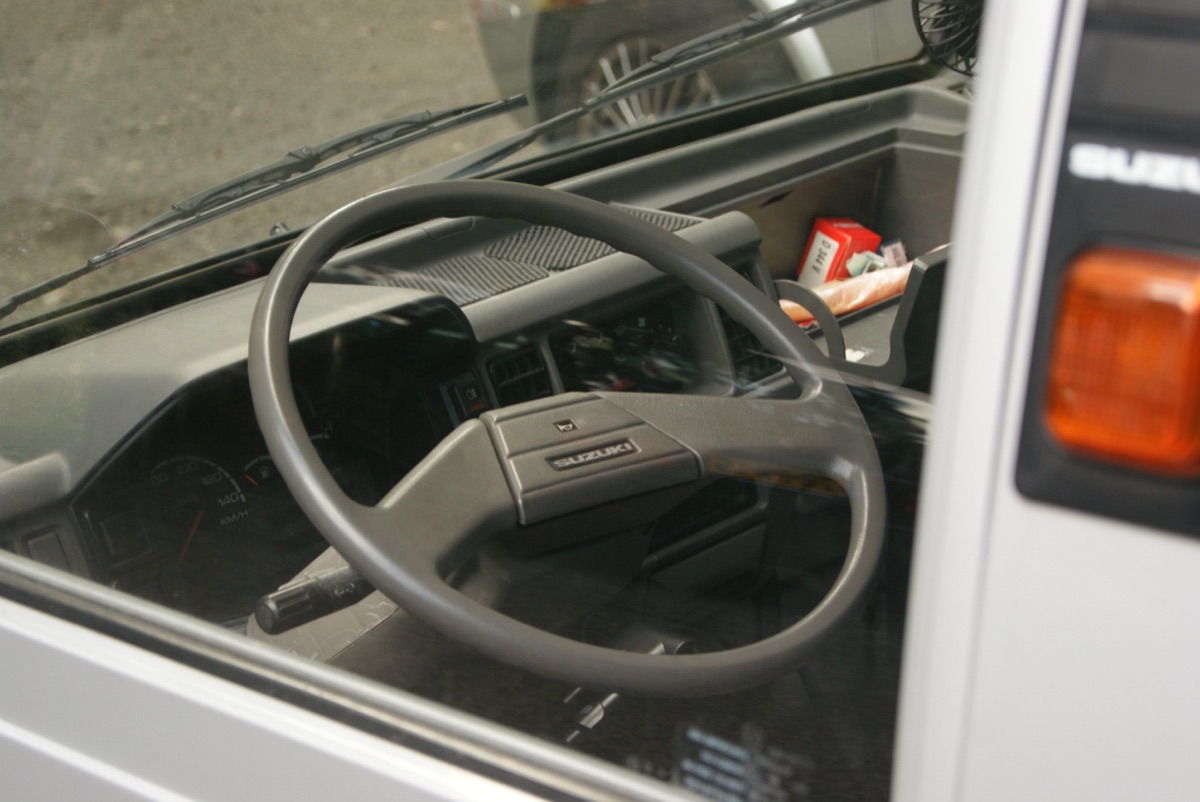
Comfort. The cab is small. You sit upright with your feet nearly directly above the front axle. There is minimal sound deadening from the factory. The seats are thin. After about 45 minutes of continuous driving, you will notice it. After 90 minutes, you will really notice it. A quality seat cushion makes a genuine difference for daily use.
Noise. This is the thing nobody warns you about sufficiently. At 50 mph, the engine is loud. Wind noise is loud. Road noise is loud. Everything is loud. You are sitting on top of a small engine that is revving high to maintain speed, inside a cab with the structural heft of a garden shed. Conversations happen at elevated volume. Music requires the stereo turned up considerably. Some owners add aftermarket sound deadening material to the doors and floor, and that is worth considering if this is genuinely your daily vehicle.
Highway Driving Limitations
Let me be direct: daily driving a kei truck works until you need a highway. These vehicles were not designed for sustained 65+ mph travel, and the experience reflects that. If you want to see what a 1,000 mile kei truck road trip actually looks like, watch Doug Vargo's Honda Acty cross country adventure. Spoiler: 39 mpg and one broken alternator belt.
Merging onto a highway with a 660cc engine requires planning. You need the full on-ramp. You need to be in the right gear at the right time. Once you are up to highway speed (assuming traffic flow allows you to sit at 55 to 60) the truck will maintain it, but there is zero reserve power. Hills will slow you down. Passing is not really an option. Semi trucks will blow past you and the buffeting from their wake is genuinely unsettling in a vehicle this light.
The Drive and other outlets covering these trucks have documented similar findings. The honest assessment is that if your commute involves more than a few miles of highway at 65 mph or above, a kei truck is a poor daily driver choice. For 45 mph state routes, two lane rural roads, and in town driving, the calculus changes entirely.
Compare this to a standard pickup and the highway gap becomes obvious. Compare it to a UTV or side by side, though, and the kei truck is dramatically more capable on paved roads. Keep in mind that several states cap kei truck speeds at 25 to 55 mph anyway. Check our 2026 state law roundup to see if your state has restrictions that make the highway question moot.
Safety Considerations: An Honest Assessment
This section matters and deserves honesty rather than cheerleading.
Kei trucks imported under the 25 year rule were never designed to meet federal safety standards. They do not have airbags. They do not have modern crumple zones. They do not have side impact protection, ABS, or traction control. The cab over design means your feet and legs are the crumple zone in a frontal collision.
At 25 to 35 mph around town, the risk profile is manageable, comparable to driving older vehicles that many people still use daily. At highway speeds, or in any collision involving a modern full size truck or SUV, the physics are not in your favor. The weight difference alone is severe. A kei truck weighs around 1,500 to 1,800 pounds. A modern F-150 weighs around 4,500 to 5,500 pounds.
Owners in the kei truck community on Reddit discuss this openly. The consensus is pragmatic: drive defensively, stay off high speed roads when possible, and understand the risk you are accepting. Some owners add LED headlights and auxiliary lighting to improve visibility, which is a reasonable upgrade for daily use.
I am not going to tell you a kei truck is safe by modern standards. It is not. What I will tell you is that thousands of people daily drive vehicles with similar safety profiles (older trucks, classic cars, motorcycles) and make informed decisions about acceptable risk. You should make yours with clear eyes.
Weather and Climate
A kei truck in mild weather is pleasant. Windows down, short bed loaded with whatever you need to haul, engine humming along at a reasonable pace. It is genuinely enjoyable.
A kei truck in winter is a different experience. The heaters in most models are adequate but not powerful. Defrosting the windshield takes time. The lightweight chassis means the truck gets pushed around by crosswinds. In snow, the rear wheel drive models (which are most of them) are predictably terrible without weight in the bed and appropriate tires.
If you live somewhere with real winters and plan to daily drive, four wheel drive models like the Honda Acty 4WD or Suzuki Carry 4WD are significantly better. Good winter tires make an enormous difference. Some owners also add aftermarket cab heater upgrades, which range from improved fan assemblies to small auxiliary heaters. These are worth investigating if you are in a cold climate.
In extreme heat, the small cab heats up fast. There is not much thermal mass to buffer temperature. Air conditioning, if your model has it, works but the compressor load on a 660cc engine is noticeable, and you will feel the power loss.
Fuel Economy and Running Costs
This is where the kei truck starts winning. Daily driving a kei truck is remarkably cheap.
Fuel economy sits between 35 and 50 mpg depending on driving style, model, and conditions. Most owners report 40 to 45 mpg in mixed driving. With a small fuel tank (typically 7 to 10 gallons), fill ups cost very little. At current fuel prices, many owners spend $25 or less to fill the tank and get 250 to 350 miles of range.
Maintenance costs are low. Oil changes require less oil. Tires are small and inexpensive. Brakes are simple. The engines, particularly the Suzuki F6A and Honda E07A, are mechanically straightforward and well documented. Finding replacement parts has become much easier as the import market has matured, though you should still expect some parts to require longer lead times than domestic vehicles.
Registration costs vary by state, so check our state by state road legality guide for specifics, but in most places, registration and annual fees are minimal.
The total cost of ownership for a kei truck as a daily driver is genuinely difficult to beat. If you are coming from a modern truck or SUV with a $500+ monthly payment, the savings are dramatic.
Insurance Challenges
Insuring a kei truck for daily use is one of the more frustrating aspects of ownership. Many standard auto insurers do not know what to do with a 1990s Japanese mini truck. Some will decline coverage. Others will classify it incorrectly and charge accordingly.
The two approaches that work best are specialty insurers and agreed value policies. Hagerty is the most commonly recommended option in the kei truck community for an agreed value policy, though their coverage may come with mileage restrictions that complicate true daily driver use. For standard liability and collision, you can compare insurance quotes from major carriers, but be prepared to call and speak with an agent rather than completing everything online.
Some owners register their kei trucks as off highway vehicles or farm equipment depending on state law, which changes the insurance picture entirely. Again, our state law guide covers this in detail.
Budget between $300 and $800 per year for insurance on a daily driven kei truck, depending on your state, coverage level, and driving record. It is usually cheaper than insuring a modern vehicle, but getting the policy set up requires more effort. For the full breakdown of providers, rates, and policy types, see our kei truck insurance guide.
Where Daily Driving Works Well
Daily driving a kei truck works brilliantly in specific contexts.
Small towns and rural areas. Speed limits of 25 to 45 mph, short distances between destinations, and roads where the truck's size is an advantage rather than a liability. This is where kei trucks were designed to operate. Running errands in a town where everything is within 10 miles is the kei truck's sweet spot.
Farm and property use with road trips between. If you live on acreage and need a vehicle that works on the property and can also run to the feed store or hardware store 15 miles away on a two lane road, a kei truck is ideal. For property only transport, some owners debate whether a golf cart is enough. Our kei truck vs golf cart comparison breaks down where each one makes sense. MotorTrend's coverage of kei trucks highlights this dual use capability as one of their strongest selling points.
Urban environments with low speed limits. In cities where traffic rarely moves above 35 mph anyway, the speed limitation is irrelevant. The small footprint makes parking trivially easy. You can fit a kei truck into spaces that a Civic cannot touch.
Second vehicle or seasonal daily driver. Many owners daily drive their kei truck from spring through fall and switch to a more weather capable vehicle in winter. This is arguably the most practical approach, and in the warmer months, some owners build out their trucks as micro campers for weekend trips. The same logic applies to retirees who no longer need an interstate vehicle. Our breakdown of why $6K kei trucks make sense for drivers over 65 walks through the demographic case.
Where It Does Not Work
Suburban highway commuters. If your daily drive involves 20 miles of interstate at 70 mph, a kei truck is the wrong vehicle. Full stop. The stress on the engine, the noise, the vulnerability in traffic. None of it makes sense for that use case.
Families needing to transport more than one passenger. Most kei trucks seat two. Some have jump seats that are technically usable by small adults for short distances. None of them are appropriate for carrying children in car seats.
Anyone uncomfortable with the safety trade offs. If the lack of airbags and modern safety structures gives you pause, listen to that instinct. There is no shame in deciding the risk profile does not match your comfort level.
Before buying any kei truck for daily use, go through a thorough pre purchase inspection checklist. A kei truck that needs constant repairs is not a viable daily driver regardless of how well the concept works on paper.
Owner Tips for Daily Use
Owners who successfully daily drive kei trucks tend to share a few common practices.
Invest in comfort upgrades early. A good seat cushion, sound deadening, and upgraded speakers transform the experience. Some owners also add small off road and comfort modifications that make daily use more practical.
Keep the maintenance schedule tight. These are old engines with high mileage. Oil changes every 3,000 miles. Check the coolant. Inspect belts and hoses regularly. A well maintained kei truck is reliable. A neglected one will leave you stranded. Stock up on common wear items from a reputable kei truck parts supplier so you are not waiting weeks for a water pump when yours fails.
Plan your routes. After a few weeks, you will naturally develop routes that avoid the worst hills and the fastest roads. This is not a limitation. It becomes second nature. You will also discover that the back roads are more enjoyable anyway.
Carry basic tools. A small toolkit, a tire patch kit, and a basic understanding of the engine will serve you well. These trucks are mechanically simple enough that many roadside issues can be resolved without a tow.
Be visible. Add reflective tape, keep your lights in good condition, and consider auxiliary lighting. You are small and low in a world of lifted trucks and distracted drivers. Anything you can do to increase visibility is worthwhile.
Talk to other owners. The kei truck community is active and helpful. Search kei truck classifieds not just for vehicles but for the community knowledge that comes with the listings and forums. Experienced daily drivers have solved most of the problems you will encounter. When you are ready to shop, browse our dealer directory for trusted importers near you.
The Bottom Line
Daily driving a kei truck is not for everyone, and anyone who tells you otherwise is selling something. It is slow, loud, and objectively less safe than a modern vehicle. For the full picture, see the honest downsides of ownership. The cab is cramped, the highway experience ranges from unpleasant to genuinely sketchy, and insuring one requires more phone calls than it should.
But it is also cheap, efficient, endlessly practical for hauling, easy to park, simple to maintain, and more fun than any vehicle in this price range has a right to be. If your life and commute fit within its capabilities (low speed roads, moderate distances, mild to moderate climate) a kei truck is not just a viable daily driver. It is a genuinely great one.
The key is honesty with yourself about what you need. Match the vehicle to your actual life, not the life you imagine, and a kei truck will serve you well every single day. For a closer look at what daily ownership feels like, watch our Suzuki Carry walkaround for the American market.
Advertisement


