Vermont Kei Truck Law: The 130 Inch Cap That Leaves Out 1999 and Newer Trucks
Vermont's Act 153 defines a kei vehicle as 130 inches long or less. The Suzuki Carry and Honda Acty built from 1999 on are 133.7 inches. Here is what the statute says, where the number came from, and what to do before you buy.

Advertisement
Vermont passed the cleanest kei truck law in the country this summer, then wrote one number into it that a 1999 Suzuki Carry cannot meet. The number is 130 inches. The truck is 133.7. That is a 3.7 inch gap, and it sits right on the line between the trucks most people want to import and the trucks the statute names.
We got this wrong ourselves. When we covered Act 153 in July, we wrote that every imported kei truck fits the definition "with room to spare." Reading the enacted text again while going through this month's state count headlines, that sentence does not survive contact with a tape measure. Here is the corrected version.
The Number That Does Not Fit
Governor Phil Scott signed S.326 on June 16 and the kei sections took effect July 1. The enacted text of Act 153 adds two definitions to 23 V.S.A. § 4. Subdivision (90) reads: a "kei vehicle" means a motor vehicle that has four wheels, an engine displacement of 660 cubic centimeters or less, an overall length of 130 inches or less, an overall height of 78 inches or less, and an overall width of 60 inches or less. Subdivision (89) defines a "kei truck" as a kei vehicle designed, used, or maintained primarily for transporting property.
The rest of the act is excellent drafting, and our Vermont Act 153 breakdown still stands on the mechanics: kei cars fold into the pleasure car definition, kei trucks into the farm truck definition, and towns lose the power to ban either one. The length cap is the only part that bites.
| Reference point | Millimeters | Inches |
|---|---|---|
| Vermont statute cap | 3,302 | 130.0 |
| Japan kei class limit before October 1998 | 3,300 | 129.9 |
| Suzuki Carry DA52T and Honda Acty HA6 (1999 on) | 3,395 | 133.7 |
| Japan kei class limit since October 1998 | 3,400 | 133.9 |
The statute's 130 inches lines up with Japan's old limit. The Carry and Acty built after the limit moved are about 93 millimeters longer than the statute allows.
Where 130 Inches Came From
Japan changed the kei body size rules in October 1998. The national kei car association lists the maximum length moving from 3.30 meters to 3.40 meters, and the same revision widened the maximum body width from 1.40 meters to 1.48 meters. The new body rules also came with higher safety expectations, and the trucks that followed were longer and wider than the ones they replaced. The Wikipedia kei car history puts the current class at 3.4 meters long, 1.48 meters wide, under 2.0 meters tall, and 660 cc.
Whoever drafted the Vermont definition almost certainly pulled the old 3.30 meter figure, converted it, and rounded to 130. We cannot prove that from the bill record. It is an inference from the numbers matching. What the text shows is the cap itself, and the cap is the pre 1998 number.
Which Trucks Land on Which Side
This is where the 25 year rule makes the problem worse. Under the 25 year import rule, eligibility runs from the build date, so this month the eligible pool covers trucks built through about October 2001. The pre October 1998 trucks, which fit under 130 inches, are the older and more worn half. The roughly three years of production since the body size change, which are the cleaner and more desirable trucks, are the long ones.
We checked the two models that matter most. A Japanese spec database entry for the 1999 Suzuki Carry (DA52T) lists an overall length of 3,395 millimeters. A third party spec sheet that cites Honda Japan's official PDF gives the same 3,395 for the Honda Acty HA6 and HA7. That is 133.7 inches in both cases. Our Suzuki Carry model page and Honda Acty model page cover the generations in detail.
We have not pulled manufacturer lengths for the Hijet, Sambar, or Minicab. They were built to the same class limit, so we expect similar numbers, but expecting is not measuring. If you are shopping a Hijet or Sambar, get the length off the spec sheet for the exact chassis code before you assume anything.
The other half of the pool is fine. A truck built before October 1998 is capped by the old class limit at roughly 129.9 inches, so it fits under Vermont's number. If you were already hunting for an older, shorter truck, nothing changes for you.
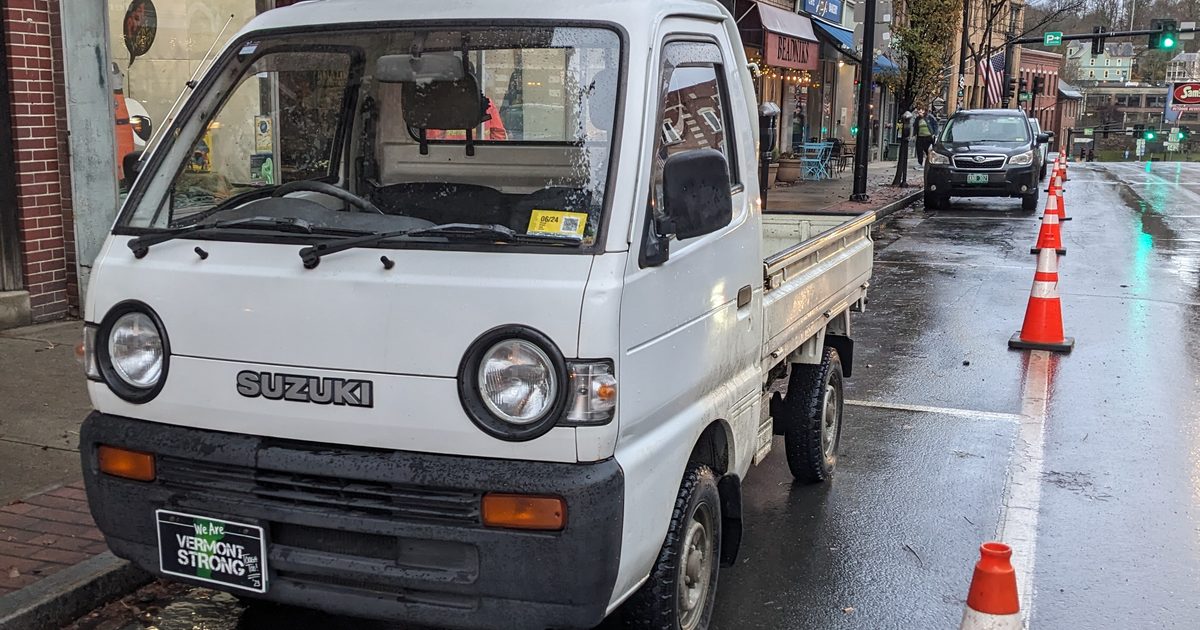
A Suzuki Carry on Main Street in Brattleboro, Vermont, by Artaxerxes via Wikimedia Commons, CC BY-SA 4.0 (cropped). The hero image at the top is a third generation Honda Acty truck by Kuha455405 via Wikimedia Commons, CC BY-SA 3.0.
What the Statute Does and Does Not Tell Us
Here is what we know and what we do not.
We know the definition in subdivision (90) says 130 inches or less. We know a stock 1999 Carry or Acty is 133.7. We found no Vermont DMV guidance on how the agency measures length when it registers a kei vehicle, and we found no documented case of a truck being turned away for being too long. So we cannot tell you the DMV counter will measure your truck. It may not. A clerk working from import paperwork may never reach a length question.
Here is our reading, and it is untested: if a 133.7 inch truck is not a "kei vehicle" under subdivision (90), the pleasure car and farm truck language that names kei vehicles has nothing to attach to for that truck, and neither does the clause that stops towns from banning registered kei vehicles. That is a reading of the text, not a ruling from anyone with authority over it. A DMV official or a Vermont attorney is the right place to test it.
What to do before you spend money. Ask the Vermont DMV in writing whether it applies the 130 inch length in subdivision (90) to imported trucks, and get the answer in writing. Measure the truck bumper to bumper yourself rather than trusting a listing, because a spec sheet can be off by a few millimeters or copy the class limit instead of the actual body. A 25 foot tape measure is a fifteen dollar tool for a decision worth thousands. Then run the truck through our buying checklist like any other import.
We Got This Wrong on Our Own Pages
Our Vermont state page and our July Act 153 post both said imported trucks clear the kei definition "with room to spare." Both were wrong for 1999 and newer trucks. We have corrected the prose on both pages to state the 130 inch figure and the 133.7 inch reality, and we are spelling out the gap instead of burying it.
We also have a map decision to make. Our Vermont state law page lists the state as legal, and that is still how the map reads today. After this, the honest label is "legal, with a length asterisk that excludes most of the trucks people want." Whether that changes the color on the map is a call we are still making. You can read the official S.326 bill page and decide for yourself in the meantime.
The legislature has an obvious fix available. Matching Japan's current 3.4 meter class limit in the definition would bring the 1999 to 2001 trucks inside the law, and it would be a small edit to subdivision (90). Until someone files that bill, the number in the statute is the number.
Why Every Legal State Count Is Different
This is the same problem showing up at national scale. On October 13, Oiwa Garage's new state guide announced that kei trucks are street legal in 22 states, with 20 more allowing conditional use and 8 prohibiting road registration. Our own count, after the September audit, is 12 legal, 25 restricted, 10 illegal, and 3 unclear. Another tracker published an August count of 11 full registration states.
Those numbers do not disagree because anyone is lying. They disagree because "legal" is doing different jobs. Oiwa's guide calls a state street legal when kei trucks get the same title and registration as other vehicles. The August tracker counts full registration only when no kei specific road class or speed cap statute applies. We sort states by what the statute or the DMV actually lets you do on public roads. Same pile of laws, three rulers. Oiwa's own state table flags the Vermont length gap in the Vermont row, which tells you even the headline count carries asterisks. We cannot tell from the press release whether Vermont sits inside the 22.
Our 50 state legality guide and the September audit explain how we classify each state. The Vermont length cap is a clean example of why a single number for "legal states" is less useful than the fine print for the one state you plan to register in.
The Bottom Line
Vermont wrote a good law with a bad number in it. If your truck was built before October 1998, you fit under the cap. If it was built from 1999 on, you are 3.7 inches over on the two models we checked, and nobody has said yet what the DMV will do about it. Ask in writing, measure it yourself, and do not buy a Vermont bound truck on the strength of a headline that says the state is legal. The r/keitruck community will be the first place real Vermont registration reports show up, and we will update this post when one does.
Advertisement


