Pennsylvania Kei Truck Laws: The Boom NHK Filmed Can't Get Plates
Japan's public broadcaster sent a correspondent to Lancaster County to film America's kei truck boom. We checked NHK's numbers, then checked Pennsylvania law. The trucks on that lot can't get normal plates, and the bill to fix it dies November 30.

Advertisement
Japan's public broadcaster flew a correspondent halfway around the world to film America falling in love with kei trucks, and of all the places to set up a camera, it picked a dealer lot in Lancaster County, Pennsylvania. That is a little like filming a documentary about craft beer in a dry county. The trucks are there. The fans are there. The plates are not. Since December 2021, Pennsylvania has refused normal road registration for new mini truck owners, and the one bill that would change that has sat untouched in committee for eighteen months. It dies November 30.
The NHK piece is warm and fun and mostly right. It also skips the most important fact about the state it was filmed in. So we checked the numbers in the report, then checked the law.
What NHK Actually Filmed
NHK World ran two versions of the story this month. The first, a news segment titled "Japan's 'Kei' trucks hitting U.S. roads", went up October 9. A longer feature, "'Kei' in the USA! Japan's mini trucks go stateside," followed on October 15. Correspondent Inoue Yuki, an anchor out of NHK's New York bureau, did the driving. American outlets picked it up a few days later, and The Drive called the whole thing "too wholesome", which is fair.
Most of the airtime goes to Lancaster Mini Truck, a small importer on West Maple Grove Road in Denver, Pennsylvania, that bills itself as Lancaster County's largest mini truck dealer. Owner Jake Simpson tells NHK he bought his first truck five years ago and couldn't get gas without strangers walking over to ask about it. He turned the hobby into a business and now brings in 15 to 20 trucks a month, selling most of them for $6,000 to $8,000. He calls them a no brainer, and he pulls out a tape measure to prove a point about beds that we'll get to in a second.
The second voice is Joey Iorio, who NHK identifies as a cofounder of a group called Empire State Kei Advocates. Iorio says he has "probably called every single state Senator" in New York trying to get kei trucks legalized there. We couldn't find a website or bill tied to the group beyond the NHK report, so treat that as NHK's account. It does line up with what we found when we covered New York's legalization fight in July: lots of organizing, no bill in the Senate database.
Checking NHK's Numbers
A Japanese broadcaster explaining Japanese trucks to Americans is a good setup for a few figures to get rounded on the way through. Here is how each one holds up.
The tape measure test
Simpson stretches a tape across a kei truck bed and then across the bed of a late model Ram 3500 crew cab, and they come out the same. That sounds like TV magic. It isn't. Suzuki's own Carry cargo spec page lists a bed length of 1,940 mm, which is 76.4 inches. Ram's 3500 crew cab with the 6 foot 4 inch box measures 76.3 inches at the floor according to Ram dealer spec sheets. Within a quarter inch, on a truck that weighs and costs several times as much.
That 1,940 figure comes from the current Carry spec sheet. The trucks on a Pennsylvania lot are 25 or more years old, so treat it as the class standard rather than a measurement of the exact truck in the video. Older kei beds land in the same neighborhood because the class rules boxed every manufacturer into the same footprint.
The Ram wins on width, 66.4 inches against the Carry's 1,410 mm, or 55.5 inches. The kei truck wins on everything you do with your back. The bed floor sits on top of the wheels, so there are no wheel wells eating into it, and all three sides fold down. Suzuki lists the bed floor at 650 mm, about 26 inches off the ground, so you drop a side and slide cargo off instead of reaching over a bed wall.
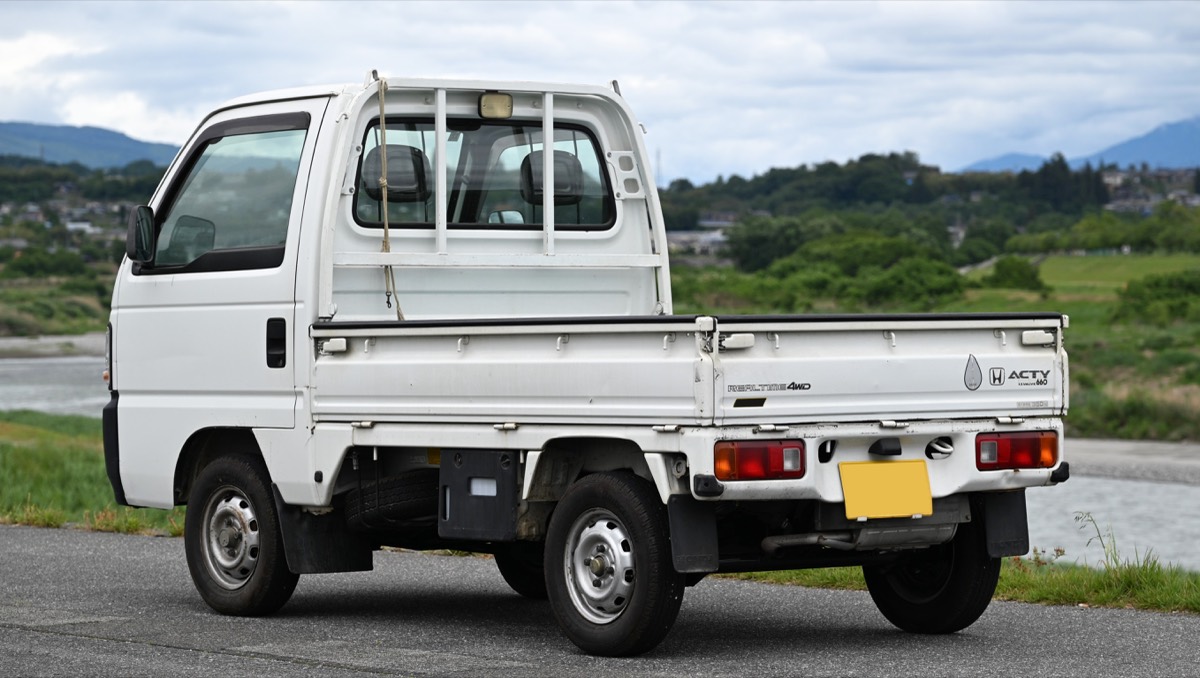
Photo: "1996-1999 Honda Acty Truck SDX 4WD rear" by TTTNIS, CC0, via Wikimedia Commons. Resized from the original.
The 30,000 figure
NHK says an estimated 30,000 kei trucks have come into the United States over the past five years. That's an estimate, and the report says so. It matches the number we cited in our kei truck import boom breakdown, which came from an industry market analysis. Nobody we've found publishes a hard count from customs data, so 30,000 is the best available ballpark, not a census.
The price
$6,000 to $8,000 for a truck already titled and sitting on a Pennsylvania lot is reasonable. A Japanese auction truck runs $2,500 to $4,500 for average condition before broker fees, shipping, and port costs, and turnkey four wheel drive trucks on some dealer lots ask $14,000 to $16,000. Simpson's range lands at the sensible low end of the retail market.
The 40 mpg line
This is the one that doesn't survive. Simpson says the trucks get around 40 mpg, and you'll hear that from nearly every dealer in the country. It's a Japanese lab number. When we dug into the official ratings for the trucks you can actually import, they land between 34 and 39 mpg on the Japanese test cycle, and real driving comes in lower. Our kei truck MPG breakdown puts the honest mixed use number around 30. Still good. Not 40.
The Part NHK Skipped: Pennsylvania Won't Plate These Trucks
Here is what a viewer in Osaka would never guess from the footage. Pennsylvania is one of the toughest states in the country for a kei owner who wants to drive on a public road.
PennDOT's mini truck FAQ lays it out plainly. A mini truck in Pennsylvania can be titled three ways. An off road title lets you own it and drive it on private property only. A farm exemption covers a truck used exclusively on farms the owner runs, renewed every two years. Antique registration covers trucks 25 years and older used for occasional transportation, not commercial work or daily driving. No unrestricted on road registration is available unless the owner holds a grandfathered status letter from PennDOT dated December 1, 2021, and that status dies the moment the truck is sold.
The same FAQ doesn't hide how PennDOT feels about the trucks themselves. It notes that NHTSA "does not endorse the use of mini trucks on public highways," points out that trucks built before 1998 weren't subject to crash testing, and describes them as "most likely another nation's cast-offs." That is the agency that controls your plates. It is not a neutral party.
So the trucks NHK filmed rolling around Lancaster County are, for a new buyer, farm trucks, private property toys, or antiques with a short leash. Which is fine. Lancaster County is farm country, and an off road title on a working dairy is exactly the use case these trucks were built for. But the "hitting U.S. roads" framing is generous in this particular state. Our Pennsylvania kei truck law guide walks through each title path, the fees, and which one fits which buyer.
HB 1205 Dies November 30
There is a fix on paper. House Bill 1205, sponsored by Rep. David Zimmerman, would define a "mini truck" in Title 75, treat it as a passenger car for title and registration, and let it run on roads posted at 55 mph or less. Faster roads could only be crossed, and only at signalized intersections. The bill sets minimum insurance at $15,000 per person, $30,000 per accident, and $5,000 property damage, and it exempts mini trucks from both safety and emissions inspection. Five other Republican representatives signed on as cosponsors. Here's the kicker: Zimmerman, a lifelong Lancaster County resident from East Earl Township, represents the 99th District, and his official biography lists Denver borough inside it. The dealer NHK filmed sits in the sponsor's own district.
Then nothing happened. The official record shows one action: referred to the House Transportation Committee on April 15, 2025. No committee meetings. No votes. The Pennsylvania General Assembly's two year session ends November 30, 2026, and bills that haven't passed by then die with it. The House calendar shows two session days left in November, the 9th and the 10th. To become law, HB 1205 would need a committee vote, a House floor vote, and the entire Senate process inside that window. The record gives no sign that's coming.
If it dies, a sponsor can reintroduce it in the 2027 session with a new number and start over. That is the realistic best case.
The 130 inch catch nobody in Pennsylvania is talking about
Read HB 1205's definition closely and you hit a number we've written about before. A mini truck under the bill must have "an overall length of 130 inches or less." PennDOT's FAQ uses the exact same 130 inch figure in its own definition. That is the old Japanese kei class limit from before October 1998. A 1999 or newer Suzuki Carry or Honda Acty runs 133.7 inches, as we laid out when we found the same cap sitting inside Vermont's new kei law.
That means two things. First, if HB 1205 passed as written, the cleanest and most desirable trucks you can import right now, the 1999 to 2001 builds, would sit outside its definition. Any 2027 reintroduction should fix that number, and owners writing to Harrisburg should say so.
Second, and this one is an open question rather than an answer: PennDOT's three title paths are written for vehicles that meet its own mini truck definition. We don't know how a PennDOT clerk handles a 133.7 inch truck. We found no guidance on it and no documented case either way. Our read is that the agency would not suddenly treat a longer truck as a normal car, but that is an untested hypothesis, not a rule. If you're buying a 1999 or newer truck in Pennsylvania, ask PennDOT in writing before you hand over money.
What This Means If You Buy in Pennsylvania
Buying a kei truck in Pennsylvania today is a perfectly sane decision if you go in with the right plan. Decide which of the three title paths fits before you shop, because the path determines whether the truck makes sense at all. A farm exemption works for genuine farm use. An off road title works for big properties, orchards, hunting land, and job sites. Antique registration gives occasional road use on a 25 year old truck, with no annual safety or emissions inspection, but it isn't for commuting or business.
Ask the dealer what paperwork comes with the truck and what title they expect you to get. A seller who tells you plates are no problem in Pennsylvania is either holding a grandfathered truck, which loses that status when it changes hands, or telling you something PennDOT won't back up. The federal side is the easy part. A 25 year old truck clears NHTSA's import rules on age alone. The state side is where Pennsylvania buyers get burned.
If you want road access, the honest answer right now is geography. States like Texas and Vermont now register kei trucks by statute, and our kei truck vs pickup comparison is worth a read if you're weighing whether a small used pickup gets you more in a restricted state.
The Bottom Line
NHK got the vibe exactly right. Americans really are buying these trucks, the bed really is as long as a Ram 3500's, and the people selling and lobbying for them really are that enthusiastic. What the report missed is that it was filmed in a state that won't give those trucks normal plates, and whose one fix is about to expire without so much as a committee hearing.
If you live in Pennsylvania and want that changed, the playbook that worked in Texas and Vermont is the same one Iorio is running in New York: organized owners calling every legislator, with clean statutory language in hand. The SEMA Action Network backed the Texas and Colorado wins and tracks state vehicle bills. Get on the record before the 2027 session starts, and tell whoever reintroduces HB 1205 to raise that 130 inch cap while they're at it.
Until then, buy for the title path you can actually get. A Pennsylvania kei truck is a great farm truck and a great property truck. It's just not a daily driver, no matter how good it looks on Japanese TV.
Advertisement


