Kei Truck & Kei Car Laws in Texas (2026)
LegalTexas SB 1816, in effect since June 20, 2025, gives full road legal access to any kei vehicle that complies with federal law, which in practice means the 25 year import rule.
Are Kei Trucks Legal in Texas?
Yes, fully legal. Texas is one of the best states in the country for kei truck owners. Governor Greg Abbott signed Senate Bill 1816 into law in 2025, officially recognizing kei trucks, kei cars, and kei vans as "miniature vehicles" under Texas law. The bill took effect immediately when Abbott signed it on June 20, 2025, codifying into state statute what the Texas Department of Motor Vehicles had already been allowing administratively since 2024.
SB 1816, backed by SEMA (Specialty Equipment Market Association), removes the ambiguity that previously existed around kei truck registration in Texas. The bill defines a miniature vehicle as one that "complies with applicable federal law," so in practice a kei truck has to clear the federal NHTSA 25 year import rule. This means popular models like the Suzuki Carry, Honda Acty, Daihatsu Hijet, and Mitsubishi Minicab can be legally imported, titled, registered, and driven on Texas roads.
What Changed with SB 1816
Before SB 1816, Texas kei truck registration was handled inconsistently at the county level. Some counties classified them as "off-highway vehicles" or "slow-moving vehicles," while others issued standard registrations. The experience varied wildly between rural and urban counties.
SB 1816 changes this by:
- Creating a "miniature vehicle" classification in Texas law
- Requiring a Texas title and registration, and a vehicle that can operate in compliance with traffic laws
- Tying eligibility to federal law, which in practice means the 25 year import rule
- Standardizing the registration process across all 254 Texas counties
- Aligning with federal import standards for consistency
For more details on importing, check our complete guide to importing a kei truck from Japan. Wondering how kei trucks compare to side-by-sides? Read our kei truck vs UTV comparison.
Registration Process and Requirements
To register a kei vehicle in Texas under the new law, you will need the following documents:
- Title or Manufacturer's Certificate of Origin (MCO): If the vehicle was previously titled in another state, you can transfer that title. If importing directly, you will need the original Japanese export certificate or deregistration document translated into English. See our complete state-by-state guide for details.
- Bill of Sale: A completed bill of sale showing the purchase price, buyer and seller information, and vehicle identification details.
- Customs Documentation: If imported, you need the CBP Form 7501 (Entry Summary) and EPA Form 3520-1, along with DOT Form HS-7 demonstrating the vehicle is exempt from FMVSS (typically via the 25-year exemption).
- Proof of Insurance: Texas requires liability insurance on all registered vehicles. For more guidance, see our kei truck insurance guide. Minimum coverage is 30/60/25 ($30,000 per person, $60,000 per accident for bodily injury, $25,000 for property damage).
- VIN Inspection: A VIN verification may be required, particularly for imported vehicles. This can be done at your local county tax office or by a licensed VIN inspector.
- No Safety Inspection Required: As of January 1, 2025, Texas eliminated mandatory safety inspections for non-commercial vehicles under HB 3297. Your kei truck no longer needs an annual safety inspection before registration. However, a $7.50 inspection program replacement fee is added to your registration. If you live in an emissions testing county (Harris, Dallas, Tarrant, etc.), you still need to pass an emissions test, though most 25+ year old kei trucks are exempt.
Step-by-Step Registration
- Obtain all import documentation from your customs broker or importer.
- Get a VIN inspection at your county tax assessor-collector's office.
- Purchase liability insurance that meets Texas minimums.
- Visit your county tax office with all documents to apply for title and registration.
- Pay applicable fees and taxes.
Restrictions
- Federal Import Rule: SB 1816 itself sets no age. It requires a miniature vehicle to comply with applicable federal law, which for a kei truck means clearing the 25 year import rule. As of 2026, vehicles manufactured in 2001 or earlier qualify.
- Traffic Law Compliance: The statute does not list required equipment, but it does require that the vehicle be capable of operating in compliance with Texas traffic laws. A kei truck missing equipment that traffic law requires, such as working lights, may need upgrades before registration.
- County Administration: While SB 1816 standardizes the legal framework, registration is still administered by county tax assessor-collector offices. The process should be more uniform now, but some variation in processing experience may still exist between counties.
- Standard Traffic Laws Apply: Registered kei vehicles must obey all standard Texas traffic laws. Be sure to review our pre-purchase inspection checklist before committing.
Legislative Timeline
Legislative Timeline
- Unclear
County-Level Inconsistency
No state statute addressed kei trucks specifically. Registration varied by county: some issued standard plates, others classified them as off-highway or slow-moving vehicles.
- Legalized
TxDMV Begins Administrative Registration
The Texas Department of Motor Vehicles began allowing kei truck registrations administratively, creating a de facto legal status without explicit legislation.
- Pending
SB 1816 Introduced with SEMA Backing
Senate Bill 1816, backed by the Specialty Equipment Market Association (SEMA), was introduced to formally create a "miniature vehicle" classification in Texas law.
- Legalized
Governor Abbott Signs SB 1816
Governor Abbott signed SB 1816 and it took effect immediately, codifying kei truck legality into the Texas Transportation Code. All 254 counties now follow a standardized process. Eligibility follows federal law, which means the 25 year import rule.
- Legalized
Texas Ends Non-Commercial Safety Inspections
HB 3297 eliminated mandatory annual safety inspections for non-commercial vehicles, including kei trucks. A $7.50 replacement fee is added to registration instead. Emissions testing still applies in designated counties, but most 25+ year old kei trucks are exempt.
Cost Breakdown
| Item | Estimated Cost |
|---|---|
| Title Application | $28 - $33 |
| Registration (annual) | $50.75 (base) |
| Inspection Replacement Fee | $7.50 |
| Sales Tax (6.25%) | Varies by purchase price |
| County Fees | $10 - $20 (varies) |
| Insurance (annual) | $300 - $800 (varies by provider) |
Total first-year costs, excluding insurance and the vehicle purchase price, typically run between $200 and $500 depending on your county and the vehicle's declared value.
Recent Legislative Changes
SB 1816 (2025) is the most significant piece of kei truck legislation Texas has ever passed. Before this law, the Texas Department of Motor Vehicles had begun allowing kei truck registrations administratively in 2024, but there was no statute specifically addressing these vehicles. SB 1816 codifies kei truck legality into Texas Transportation Code, providing permanent legal protection for owners and dealers.
The law also establishes protections for dealers who sell kei vehicles, creating a clear regulatory framework for the growing market. Texas Standard reported that Texas joined 28 other states in formally legalizing these vehicles.
HB 3297 (2025): Separately, Texas eliminated mandatory safety inspections for all non-commercial vehicles effective January 1, 2025. This means kei trucks no longer need an annual safety inspection before registration. A $7.50 replacement fee is added to registration costs instead. Vehicles in emissions testing counties still need emissions checks, but most 25+ year old imports are exempt. This change, combined with SB 1816, makes Texas one of the easiest states in the country for kei truck ownership.
If you're near the border, you may also want to check kei truck laws in Oklahoma, Arkansas, Louisiana, and New Mexico, because regulations vary significantly across the region.
Tips from Local Owners
- Registration should be smoother now. With SB 1816 in effect, county tax offices should no longer be confused about whether to register kei vehicles. If you encounter resistance, reference the law by name and bill number.
- Bring printed documentation. Come prepared with printed copies of all import paperwork, the 25-year rule exemption letter, and any prior state titles. The more organized you are, the smoother the process.
- Get insurance first. Not all insurance companies will cover kei vehicles. Hagerty, State Farm, and some specialty importers offer policies. Shop around before you show up at the tax office.
- Join local communities. Texas has active kei truck communities on Facebook and forums like r/minitrucks. Local owners can point you to the specific tax offices and inspection stations that are kei friendly.
- Consider a farm registration. If you plan to use the vehicle primarily for agricultural purposes, a farm plate may simplify the process and reduce costs in some counties.
Find verified kei truck dealers in Texas in our dealer directory.
Where to actually buy one in Texas
2 verified kei truck dealers in Texas. Most handle import, titling, and delivery.
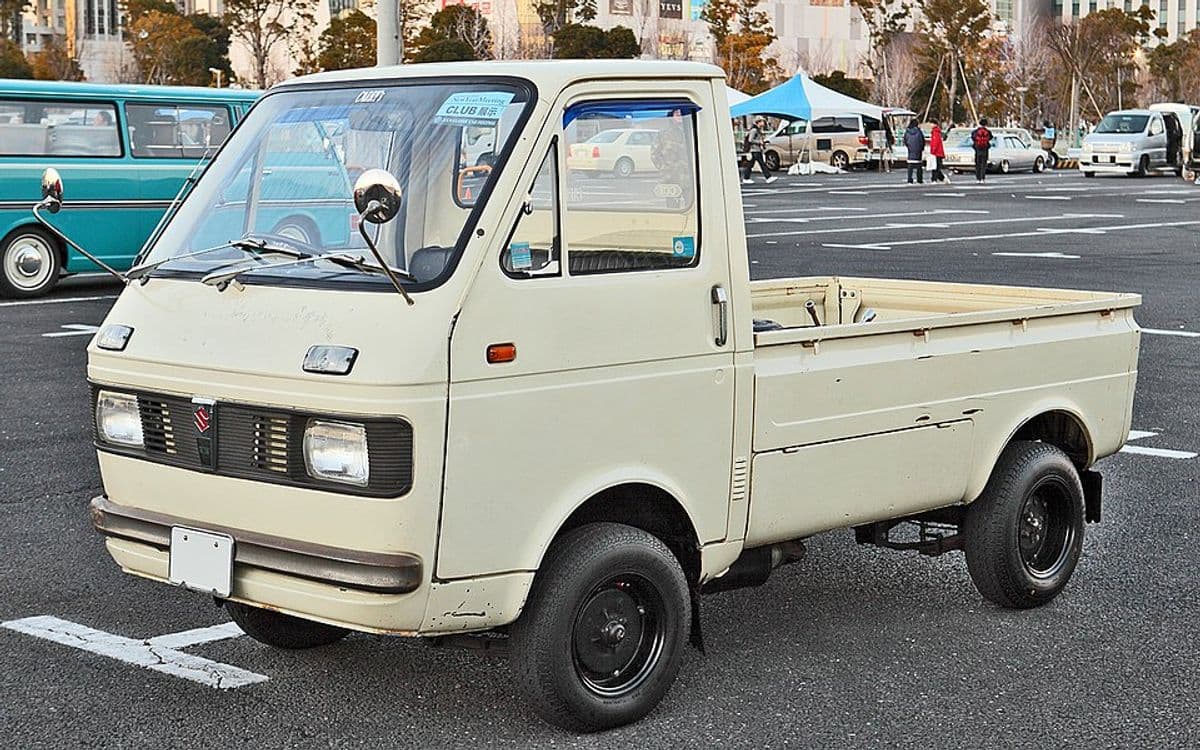
Suzuki Carry
1969-Present
Hill Country heat, Gulf humidity, and Texas distances reward the truck with the deepest parts pipeline. The Carry is the most imported kei truck in the US, AC parts are plentiful, and the factory dump bed earns its keep on a ranch faster than any other kei configuration.
Across the state line
Get the weekly kei truck brief
Law changes, price drops, new models, and build inspiration. One email a week.