2026 Mazda Scrum Truck Gets the Carry's Facelift, Undercuts It on Price
Mazda just refreshed its Scrum Truck for the first time in 13 years. Same Suzuki Carry bones, sharper face, modern safety tech, and a lower starting price. Here's why the cheapest badge on the platform might be the smartest buy.

Advertisement
TL;DR: The 2026 Mazda Scrum Truck is the same Suzuki Carry facelift wearing a different badge, but it starts at roughly $8,000, undercutting the Carry at entry level. Same 658cc engine, same Dual Sensor Brake Support II safety suite, same 4WD system. For US import shoppers, Scrums have always been the overlooked bargain at Japanese auctions. That dynamic just got more interesting.
The Mazda Scrum is the kei truck world's best kept secret, and Mazda seems perfectly fine with that. On February 12, 2026, the company quietly announced its first major Scrum Truck update in 13 years. No press conference. No flashy reveal. Just an updated spec sheet and a call to dealers. The truck showed up on lots the same week, and according to Kuruma News, dealership inquiries started climbing immediately, especially around the improved fuel economy and safety features.
That understated rollout is perfectly on brand. The Scrum has always operated in the shadow of the Carry, which makes sense given that it is, mechanically, the exact same vehicle. But shadows can be useful when you are shopping for a deal.
One Truck, Three Badges
If you are new to kei trucks, here is how Japan's light commercial vehicle market actually works. Suzuki builds the Carry at its Shizuoka plant. That same truck rolls off the line wearing three different badges for three different dealer networks: the Suzuki Carry, the Nissan Clipper, and the Mazda Scrum. Same chassis. Same engine. Same wiring harness. The only differences are the front badge, some minor trim details, and the price.
This OEM supply arrangement has been running since 1989, when Mazda first launched the Scrum through its Autozam sub brand during Japan's economic bubble. When the bubble popped and Ford took control of Mazda, the sub brands died but the Scrum survived. Thirty seven years later, it is still in production, still a Carry in everything but name.
The Nissan Clipper follows the same formula. Nissan stopped building its own kei trucks years ago and sources everything from Suzuki and Mitsubishi. So when Suzuki updates the Carry platform, as it did in early 2026, the refresh cascades to all three brands within weeks.
What Changed on the 2026 Scrum
Everything that changed on the Suzuki Carry facelift applies here, because it is the same truck. But for completeness:
The front end is the most visible upgrade. Slimmer LED headlights with darkened internals replace the old round ish units that have defined this platform since 2013. A new grille and revised front bumper sharpen the face considerably. Mazda describes the look as "more masculine," which is generous for a vehicle that weighs about 1,700 pounds. A new Moss Grey Metallic color option joins the palette.
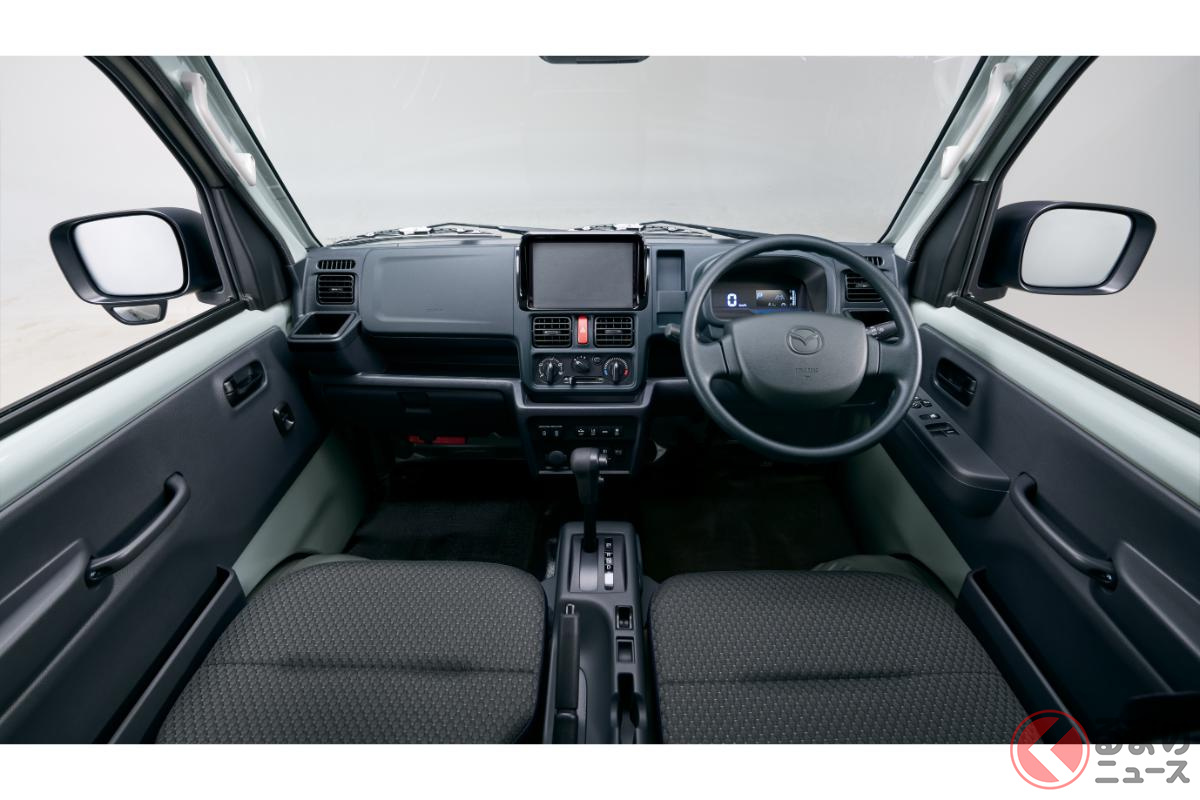
Inside, the dashboard gets a proper refresh. All trims now feature a digital instrument cluster, and the top spec KX grade adds piano black center garnish with chrome accented air conditioning louvers. There is no standard infotainment screen, but a seven or eight inch unit can be fitted as an option. New practical touches include a smartphone tray and cupholders beneath the air vents.
The real upgrade is safety. The entire 2026 Scrum lineup comes standard with Suzuki's Dual Sensor Brake Support II, a system that combines a monocular camera with millimeter wave radar. It detects cars, pedestrians, cyclists, and motorcycles, and can intervene at intersections during turns. Additional standard equipment includes front and rear parking sensors, low speed forward brake support, lane departure prevention, sign recognition, and a traffic light change notification that nudges you when the light turns green. As NHTSA aligned international safety standards push even commercial vehicles toward more electronics, this is the new baseline.
The Scrum's Pricing Advantage
Here is where the badge engineering story gets genuinely interesting for buyers. The 2026 Mazda Scrum Truck starts at ¥1,127,600 (roughly $8,000) for the base KC two wheel drive manual. The equivalent Suzuki Carry KC starts at ¥1,172,600 ($7,500 at current exchange rates). Depending on when you check the yen to dollar conversion, the Mazda can be slightly cheaper at the entry level in yen terms.
The Scrum Truck lineup tops out at ¥1,634,600 (about $10,700) for the KX four wheel drive automatic. Across the range, Mazda reorganized its grades from the old KC/KC Safety Package/KX structure to three cleaner tiers: KC, KC Nouhan, and KX. The "Nouhan" designation translates roughly to "farming busy season" and is a trim specifically configured for agricultural work. That designation resonates deeply in Japan's rural prefectures where these trucks are essential equipment.
For comparison, the Suzuki Carry tops out higher thanks to the Super Carry extended cab variant and the X Limited special edition, which push the ceiling to ¥1,800,700 ($11,500). The Bring a Trailer crowd would probably love the X Limited's black out treatment and bold SUZUKI lettering, but Mazda does not offer an equivalent trim. If you want the extra cab space or the lifestyle styling, the Carry or Clipper is your play.
Why This Matters for US Import Shoppers
You cannot legally register a 2026 Scrum in the United States. The 25 year import rule means these facelifted trucks will not be eligible until 2051. But the refresh still matters for the US kei truck market in three tangible ways.
First, parts production. When Suzuki invests in a platform update, it signals continued commitment to the architecture. The DA16T chassis underpinning the Carry, Scrum, and Clipper will remain in production for years, which means replacement parts for older models on the same platform will stay available through suppliers like Amayama and Oiwa Garage.
Second, auction pricing dynamics. When Japanese domestic buyers upgrade to the 2026 model, their older Scrums hit the used market. And here is the thing about Scrums at auction: they consistently sell for less than equivalent Carrys. Japanese buyers have brand preferences, and Suzuki's dealer network is larger and more trusted for commercial vehicles. A 2010 Scrum with identical mileage and condition to a 2010 Carry will often sell for ¥30,000 to ¥50,000 less at USS auctions. US importers who understand that a Scrum is a Carry can exploit that gap.
Third, the safety tech trajectory. The 2026 refresh standardized automatic emergency braking, parking sensors, and lane departure warnings across every grade, including the cheapest work truck trim. That is a far cry from the zero electronic safety aids on the 1990s models currently being imported to the US. When these 2026 trucks eventually become importable, they will arrive with a safety package that competes with modern American vehicles. Until then, if you are buying a pre-purchase checklist era Carry or Scrum from the early 2000s, know that aftermarket safety additions like backup cameras and blind spot mirrors are worth the investment.
Specs at a Glance
| Specification | Detail |
|---|---|
| Engine | 658cc R06A 3-cylinder, naturally aspirated |
| Power | 50 hp / 59 Nm (44 lb ft) |
| Transmission | 5-speed manual or 4-speed automatic |
| Drivetrain | RWD or part-time 4WD (with diff lock) |
| Fuel economy | 19.6 km/L (46 mpg) WLTC best |
| Dimensions | 3,395 x 1,475 x 1,765 mm |
| Bed size | 2,030 mm floor length x 1,410 mm width |
| Turning radius | 3.6 m (11.8 ft) |
| Ground clearance | 273 mm (10.7 in) |
| Payload | 350 kg (772 lbs) |
| Price range | ¥1,127,600 to ¥1,634,600 ($8,000 to $10,700) |
The Scrum vs the Carry vs the Clipper: Which Badge Do You Pick?
If you are importing a used kei truck to the US, the honest answer is: whichever one is cheapest with the best condition report. The Suzuki Carry has the strongest name recognition, the widest parts network, and the highest resale in the US market. The Mitsubishi Minicab and Daihatsu Hijet compete on a completely different platform. But within the Suzuki ecosystem, the Scrum and Clipper are identical trucks that auction lower purely because of badge bias.
For anyone shopping through a dealer or directly at Japanese auction, search for all three model codes. On the DA16T platform (2013 onward), the Carry is model DA16T, the Scrum Truck uses the same designation but is listed under Mazda, and the Clipper uses Nissan's DR16T code. Same truck, same parts, different sticker on the steering wheel. The r/keitruck community regularly confirms this cross compatibility, and if someone posts a fix for a Carry, it works on a Scrum.
The Bottom Line
The 2026 Mazda Scrum Truck refresh is not a new truck. It is a better version of a truck that has been proving itself for over a decade, wearing the badge of a company that would rather let the product speak than throw a launch party. Meanwhile, Toyota and Daihatsu showed off custom kei trucks at Tokyo Auto Salon 2026 as part of a very different kind of brand exercise. The safety upgrades bring the platform into the modern era, the interior improvements address years of neglect, and the pricing undercuts its Suzuki sibling at the entry level.
For US kei truck enthusiasts, the takeaway is simple: if you spot a Scrum at auction or at an importer and the price is right, do not overthink the badge. You are getting a Carry. Every wrench fits, every part crosses over, and your mechanic will never know the difference. The Mazda Scrum has been the smartest value play in kei trucks for 37 years. This refresh just gave that argument better headlights and automatic emergency braking.
Advertisement


