2026 Daihatsu Hijet Upgrade: Smart Assist Gets Smarter After the Scandal
Daihatsu just upgraded the Hijet Truck with expanded Smart Assist safety tech and standard LED headlights. After a certification scandal that shut down production for months, this is more than a spec bump. It is a statement.

Advertisement
TL;DR: Daihatsu upgraded the Hijet Truck on March 19, 2026, with expanded Smart Assist collision avoidance that now detects bicycles, oncoming vehicles at intersections, and pedestrians crossing from the far side. LED headlights with adaptive driving beam are now standard on the Extra grade. The KF engine and chassis are unchanged. For US buyers of imported Hijets, this signals that Daihatsu is back to business after the certification crisis and the platform has years of life left.
Two years ago, Daihatsu was in ruins. A certification fraud scandal had exposed 174 testing irregularities across 64 models, shuttered every factory in Japan for months, and forced the company's president and chairman to resign. Toyota, Daihatsu's parent company, took over model certification entirely. The financial damage was a ¥5 billion operating loss: Daihatsu's first in over three decades.
So when Daihatsu quietly announced a partial upgrade to the Daihatsu Hijet Truck on March 19, 2026, the news carried weight that transcends LED headlights and sensor calibrations. This is a company that needed to prove it could build vehicles people can trust again. And the Hijet, with cumulative production north of 4.85 million units since 1960, is the vehicle that carries that burden.
What Daihatsu Actually Changed
The headline upgrade is an expansion of the Smart Assist active safety system. Previous versions of the Hijet's Smart Assist could detect vehicles and pedestrians in front of the truck. The 2026 update adds three new detection scenarios that address the most dangerous situations for a kei truck operating in tight Japanese urban environments.
First, the system now detects bicycles crossing the road ahead. In Japan, where cycling infrastructure is woven into nearly every residential street, bicycle collisions are a leading cause of minor commercial vehicle accidents. The Hijet's compact dimensions and cab over design mean the driver is sitting directly above the front wheels with limited forward visibility at low speeds. A bicycle appearing from behind a parked car is exactly the scenario where automatic emergency braking saves lives.
Second, Smart Assist now monitors for oncoming vehicles during right turns at intersections. In Japan, where vehicles drive on the left, right turns require crossing oncoming traffic, which is the same geometry as an American left turn. The system uses its camera and radar to detect vehicles approaching from the opposite direction and intervene if the driver initiates a turn into their path.
Third, the system detects pedestrians crossing from the far side during turns. This is the blind spot that kills people: a pedestrian stepping off the far curb while the driver is focused on traffic flow. The Hijet's tall, narrow cab makes this particularly challenging to spot visually, and the new sensor coverage addresses it directly.
These are not gimmicks. Japan's Ministry of Land, Infrastructure, Transport and Tourism has been tightening commercial vehicle safety requirements steadily since 2020, and kei trucks, which historically shipped with minimal electronic aids, have been playing catch up. Daihatsu delivering these features on a working truck that starts under $9,000 is genuinely impressive.
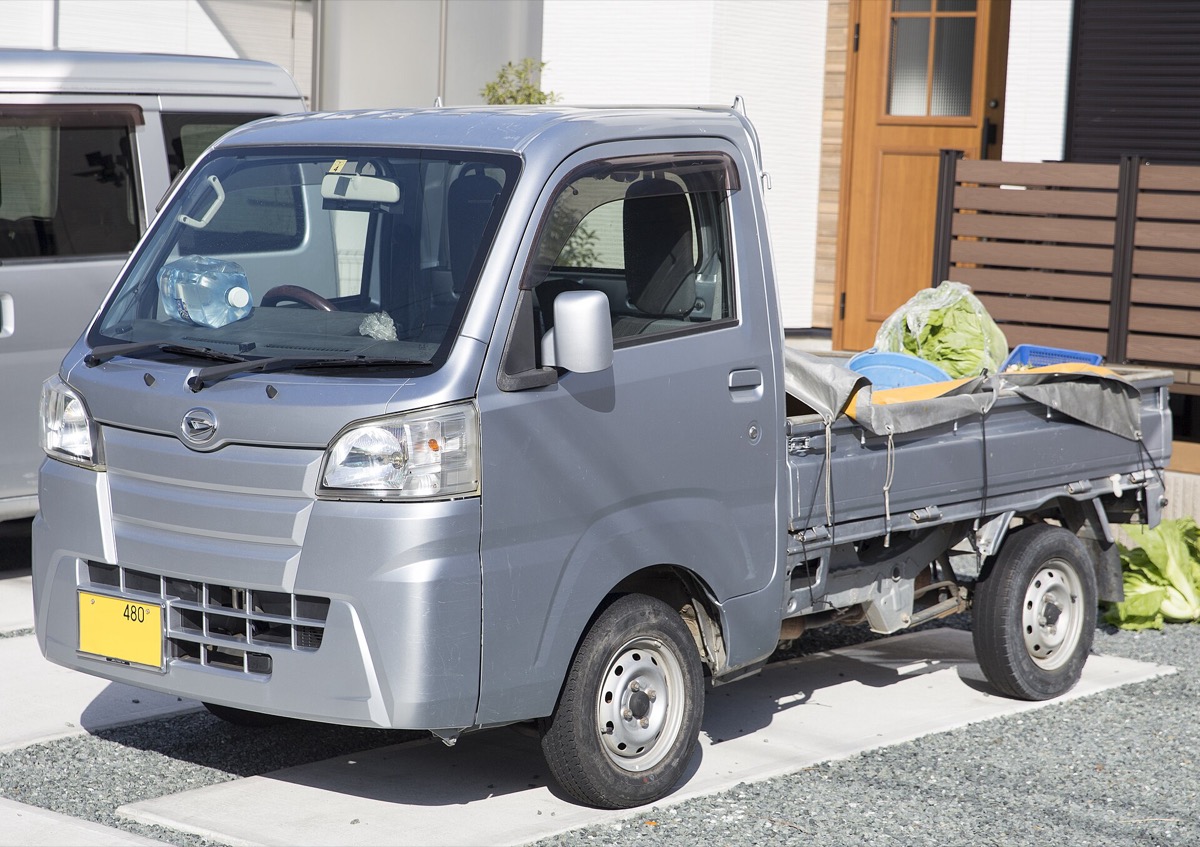
LED Headlights and Adaptive Beam Go Standard on Extra
Beyond the Smart Assist expansion, Daihatsu made LED headlights, adaptive driving beam (ADB), and side view lamps standard equipment on the Extra grade. The Extra is the higher trim level aimed at buyers who want a bit more comfort from their daily work truck.
Adaptive driving beam automatically adjusts the headlight pattern to avoid blinding oncoming drivers while maintaining maximum illumination everywhere else. It is a feature that was exclusive to luxury cars five years ago and is now standard on a truck that weighs less than 1,800 pounds. The side view lamps illuminate the area beside the truck during low speed turns, which is a practical upgrade for drivers who load and unload in dark agricultural environments or construction sites before dawn.
The base trim keeps halogen headlights, which is fine for a truck destined for daytime agricultural work. But for anyone driving to and from job sites on unlit rural roads (which describes most kei truck owners in the US), LED headlights are a meaningful safety upgrade. If you are shopping for LED upgrades on an older Hijet, aftermarket kits are available through suppliers like Megazip that cross reference Daihatsu part numbers.
Under the Seat: Same KF Engine, Same Reliability
Daihatsu did not touch the powertrain. The Hijet continues with the KF series 658cc DOHC three cylinder engine producing approximately 53 horsepower and 47 lb ft of torque. Transmission options remain a five speed manual and a CVT automatic, with rear wheel drive standard and part time four wheel drive with a transfer case available.
That is not a criticism. The KF engine family has been in production since 2006 and has earned a reputation for durability that rivals the Suzuki Carry's R06A. The DOHC valvetrain with Daihatsu's DVVT variable valve timing system delivers better fuel economy and smoother power delivery than the older EF series engines found in pre-2000 Hijets. For anyone still on the fence between the two generations, our pre purchase checklist covers what to look for on both.
The Hijet's four wheel drive system remains a part time setup with a manually engaged transfer case and selectable low range. Combined with a wheelbase shorter than most ATVs and roughly 270mm of ground clearance, the 4WD Hijet is genuinely capable on unpaved roads, muddy farm paths, and the kind of terrain that makes it such a popular alternative to a UTV for property owners.
How the Hijet Stacks Up Against the 2026 Carry and Minicab
The Hijet upgrade arrives at the tail end of a refresh wave that has swept across every major kei truck platform in Japan. The Suzuki Carry got its first facelift in 12 years in January 2026, bringing LED headlights and its Dual Sensor Brake Support II system with autonomous emergency braking. The Nissan Clipper, a rebadged Carry, followed with identical hardware. The Mitsubishi Minicab added its own forward collision mitigation and lane departure prevention around the same time. Even the Nissan Clipper Truck got a matching safety suite.
The Subaru Sambar also received the same Smart Assist upgrade days after the Hijet, which makes sense since it is a rebadged Hijet. Subaru skipped the turbo option, though, so the Hijet retains an edge on power.
The common thread across all of them is safety technology that would have been unthinkable on a kei truck a decade ago. Automatic emergency braking with pedestrian detection. Lane departure prevention. Road sign recognition. These trucks that used to ship without ABS now have more active safety features than many full size pickups sold globally.
Where the Hijet distinguishes itself is in its independence from the Suzuki/Nissan/Mazda OEM supply chain. While the Carry, Clipper, and Scrum are all literally the same truck wearing different badges (built by Suzuki and rebadged for each dealer network), the Hijet is a Daihatsu original. Different chassis, different engine family, different engineering philosophy. The Toyota connection means some components cross reference with Toyota's global parts catalog, which is a real advantage for US owners sourcing maintenance items through Oiwa Garage or Amayama.
The Hijet is also one of the few kei trucks available with a factory jumbo cab option, which extends the cabin roof rearward for additional headroom. For taller American buyers who find standard kei truck cabs claustrophobic, the jumbo cab Hijet has always been the answer.
The Scandal Elephant in the Room
You cannot write about a 2026 Daihatsu product without addressing what happened in 2023. An independent investigation found that Daihatsu had been manipulating safety certification test data across decades, including crash test results and door latch performance data. The Japanese government revoked certifications. All domestic production stopped from December 2023 through May 2024. The company posted its first operating loss since 1992.
The fallout was severe but also, arguably, exactly what Daihatsu needed. Toyota installed new leadership. Certification authority moved to Toyota's oversight. Every model in production was retested and recertified under the new process. The company has been transparent about the changes, and the Japanese government has been watching closely.
Does this mean every Hijet rolling off the line in 2026 is safe? The engineering says yes. The recertification process was thorough, and Toyota's quality control infrastructure is one of the strongest in the automotive industry. But trust takes time, and Daihatsu knows that every model update, every safety feature added, every production milestone hit without incident is a brick in rebuilding their reputation.
For US buyers of older imported Hijets, the scandal has a silver lining. Daihatsu is working harder than ever to demonstrate quality and commitment to the platform. That translates directly into continued parts production, engineering resources, and the kind of institutional investment that keeps a 66 year old nameplate alive and relevant. The electric kei van program that Toyota and Daihatsu co-developed is further evidence that the Hijet platform has a very long runway ahead.
What This Means for US Kei Truck Buyers
You cannot buy a 2026 Hijet in the United States. The 25 year import rule means the newest Hijets legally importable today are from 2001, and even those are on the edge. The Hijet models dominating US inventory right now are from the 1990s, powered by the older EF series engines.
But new model updates in Japan have a direct impact on US kei truck ownership in three ways.
First, continued production means continued parts manufacturing. When Daihatsu updates the Hijet and keeps it on sale in Japan, all the shared components between generations, from oil filters to timing chains to wheel bearings, stay in active production. That availability flows downstream to the parts suppliers that US owners rely on for maintenance. Our parts sourcing guide covers the best suppliers.
Second, platform investment signals longevity. A manufacturer does not spend engineering resources on Smart Assist upgrades and LED headlight integration for a product line it plans to discontinue. The Hijet's 4.85 million unit production run and its continued development tell you this platform will be around for a long time, which supports resale values on older imported models.
Third, the 2026 safety tech revolution across all kei truck makers is generating mainstream automotive press coverage that raises awareness of the vehicle class. Stories in The Drive, Hagerty, and other outlets introduce kei trucks to audiences who have never heard of them. That growing awareness fuels demand, community growth, and the kind of aftermarket investment that makes owning a kei truck in America easier every year. If you are exploring the dealer directory, you will notice the network keeps expanding.
Oregon's latest attempt to legalize kei trucks for road use may have died in committee last week, but the broader trend is clear: more states are allowing registration, more dealers are stocking inventory, and more manufacturers are investing in the platforms that feed the US import pipeline. Check our state legality guide for the current status where you live.
The Bottom Line
The 2026 Daihatsu Hijet upgrade is a modest spec bump on paper: better collision avoidance sensors, standard LEDs on the nicer trim, same engine, same bed, same 660cc kei truck formula that has worked for 66 years. But context matters. This update comes from a company that was flat on its back two years ago, rebuilding trust one vehicle at a time under Toyota's watchful eye. Every unit that ships clean, every safety feature that works as advertised, every quarter without a recall is Daihatsu earning back what it lost.
For the American kei truck community, the message is simple. The Hijet is not going anywhere. The platform is getting safer, the parts pipeline is secure, and the institutional commitment behind this vehicle is stronger than it has been in years. Whether you are shopping for a 1995 Hijet at auction on Goo-net Exchange or already running one on your property with a set of off road mods, the 2026 update is good news.
Advertisement


