Daihatsu Copen Production Ends This Week: Japan Just Lost Its Last Kei Sports Car
Daihatsu ends Copen production at the end of August 2026 after 24 years and roughly 110,000 cars. The last kei sports car in production is gone. Here is why it died, what happens at the August 31 farewell, and why the original L880K suddenly matters to American importers.

Advertisement
TL;DR: Daihatsu builds its last Copen this week. Production of the little 660cc convertible ends at the end of August 2026, closing out 24 years and roughly 110,000 cars across two generations. On August 31 the company is throwing a farewell event at the Ikeda factory where the final car rolls off the line, then the Copen moves into a museum on September 1. With the Honda S660 already dead since 2022, Japan now builds zero kei sports cars. For Americans, there is a silver lining: the original 2002 Copen L880K starts clearing the 25 year import rule in mid 2027.
The kei sports car is extinct. Not endangered, not on hiatus, extinct. Sometime this week a worker at Daihatsu's Ikeda plant will torque the last bolt on the last Copen, and for the first time since the early 1990s golden era of the Cappuccino, Beat, and AZ-1, no factory in Japan will be building a sports car in the 660cc class.
Daihatsu announced the decision back in September 2025, but the actual end lands now, at the end of August 2026. If you have spent any time around kei vehicles, this one stings. The Copen was the proof that the same regulatory box that gives us the $7,000 Daihatsu Hijet work truck could also produce something with a folding roof and a redline worth chasing.
What Daihatsu Announced, and the Number That Explains It
The official line is straightforward. In its press release, Daihatsu confirmed that production of the current model Copen ceases at the end of August 2026, while stressing that it is "continuing various research to bring the COPEN back to the market." That is corporate speak for: the car is dead, the nameplate is not, and nobody is promising anything.
The more revealing detail came from Japanese wire service coverage. According to Jiji Press, the decision was made "due to reasons including a regulatory issue," and total Copen sales reached about 110,000 units as of the end of August 2025.
Sit with that number for a second. Twenty three years of production, two generations, and 110,000 cars. That is under 5,000 a year on average. Suzuki moves more Carry trucks than that in a couple of months. The Copen was never a volume product; it was a passion project that survived inside a company that mostly builds vans, trucks, and grocery getters. Passion projects survive until the accountants and the regulators show up in the same meeting.
24 Years, Two Generations, One Party Trick
The Copen earned its cult following the day it launched in June 2002 with a genuine world first for the class: the Active Top, an electrically operated retractable hardtop on a kei car. Press a button and the roof folded itself into the trunk, on a car shorter than a modern Mini. Nothing else in the 660cc world did that. The original L880K paired that party trick with the JB-DET, a 659cc DOHC turbocharged four cylinder making the class capped 64 PS, sent through a 5 speed manual or 4 speed automatic to the front wheels. At around 830 kg, it did not need more.
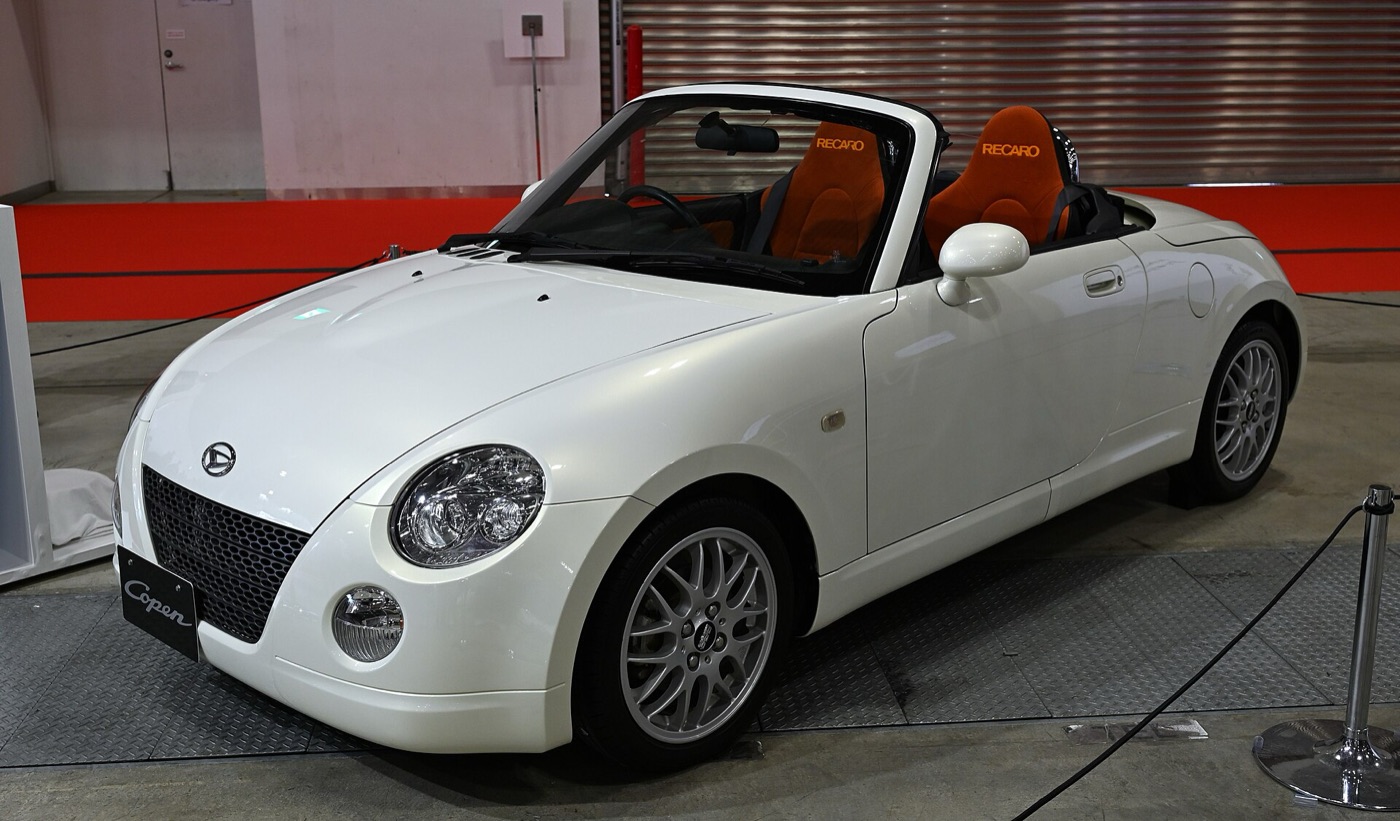
The first generation ran a full decade, ending in 2012. Daihatsu revived the car in 2014 with the second generation LA400K, built on a new D-Frame structure that let the company hang different body panels on the same chassis. That is how you got the retro faced Cero, the sharper Robe, and the chunky XPLAY out of one car. A three cylinder KF turbo replaced the old four, still pegged at 64 PS because the kei class power ceiling never budged.
The surprise late chapter was the GR Sport, developed with Toyota's motorsport arm and sold through Toyota dealers. A Toyota badged kei roadster was not on anyone's bingo card, and it introduced the Copen to buyers who had never set foot in a Daihatsu showroom. It was not enough to save the car, but it made the final lineup of Robe, Cero, and GR Sport the best the Copen ever was.
Why the Copen Actually Died
Blame a pile up of small pressures rather than one killer. The "regulatory issue" Jiji cited is the same force we covered in the 2026 kei safety tech overhaul: Japan keeps ratcheting up active safety and compliance requirements, and retrofitting a low volume 2014 platform to meet them costs real engineering money. Spread that cost over 5,000 cars a year and the math dies on the whiteboard.
Then there is the segment itself. As CarBuzz noted in its coverage, Daihatsu is at least studying whether the roadster can return someday. But the market for tiny, affordable, fun cars has been evaporating for years. Honda killed the S660 in 2022 when its platform hit the same regulatory wall. The Mazda MX-5 only survives because it sells globally. The Copen sold in one country, in one shrinking niche, in an era when Japanese buyers are migrating to tall kei wagons and, increasingly, to electric kei vehicles like the ones shaking up the market in the BYD Racco story.
The Copen was the last holdout, and holdouts eventually run out of exemptions.
The Farewell: OPEN FUTURE DAY and a Museum Spot
Give Daihatsu credit: they are not letting the car slip away quietly. The company has been running gratitude events nationwide since April 2026 through its official Copen special site, and the finale lands on August 31 with an event called OPEN FUTURE DAY at the Ikeda factory itself.
The format is genuinely cool. Fifty Copen owners, chosen by lottery from applications taken in July, pay ¥3,000 apiece to stand on the factory floor and watch the final Copen roll off the line, with footage tracing that last car's journey through production. Everyone else gets a YouTube livestream. Then on September 1, the Humobility World museum at Daihatsu headquarters opens a Copen exhibition, moving the car from the price list to the display pedestal in a single day.
Compare that to how most discontinued cars die, with a quiet fleet order and a press release nobody reads. Daihatsu is giving a 64 horsepower convertible a state funeral. That tells you what the car meant internally.
The Import Angle: The L880K Turns 25 Next Year
Here is where this stops being a eulogy and starts being actionable for Americans. The original Copen launched in June 2002, which means the earliest L880K cars start clearing the federal 25 year exemption in mid 2027. Under NHTSA import rules, a vehicle 25 years or older can enter the country without meeting federal motor vehicle safety standards, the same pathway every kei truck in America came through.
A dead nameplate plus a farewell museum exhibit plus fresh import eligibility is a textbook recipe for price appreciation. We have watched this movie with other JDM icons, and specialist guides are already noting that clean L880K values are firming ahead of the 2027 window. If a Copen is on your list, the playbook is the same one from our kei truck import guide: the process, the customs forms, and the broker math are identical whether the cargo is a farm truck or a roadster. Auction platforms like Goo-net Exchange list Copens year round, and established importers such as Duncan Imports already move kei sports cars alongside their truck inventory.
Two cautions before you wire money to Japan. First, check your state. A kei roadster faces the same DMV chaos as a kei truck in the wrong state, and our state legality guide maps exactly which states will plate a kei vehicle without a fight. Second, inspect like it is your job. Early Copens are old enough to rust, the Active Top mechanism has hydraulic components that age poorly, and a seized roof is a four figure repair. Our pre purchase checklist applies almost line for line.
What This Means for the Kei Market
Zoom out and the Copen's death fits a pattern we flagged in our mid 2026 market report: Japan's kei segment is consolidating hard around commercial workhorses and electrified daily drivers, and everything that does not pay rent is getting cut. The quirky stuff, the fun stuff, the low volume stuff is being regulated and cost engineered out of existence.
For American enthusiasts, that has a strange consequence. The 25 year pipeline means the US market is always importing Japan's past, and Japan's past just got objectively cooler than its present. The trucks keep coming, but from 2027 onward the pipeline starts delivering Japan's last affordable sports cars too: S660s in 2040 is a long wait, but L880K Copens land next year. Communities like r/keitruck are already broader than the name suggests, and expect the kei car side of the hobby to grow fast once round headlight Copens start showing up at import lots. If you want to know why these tiny machines inspire this much attachment in the first place, start with what makes a kei vehicle a kei vehicle and work forward from there.
And keep an eye on auction results. Sites like Bring a Trailer have shown repeatedly that fresh 25 year eligibility plus a discontinued badge equals bidding wars. The Copen has both boxes checked as of this week.
The Bottom Line
The last kei sports car dies this week after 24 years and about 110,000 cars, killed by regulations and math rather than by anyone falling out of love with it. Daihatsu says it wants to bring the Copen back someday, and maybe an electric version eventually makes the business case work. Do not hold your breath.
The practical takeaway for Americans: the original L880K Copen becomes legally importable starting mid 2027, prices are already moving, and the smart buyers are lining up funds and shortlisting cars now. Keep an eye on valuation trackers like Hagerty once the first cars land, because discontinued JDM icons rarely stay cheap for long. The little roadster with the folding roof is about to have a very loud second life on this side of the Pacific.
Advertisement


