BYD Racco: China Just Cracked Japan's Kei Car Fortress
BYD launched the Racco kei EV in Japan on July 28 at $13,100 and pulled 1,002 orders in two weeks. It is the first foreign kei car that has ever actually sold. Here is why the most protected vehicle segment on earth just got breached, and what it means for kei truck fans.

Advertisement
TL;DR: On July 28, 2026, BYD launched the Racco, a kei class EV built specifically for Japan, priced from ¥2,145,000 ($13,100). It pulled 1,002 orders in its first two weeks, the fastest start of any BYD model in Japan, and 80 percent of buyers picked the most expensive trim. Japan's subsidy system still makes a Nissan Sakura cheaper on the road, but the fortress that Suzuki, Daihatsu, and Honda have defended for nearly eight decades finally has a foreign vehicle inside the walls. Kei truck buyers should pay attention, because the commercial kei segment is the obvious next target.
For 77 years, the kei class has been the most protected vehicle segment on the planet. Since Japan created the category in 1949, exactly one foreign automaker has ever managed to put a kei car into series production, and that attempt was such a flop that most people have never heard of it. Kei vehicles make up roughly 40 percent of new vehicle sales in Japan, and effectively 100 percent of them have always been Japanese.
That streak ended on July 28.
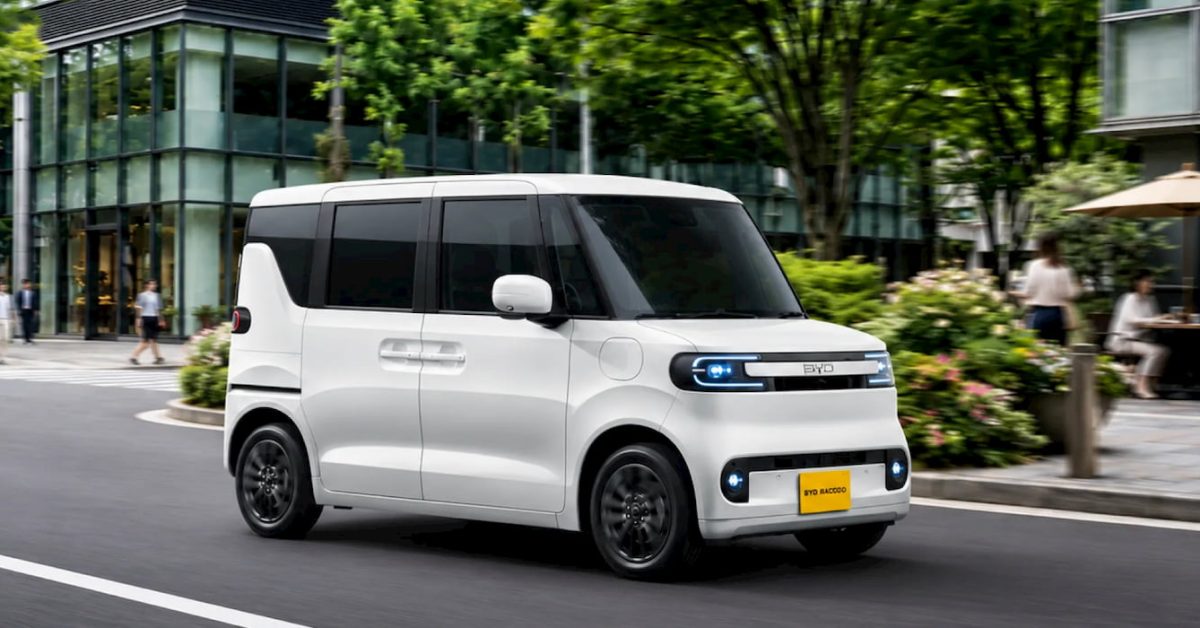
BYD, the Chinese giant that already outsells Tesla globally, launched the Racco: a super tall kei wagon with sliding doors, a Blade battery, and a sticker price that undercuts the Nissan Sakura by ¥300,000. Two weeks later it had more than 1,000 orders, the fastest start of any BYD model ever sold in Japan. If you care about kei trucks, this is the most important story of the summer, even though the Racco is not a truck. Here is why.
The Fortress Nobody Ever Breached (Except Daimler, Once, Badly)
The kei class is not a size category. It is a legal moat. To qualify for the yellow plates, a vehicle must fit inside a box no bigger than 3.4 meters long and 1.48 meters wide, with an engine capped at 660cc (or an electric motor capped at 47 kW) and output limited to 64 PS. In exchange, owners get lower road tax, cheaper insurance, cheaper shaken inspections, and in rural areas an exemption from proving they own a parking space. The full history is worth a read on the Wikipedia kei car entry, but the practical result is simple: the rules are so specific to Japan that no foreign automaker ever bothered to engineer for them.
One tried. In October 2001, DaimlerChrysler squeezed the Smart Fortwo into kei dimensions with narrower fenders and skinnier tires and sold it as the Smart K, which the company proudly billed as the first kei car from an imported brand at the 2001 Tokyo Motor Show. Japanese buyers shrugged. Production ended in 2004. For the next 22 years, the lesson stood: foreigners do not sell kei cars in Japan.
BYD looked at that history and decided the lesson was wrong. The Racco is not an adapted European city car. It is a ground up, Japan only model that BYD has no plans to sell in China, designed around the exact formula Japanese families actually buy: the super tall wagon with power sliding doors, the same recipe that makes the Honda N-Box the best selling vehicle in the country.
What ¥2.145 Million Actually Buys
The Racco lineup is three trims on one 47 kW front motor making 160 Nm of torque, right at the kei power ceiling.
| Trim | Price (tax included) | Battery | WLTC Range |
|---|---|---|---|
| Racco 200 | ¥2,145,000 ($13,100) | 22.4 kWh LFP | 210 km (130 miles) |
| Racco 300 Plus | ¥2,398,000 ($14,600) | 35.84 kWh LFP | 320 km (199 miles) |
| Racco 300 Premium | ¥2,497,000 ($15,200) | 35.84 kWh LFP | 320 km (199 miles) |
The headline number is that 320 km range. As CnEVPost reported from the launch, that makes the Racco the first kei EV in Japan to break the 300 kilometer mark. The Nissan Sakura, Japan's best selling EV, manages 180 km. The Racco also brings the segment's first power sliding doors on an electric kei, opened with a kick sensor, plus V2L power output, battery preconditioning, 50 kW DC fast charging, six airbags, and four wheel disc brakes, which is genuinely rare in a class where rear drums are standard equipment.
BYD is also leaning hard on software. The company calls the Racco the world's first SDV based light EV, meaning the whole car takes over the air updates like a smartphone. Electrek's launch coverage notes the base car gets a 10.1 inch touchscreen and a digital cluster, in a segment where the cheapest trims usually ship with a radio and a shelf. Roughly 90 percent of the components, battery and motor included, are built in house by BYD. That vertical integration is exactly how the company hits a $13,100 sticker on a car with a bigger battery than rivals charging $15,000.
The Subsidy Wall Japan Built Around Its Champions
Before anyone declares the Japanese kei industry dead, look at the fine print, because Tokyo has a second moat behind the first one. Japan's EV subsidies are not flat. The METI scoring system weighs local manufacturing, battery sourcing, charging network investment, and disaster response capability, and it just happens to award domestic brands the maximum ¥580,000 while imports like BYD qualify for the basic ¥150,000. As Carscoops broke down, a Tokyo buyer stacking national and municipal subsidies can get into a Racco for about ¥1,545,000, but a Sakura drops to roughly ¥1,298,600.
So the car with the lowest sticker price in the segment is not the cheapest one on the road. The Racco wins on range, equipment, warranty (eight years on the battery, extendable to ten), and price per spec. The Japanese incumbents win on the actual out the door number, courtesy of a scoring rubric their government wrote. Sound familiar? It is the same flavor of regulatory home cooking as the American 25 percent chicken tax, just executed with more paperwork and less shouting.
The gas powered competition is a different fight entirely. A base Honda N-Box starts at ¥1,739,100 with no subsidy needed, and Honda moves close to 200,000 of them a year. BYD is not trying to beat that today. It is trying to own the electric slice of the segment before the incumbents wake up, and against the Sakura, the Mitsubishi eK X EV, and the ¥2.7 million Honda N-ONE e:, per pricing comparisons at Paul Tan, it has a real case.
1,002 Orders in Two Weeks: Breakthrough or Rounding Error?
Both, honestly, and the honest version is more interesting than either headline.
According to a Nikkei report covered by CnEVPost on August 10, the Racco logged 1,002 orders between July 28 and August 9, beating BYD's internal target of 1,000 in the first two weeks. For scale, BYD sold 3,870 total passenger vehicles in Japan in all of 2025. One model just did a quarter of that volume in fourteen days. It is the fastest order pace of any BYD model in the Japanese market, and the company is targeting 10,000 orders by the end of 2026, backed by a dealer expansion from about 80 stores to 100 by year end and 120 by the end of 2027.
The trim mix is the tell. A full 80 percent of buyers ordered the top spec 300 Premium, 14 percent took the 300 Plus, and just 6 percent took the base 200. Japanese kei buyers are not cross shopping the Racco as a penalty box. They are optioning it up like a family flagship. If you want to see what that 80 percent are actually getting, the first detailed Racco test drive puts the 300 Premium under the microscope for 48 minutes. And the buyer breakdown (37.5 percent adding a car to the household, 35.7 percent replacing one, 26.8 percent first time buyers) says the Racco is pulling from the mainstream kei replacement market, not just early adopter EV nerds.
Now the cold water: 1,002 orders in a segment that moves well over a million units a year is a rounding error. Suzuki, Daihatsu, and Honda control about 80 percent of the minicar market per Bloomberg Intelligence, and none of them will lose a minute of sleep over August's numbers. The story is not the volume. The story is that the door is open, the product is competitive, and a second Chinese automaker, Chery, is already lining up its own kei car for Japan. Meanwhile the incumbents are pruning their own ranks: Daihatsu builds its final Copen this August, a reminder that the segment is consolidating around workhorses and EVs while everything else gets cut.
Why Kei Truck People Should Actually Care
The Racco is a passenger wagon, so it is fair to ask what any of this has to do with the Suzuki Carry sitting in your driveway. Three things.
First, the commercial kei segment is the obvious next target. Japan already proved the demand when Toyota, Daihatsu, and Suzuki launched their electric kei vans this year at roughly triple the price of their gas equivalents. BYD just demonstrated it can build a kei class EV with a bigger battery at a lower price than any of them. A Racco derived kei van, or even a kei truck, aimed at Japan Post and the delivery fleets that buy thousands of Daihatsu Hijet Cargos a year, is not a fantasy. It is a product planning meeting.
Second, competition compresses prices, and price pressure in Japan eventually shows up in the used exports Americans buy. The whole reason a 25 year old kei truck costs $6,000 landed instead of $16,000 is that Japan's domestic market keeps churning out affordable replacements and shedding used stock. If BYD forces Suzuki and Daihatsu to sharpen their EV pricing this decade, the knock on effects hit the auction houses that feed the American import pipeline we covered in the mid 2026 market report.
Third, the tech arms race just escalated. The Japanese makers spent 2026 rolling ADAS across every kei truck platform to meet safety mandates. BYD showed up with OTA updates, a heated cup holder, and child presence detection in a $13,100 car. The incumbents now have to answer software with software, and whatever they build will define the kei vehicles Americans import in the 2050s. The crowd at r/keitruck arguing about whether a 1999 Carry needs a tachometer is going to have fun with that timeline.
Will Americans Ever Get One?
Short answer: in 2051, legally, one at a time.
The Racco does not meet Federal Motor Vehicle Safety Standards, and BYD has zero incentive to attempt certification for a Japan only microcar, especially given the current state of US tariffs on Chinese vehicles. That leaves the same door every kei vehicle uses: the 25 year import rule, which exempts vehicles 25 years or older from NHTSA's FMVSS requirements. A launch year Racco becomes importable in 2051.
Here is the fun question nobody is asking: what does a software defined vehicle look like after 25 years? A 1999 Suzuki Carry still runs today because it is a carburetor away from a lawnmower. A 2026 Racco is a rolling smartphone whose feature set depends on BYD's OTA servers staying alive for a quarter century. The kei trucks Americans import work precisely because they are simple. The kei vehicles Japan is building now are anything but, and that is going to reshape what the import market of the 2050s even looks like.
The Bottom Line
The BYD Racco will not dethrone the N-Box, and 1,002 orders will not scare Suzuki's board. But segments do not fall in a day. They fall when a credible outsider proves the moat is crossable, and that just happened for the first time since 1949. The Smart K failed because it was a European car wearing a kei costume. The Racco is succeeding, so far, because BYD studied what Japanese families actually buy and built exactly that, minus the gas engine and plus 320 kilometers of range at a price the home team cannot currently match without government help.
For kei truck owners and importers, nothing changes tomorrow. Your Carry parts supply is safe, your Hijet is still analog, and the export pipeline through marketplaces like Goo-net Exchange keeps flowing. But the era of the kei class as a purely Japanese conversation is over. Suzuki has already fired back with the e Sky, a kei EV that matches the Racco's range on 38 percent less battery, and whatever Daihatsu does next will be the platform your grandkids import.
Advertisement


