Electric Suzuki Carry: Suzuki's Farm EV Trial
There is an electric Suzuki Carry, and Japanese farmers have been driving it since February. It keeps the 350 kg payload and four wheel drive, carries a deliberately small battery, and powers the farmhouse at night. Foxconn just showed a rival kei truck EV, too. Here is what both mean.
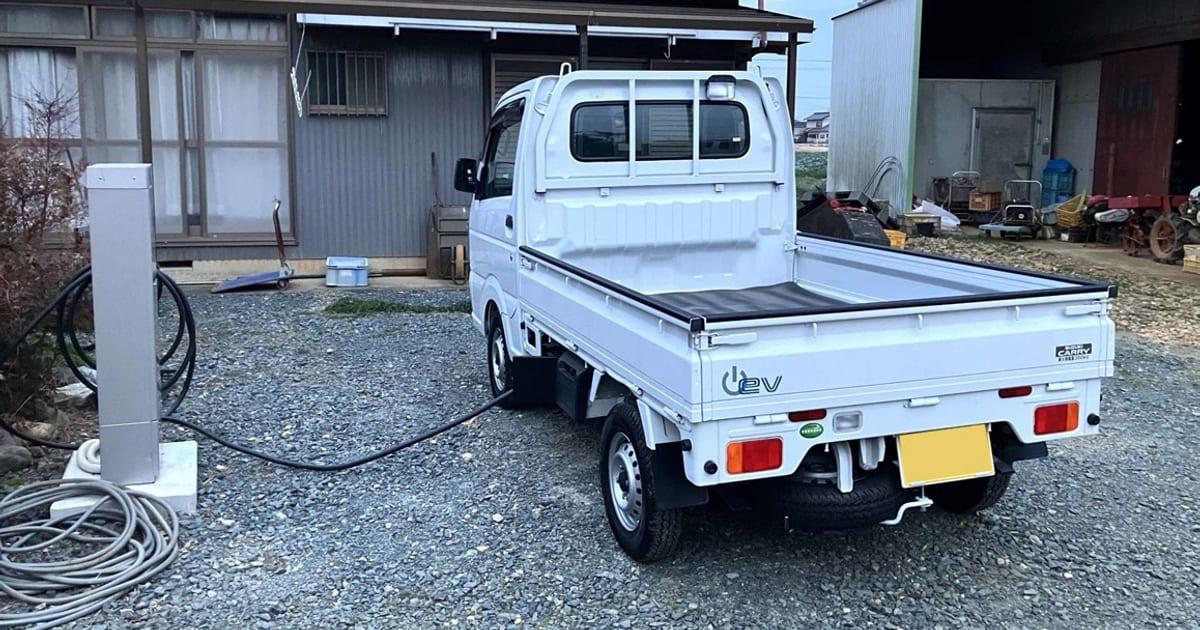
TL;DR: Yes, there is an electric Suzuki Carry, but you can't buy one. Since February 2026, Suzuki has been lending a battery electric version of its Carry kei truck to farmers in Shizuoka, Aichi, and Kumamoto for a test planned to run about a year. It keeps the gas truck's 350 kg payload, bed, and four wheel drive. It carries a deliberately small battery, and it doubles as backup power for the farmhouse. Suzuki has not announced a production model, a price, or a date. Meanwhile Foxconn unveiled its own electric kei truck design, the MODEL K, on October 30.
Photo: Suzuki Motor Corporation press material.
Since Mitsubishi stopped building its Minicab MiEV Truck in 2016, the electric kei truck story has belonged to outsiders. Kyoto startup Folofly opened orders for its FKT electric kei truck in September. The companies that actually build the trucks Japanese farmers drive mostly stayed on the sidelines.
Suzuki didn't. According to Suzuki's March 17 announcement, the company started a roughly one year trial in February 2026 with farmers in Hamamatsu and Kosai in Shizuoka Prefecture, Toyokawa in Aichi, and Aso District in Kumamoto. The truck is a Suzuki Carry with the engine pulled and a battery bolted under the bed. It is the first real look at how Suzuki thinks an electric Carry should work, and the way Suzuki built it says a lot about what Suzuki would want from a production version, if it ever builds one.
What Suzuki Actually Built
Start with what didn't change, because that is the whole point. A Suzuki product planner told Car Watch during a May 19 press visit in Hamamatsu that the conversion keeps the gas Carry's turning circle, handling, bed space, and full 350 kg maximum payload. The battery is a lithium iron phosphate (LFP) pack weighing about 100 kg, mounted under the bed. The base truck's four wheel drive stays.
That last detail matters more than anything else on the spec sheet. Folofly's FKT is rear drive only, and in snow country and on muddy orchard tracks a two wheel drive kei truck is a hard sell. Suzuki kept the transfer case and bolted an electric axle (motor, inverter, and reduction gear in one unit) to it where the transmission used to be.
Motor Fan's farm visit report fills in the rest. An electric water pump cools the motor and inverter through the gas truck's original radiator. The air cooled battery pack hangs from brackets under the bed, which raises the bed floor by only about 5 mm. Charging runs through a CHAdeMO port on the left side at 6 kW DC. There is no AC charging from an ordinary home outlet yet, and whether farmers actually need it is one of the questions the trial is meant to answer. Inside, the cab is nearly identical to a two pedal gas Carry: a key to start it, a P/R/N/D lever, and a display showing range, battery charge, and battery temperature.
Suzuki has not published the battery capacity or the motor output. Motor Fan reports the motor was specified with headroom for vehicles beyond kei trucks, which hints that this drivetrain isn't a one off science project.
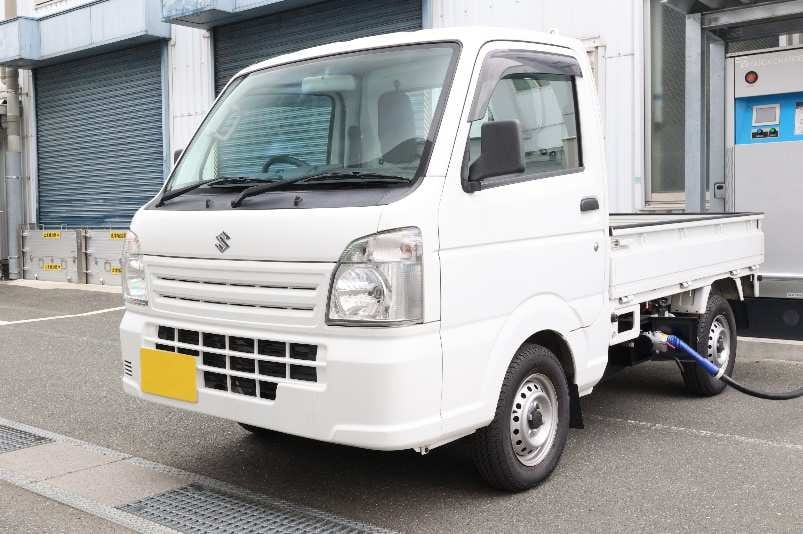
Photo: Suzuki Motor Corporation press material.
Range Is Short on Purpose
Here is the number that will make range anxious Americans wince. On the day Motor Fan visited, the truck's display showed 56 km of range at 80 percent charge. Motor Fan's own math puts a full charge at roughly 70 km, about 43 miles. Suzuki hasn't given an official figure, so treat that as a reporter's dashboard reading, not a spec.
Suzuki chose that number deliberately. The company calls its approach "battery lean": don't haul around more battery than the job needs. Motor Fan reports the battery was sized right at the line where farmers might start complaining, because every extra kilowatt hour adds cost to a vehicle class where buyers fight over every yen.
The more interesting choice is which battery Suzuki used. According to an Eliiy Power release from April 2025, the drive battery is the company's HY Battery L series, a large lithium ion pack designed for homes and public buildings, not cars. Eliiy Power's reasoning goes like this. A farm truck mostly drives to the field, sits there while the farmer works, then sits at the house overnight. Trips are short, so the truck can charge and discharge several times a day. A typical EV battery is built around charging about once a week and would wear quickly under that kind of use. A stationary pack rated to hold 70 percent of its capacity after 15 years of full cycles, roughly 17,000 of them, would not.
Eliiy Power calls the result a "moving battery," and that idea is the real story here. Suzuki isn't trying to build a long range electric truck. It's building a battery that happens to haul cabbages.
The Truck Is Also the House Battery
Suzuki lends the farms the truck along with Eliiy Power's POWER iE Connect V2H (vehicle to home) storage system, and Motor Fan reports that each participating farm had to have solar panels on the house or a barn. Solar charges the truck and a home storage battery. At night or during a blackout, the truck feeds the house. Suzuki's original April 2025 announcement framed the goal plainly: measure the latent demand for an electric kei truck, and find the best way to use solar power stored in its battery. That release also named the partners: Tokyo R&D and Pues, Eliiy Power, Mikuni, and Office F Vision.
That makes the trial as much an energy experiment as a vehicle test. It also plays to a Japanese reality Americans don't always see. Rural Japan gets earthquakes, typhoons, and the long outages that follow, and a truck that, paired with solar and a V2H unit, can keep a farmhouse running through an outage is worth more than its range figure suggests.
What the Farmers Say
Motor Fan counts six farms in the trial, growing rice, potatoes, mandarin oranges, and herbs. The reports so far are glowing, with the usual caveat that these are hand picked participants driving loaner trucks.
A Hamamatsu farmer interviewed by Car Watch runs a loop of about 35 km to three drop points, including a farmers market, carrying anywhere from 100 kg to nearly 300 kg of cabbage, potatoes, and daikon. Before the trial they filled the gas Carry about every two weeks. Now the truck plugs in at home after each run and charges itself, and they said the biggest win is never stopping for gas. They also said they were worried at first, then found the electric truck pulls harder and smoother than the gas one when starting uphill with a full bed. With solar on the house for more than a decade, the V2H setup means several days of power if the grid goes down.
The same farm told Motor Fan the truck replaced about 80 liters of gasoline a month, roughly 21 gallons. Their monthly household power bill stays under ¥7,000, though they can't separate what the solar covers from what the grid supplies. They also charge the drone they use to spray their fields. One family member asked Suzuki to just leave the truck with them. Another said that at the same price they'd take the electric truck over gas, but they want a bigger bed.
That 70 km estimate looks a lot less scary next to a 35 km daily route. Motor Fan reports the battery sits around 80 percent most of the time because the truck gets plugged in after every loop. For this use, the small battery is enough.
Foxconn Wants In Too: the MODEL K
The fresher news came from Taipei. On October 30, at Hon Hai Tech Day 2026, Foxconn unveiled three new electric vehicle designs, and one is a kei truck. Foxconn's announcement describes the MODEL K as "aimed at the specialized commercial kei truck class" for last mile delivery and mobility services. It borrows its look from Foxconn's MODEL T electric bus, and it is designed with a lower and longer bed than usual, ready for a canopy.
Don't expect a Foxconn badge on it. These are reference designs, now 12 in total, that Foxconn offers to other companies through its contract design and manufacturing business. Foxconn designs it, builds it, and someone else sells it. Nikkei reported the truck will come with a choice of 120 km or 250 km of range and that Foxconn EV strategy chief Jun Seki promised a "very competitive price." Foxconn has not published a price, a battery size, a payload, a customer, or a production date.
Our read: the MODEL K is a pitch to delivery fleets and municipalities, and to any brand that wants an electric kei truck without engineering one. A long, low bed under a canopy is a parcel delivery setup, not an orchard truck. Suzuki is building for the farm. Foxconn is building for the city.
Where the Electric Kei Truck Race Stands
Line up the players and a pattern shows. Mitsubishi was first with the Minicab MiEV Truck in 2013, a 10.5 kWh truck that kept the full bed but cost roughly three times the gas truck it was based on. Production ended in March 2016. Our guide to electric kei trucks in the USA covers its history. Folofly's FKT is on sale now with a 30 kWh battery and a claimed 225 km of range, according to Best Car Web's launch coverage, but it's rear drive only, has a shorter bed than a Carry, and is priced by quote. Toyota, Daihatsu, and Suzuki already share an electric drivetrain in the electric kei vans they launched in 2026, and those cost about three times their gas versions.
Suzuki's trial truck takes the opposite approach to Folofly. It gives up range, keeps four wheel drive and the full bed, and relies on the farm's solar panels to make up for the short range. If the trial data backs that up and Suzuki ever builds one for sale, expect it to look like this: short range, a small battery, and a big selling point that has nothing to do with driving.
The big unknown is price. Kei truck buyers are about the most price sensitive vehicle shoppers on earth, and the MiEV Truck proved that a good electric truck still fails if it costs too much. A "battery lean" truck with a long life stationary pack is Suzuki's answer to that problem. Whether it's enough, Suzuki hasn't said.
Can You Buy an Electric Carry in the US?
No, and not for a long time. Suzuki isn't selling this truck anywhere, and even if it reached Japanese showrooms next year, a new Japanese market kei truck doesn't meet federal safety standards. NHTSA's import rules only exempt vehicles that are at least 25 years old, so a production electric Carry would have to wait a quarter century under the 25 year import rule, the same as every other kei truck in the country.
If you want an electric Carry in your barn this year, you build it. Our kei truck EV conversion guide prices out the kits, the batteries, and the paperwork. Suzuki's prototype is a useful reference for anyone doing that: keep the transfer case so you keep four wheel drive, mount the pack under the bed, and size the battery for your actual daily route instead of a road trip you'll never take.
The Bottom Line
The electric Suzuki Carry is real, and it's working on Japanese farms right now. It isn't for sale, and Suzuki hasn't promised it ever will be. What the trial shows is how Suzuki thinks about the problem. Instead of trying to beat a gas Carry on range, which a small battery can't do, it wants the truck to earn its keep sitting in the driveway, soaking up solar power and keeping the lights on when a typhoon takes out the grid. That fits Japanese farms in a way a 250 km delivery truck doesn't, and it's a smarter bet than chasing range.
Foxconn's MODEL K is the other half of the picture: an electric kei truck for fleets, built by a contract manufacturer for whoever wants to put a badge on it. Between the two, the electric kei truck has gone from Mitsubishi's abandoned experiment to something two very different companies are actively working on.
For American owners, nothing changes yet. Keep your gas Carry running, look at the conversion route if you want electric now, and watch for Suzuki's next move when the trial wraps up in early 2027. The best kei truck for farming today still burns gasoline, and the owners on r/keitruck will be the first to spot an electric Carry if one ever reaches a Japanese auction.


