Best Kei Truck for Farming: Which Model Actually Fits Your Operation
Not all kei trucks are created equal, especially when you're hauling feed at dawn, navigating between orchard rows, or dumping gravel on a washed-out road. Here's which model fits which farm.

Advertisement
TL;DR: For row crops and orchards, get a Daihatsu Hijet (narrowest, best Jumbo cab). For livestock and rough terrain, get a Subaru Sambar (4-cylinder, Extra Low gear). For general farm use and cheap parts, get a Suzuki Carry (biggest aftermarket, most common). For heavy hauling with dump beds, get a Mitsubishi Minicab (rear diff lock, strongest 4WD). Budget $6,000-$12,000 total.
Walk into any farming forum and ask about the best kei truck for farming, and you will get five different answers from five different people, all of them convinced they are right. The Suzuki Carry guys swear by their Hi/Lo transfer case. The Subaru Sambar crowd will not shut up about their Extra Low gear. And somewhere in the back, a Daihatsu Hijet owner is quietly hauling twice the load with a factory dump bed while everyone else argues.
Here is the thing: they are all right, and they are all wrong. The best kei truck for your farm depends entirely on what your farm actually demands. A vineyard owner navigating tight rows needs a different truck than a rancher hauling hay across 200 acres of mud. So instead of declaring one winner, let's break down exactly what each model brings to the table and match them to the operations where they shine.
If you are brand new to these vehicles, start with our guide to what a kei truck actually is and come back. For everyone else, let's get into it.
Why Farmers Are Switching to Kei Trucks
The pitch is simple: a kei truck does about 90% of what a UTV does, at roughly half the cost, with 33–47 mpg fuel economy, an enclosed cab with heat, and an engine designed to last 200,000+ kilometers instead of 10,000 miles. A farmer outside Raleigh purchased a 1997 Honda Acty for $2,000, total, including import. He had been looking at a John Deere side by side that would have run him $30,000.
Add street legality in many states, automotive grade parts availability, and the ability to drive to the feed store without a trailer, and the appeal is obvious. So let's talk about which kei truck belongs on your farm.
The Payload Question: What Can You Actually Haul?
Let's address this upfront because it is the first thing every farmer asks. Under Japanese kei regulations, all kei trucks are rated at a maximum payload of 350 kg, roughly 770 lbs. That number is consistent across every model from every manufacturer. The Carry, the Acty, the Hijet, the Sambar, the Minicab: all 350 kg.
In practice, plenty of farmers load them heavier. Forum posts on r/keitruck are full of people hauling 1,000+ lbs without drama because these are overbuilt platforms designed for Japanese construction sites and mountain farms. But the official rating is 350 kg, and you should know that going in.
| Model | Rated Payload | Bed Size (approx.) | Curb Weight | Notable |
|---|---|---|---|---|
| Suzuki Carry | 350 kg (770 lbs) | 78" x 54" | ~1,500 lbs | Three way drop sides standard |
| Honda Acty | 350 kg (770 lbs) | 78" x 53" | ~1,500 lbs | Rear engine = flatter bed floor |
| Daihatsu Hijet | 350 kg (770 lbs) | 74" x 55" | ~1,500 lbs | Widest bed in the class |
| Subaru Sambar | 350 kg (770 lbs) | 78" x 54" | ~1,500 lbs | Rear engine = better loaded stability |
| Mitsubishi Minicab | 350 kg (770 lbs) | 78" x 54" | ~1,500 lbs | Best cab visibility |
The real differences are not in the numbers. They are in how the weight sits. The Acty and Sambar both run rear mounted engines, so weight distribution shifts rearward when loaded. This actually improves drive wheel traction on muddy hills. The front engine trucks (Carry, Hijet, Minicab) distribute weight more evenly but can get light in the rear when empty.
4WD Systems: Not All Farm Trucks Are Created Equal
This is where the models genuinely diverge, and where choosing the right truck for your terrain matters most. Every model offers 4WD, but the systems work differently, and those differences matter when you are axle deep in a February pasture.
Suzuki Carry: The Off road King
The Carry uses a part time 4WD system with a proper Hi/Lo transfer case: 2WD-High, 4WD-High, and 4WD-Low via a floor lever. An electronic axle lock button engages the front hubs for 4WD-High; in 4WD-Low, the fronts engage automatically. Many Carry trucks also come with a rear locking differential. The combination of low range gearing and diff lock makes the Carry the most capable kei truck for serious mud, steep grades, and rough terrain. Oiwa Garage has a solid breakdown of the system if you want the technical details.
Best for: Hilly terrain, muddy conditions, farms with steep grades or unimproved roads.
Honda Acty: The Automatic Approach
The Acty takes a different philosophy with Honda's "Real Time" 4WD system. This is a full time system that uses a viscous coupling to automatically send power to the front wheels when the rears lose traction. You do not shift into 4WD. It engages on its own when needed.
The exception is the Acty Attack, a farm specific variant with a manually lockable rear differential and Ultra Low forward and reverse gears. The Attack was literally designed for Japanese farmers and is the most purpose built agricultural kei truck ever made. The trade off is speed: Attack models top out around 45 mph due to the low gearing.
Best for: Farmers who want simplicity and do not want to think about shifting into 4WD. The Attack variant is ideal for steep hillside farming.
Daihatsu Hijet: The Versatile Workhorse
The Hijet offers a selectable 4WD system with a Hi/Lo transfer case and an available rear locking differential. Daihatsu calls this the "farming package." The system is straightforward: a lever for 2WD/4WD-High/4WD-Low, plus a diff lock switch when you need it.
The Hijet's 4WD system is well regarded for farm use. As Farmers Weekly noted, high range is a bit leggy for puttering around a farm, but low range transforms it into a capable runabout. The quiet engine is a specific advantage around livestock because you will not spook horses or cattle the way a UTV would.
Best for: Mixed use farms, livestock operations, and anyone who wants the widest range of factory configurations. The current Hijet generation comes in 26 distinct variants, including specialized dump trucks and refrigerated models.
Subaru Sambar: The Clever Underdog
The Sambar skips the traditional transfer case entirely. Instead, Subaru gave it a six speed transmission with an Extra Low gear. Push the knob down and far left, and the Sambar simultaneously drops into Extra Low and engages 4WD. Regular 4WD is via a button on the shift knob, activatable while moving.
The Sambar is the only kei truck with a four cylinder engine (the 660cc EN07), and it has the highest ground clearance in the class at 7.5 inches, tied with the Acty. The rear engine layout plus Extra Low gear means this truck punches above its weight off road.
Best for: Properties with varied terrain where you frequently shift between road driving and off road work. The on the fly 4WD engagement is genuinely convenient.
Mitsubishi Minicab: The Visibility Champion
The Minicab runs a conventional selectable 4WD with a 5-speed manual or 3-speed automatic. No low range gearing, which makes it the least capable in extreme off road conditions. Where it wins is visibility. The fifth generation (1991–1999) has the largest windows of any kei truck. When you are navigating crop rows or backing up to a fence line, that sightline matters. Parts availability is the weakest of the five, but the truck is solid and often the cheapest to import.
Best for: Flat terrain farms, orchards with good roads, and operations where off road extremes are rare.
Dump Beds: The Farm Game Changer
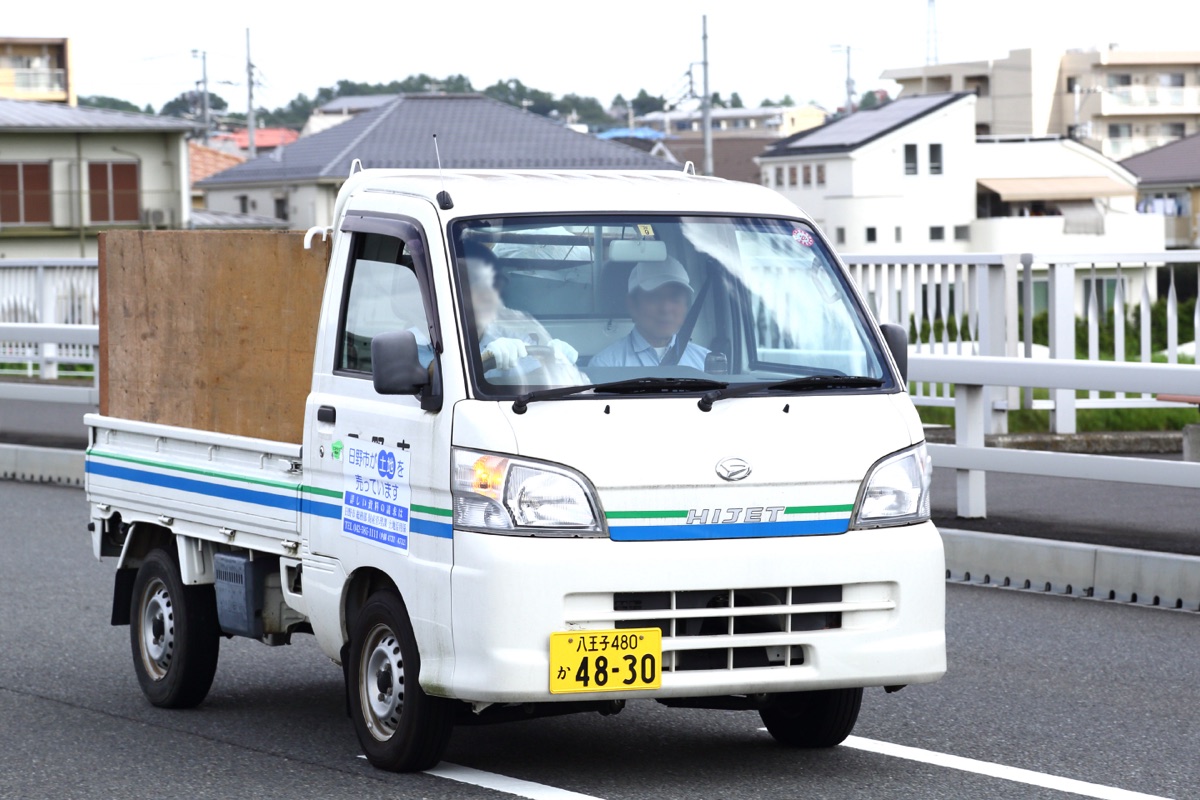
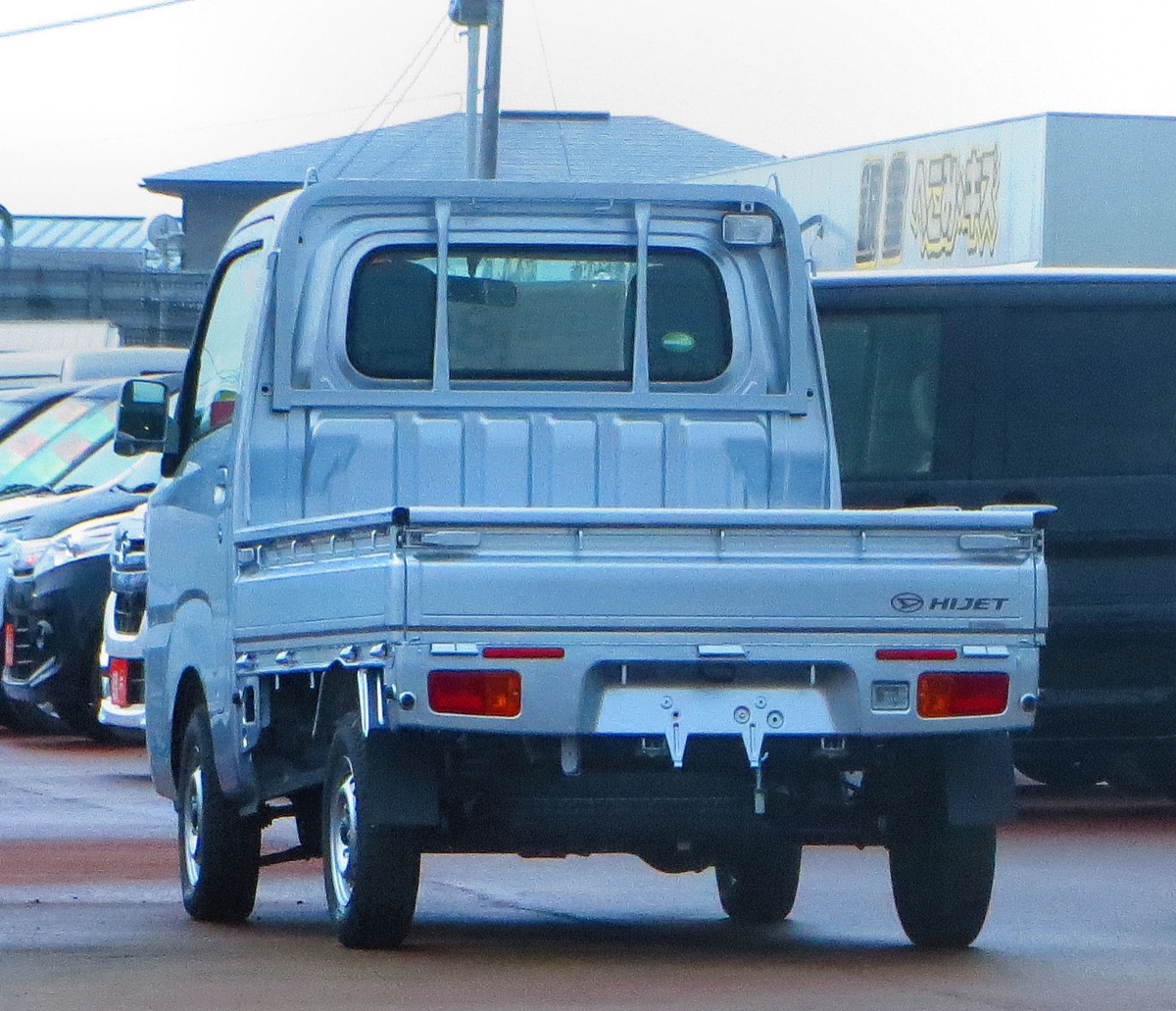
If there is one feature that separates a farm kei truck from a general purpose kei truck, it is the dump bed. This is where the Daihatsu Hijet absolutely dominates. For a deeper dive, see our dedicated kei truck dump bed guide.
Daihatsu Hijet Dump Variants
Daihatsu built more factory dump configurations than anyone else:
- LD (Light Duty) Dump: Standard tipping bed, three way drop sides, available in metallic silver or white. The workhorse option.
- HD (Heavy Duty) Dump: Reinforced steel bed with thicker plating, guard frame behind the cab, and a PTO powered dump mechanism that channels engine power directly into the lift. More controlled, more powerful lifting.
- Scissor Lift Dump: The bed raises horizontally to over 6 feet high. Hunters use these as elevated platforms. Farmers use them for loading onto trailers or into storage.
- Climber Dump: 4WD + dump bed + diff lock + manual transmission. This is the ultimate farm spec Hijet.
Suzuki Carry Dump Variants
Suzuki offers two main dump configurations:
- Kintaro Dump: Named after a Japanese folk character known for superhuman strength. Suzuki advertises it as having the longest dump bed in the kei truck class. Three way drop sides, available in 5-speed manual with Hi/Lo range.
- Sturdy Dump: Reinforced construction with thicker steel plating and a guard frame. The Carry's answer to the Hijet HD.
Other Models
The Honda Acty, Subaru Sambar, and Mitsubishi Minicab all have dump bed variants, but they are less common on the import market. If you specifically want a dump truck, your search will be easier if you focus on the Hijet or Carry.
Aftermarket option: If you find the perfect truck but it does not have a dump bed, conversion kits exist. Expect to pay around $1,200 for a complete kit.
A dump bed conversion kit runs about $1,200.
For farmers who regularly move soil, gravel, mulch, manure, or debris, a dump bed is not a luxury. It is a necessity. It turns a 30-minute shovel job into a 30-second lever pull. Duncan Imports often has dump equipped models in their farm ready inventory if you want to skip the conversion.
Matching the Truck to the Farm: Specific Use Cases
This is where rubber meets dirt. Here is how each model fits specific farming operations:
Livestock and Ranching
Recommended: Daihatsu Hijet or Suzuki Carry
Feeding rounds, fence checking, hauling feed bags, transporting small animals. The Hijet's quiet engine is a genuine advantage because you will not send a herd of cattle into a panic the way a UTV can. The Carry's low range 4WD handles the muddy pastures that come with livestock. The fold down bed sides on both make loading feed bags and animal crates straightforward.
One Daihatsu owner on a farming forum summed it up: "It's a pain to start in the winter as it's carbureted and needs a tune. It's a tight fit for me to get in. But it has proved to be exceptionally handy around the farm." Imperfect, but relentlessly practical.
Orchards and Vineyards
Recommended: Subaru Sambar or Honda Acty
Tight row spacing is the defining challenge. A kei truck is only 4.9 feet wide, narrow enough to fit between most orchard rows where a full size pickup would cause damage. The Sambar and Acty, with their rear engines and 7.5 inches of ground clearance, navigate between trees and vines without bottoming out on irrigation berms.
The Sambar's on the fly 4WD shines here. Switch from pavement to soft soil with a button press instead of stopping to shift a lever. With a 2-3 inch lift and proper tires, you can even clear low growing crops between rows.
Hay and Feed Operations
Recommended: Suzuki Carry with dump bed
The Carry's bed fits 8-10 small square bales, and the three way drop sides let you load from whichever direction is convenient. The Hi/Lo transfer case handles the loaded climb from a lower hay field back to the barn. A dump bed turns loose hay, straw bedding, or grain into a load drive dump repeat loop instead of a shovel marathon.
For tire recommendations that hold up under heavy loads on soft ground, check our kei truck tire guide. If you plan to tow hay wagons or equipment trailers, our towing capacity guide covers the limits and hitch setups for each model.
General Property Maintenance
Recommended: Any model with 4WD, Carry or Hijet if you want the most options
Brush clearing, firewood hauling, gravel spreading, and building material transport. Every kei truck handles these well. One forum user nailed it: "I have one instead of a side by side. I use it around the property, haul stuff, plow, etc. It's great for that purpose." If your property work leans more toward landscaping and lawn care, the Carry and Hijet are also the top picks for that use case. And if you have been considering a golf cart for lighter property tasks, our kei truck vs golf cart comparison explains why the kei truck usually wins that matchup too.
If your property has rough roads, the Carry or Sambar gives you the most crawling capability. If your terrain is relatively flat, the Minicab or a standard Hijet will save you money without sacrificing much. For the truly adventurous, the Daihatsu Midget II is a single seat micro truck that some Japanese farmers use for narrow path work where even a standard kei truck is too wide. Either way, a dump bed earns its keep fast.
What to Know Before You Buy a Farm Kei Truck
A few practical considerations that are specific to agricultural use:
Registration and legality. Some states offer agricultural exemptions for kei trucks used on private land, potentially allowing newer imports. Others, like Oregon, still ban them from public roads entirely. Check our state laws guide, browse kei trucks for sale to see what is available now, or find dealers near you who specialize in farm ready trucks.
Inspection priorities. Farm kei trucks live harder lives. Rust is the number one killer: bed floor, frame rails, and dump mechanism hydraulics. Use our pre purchase inspection guide before buying.
Tax deductions. Kei trucks used primarily for farm work may qualify for Section 179 deductions, potentially letting you write off the full purchase price in year one. Farmers filing Schedule F get the cleanest path.
Insurance. Even farm only trucks deserve coverage. Kei truck insurance runs $200–$600 per year. Hagerty handles specialty vehicle valuations. For details, see our kei truck insurance guide.
Parts and maintenance. The Suzuki Carry has the best US parts availability by a wide margin. The Hijet is second. The Acty, Sambar, and Minicab may require longer wait times for specific parts. Oiwa Garage is a reliable source across all models, and MotorTrend and The Drive have solid editorial coverage for further research.
It is not a replacement for a full size truck. Read our kei truck vs pickup comparison if you are on the fence. A kei truck replaces the second or third vehicle, the one you drive around the property all day, every day.
A LED light bar runs $60 to $150 on Amazon. A set of all terrain tires in 145/80R12 runs $150 to $300 for four.
Bottom Line
There is no single best kei truck for farming. There is a best kei truck for your farm. Here is the cheat sheet:
- Suzuki Carry: Best overall for rough terrain and hilly properties. Hi/Lo transfer case, diff lock, best US parts support. If you can only pick one, pick this.
- Daihatsu Hijet: Best for dump bed availability and livestock. Widest range of factory configurations and the most dump variants on the import market. The "farming package" with Hi/Lo and diff lock is the real deal.
- Honda Acty Attack: Best for hillside and mountain farming. Automatic 4WD with Ultra Low gearing, literally designed for Japanese mountain farmers. The standard Acty is fine; the Attack is the one you want.
- Subaru Sambar: Best for orchards, vineyards, and mixed terrain. On the fly 4WD, highest ground clearance, and the only four cylinder in the class. Extra Low gear is a clever transfer case alternative.
- Mitsubishi Minicab: Best on a budget or flat terrain. Cheapest to import, best cab visibility, perfectly adequate when off road extremes are rare. Weakest parts availability.
If you need enclosed cargo for weather sensitive loads, consider a kei van like the Suzuki Every or Honda Vamos instead of a bed truck.
Whatever you choose, you are getting a vehicle that Japanese farmers have relied on for over 60 years. These trucks were built from the ground up for agricultural work, not designed for suburbs and marketed to farmers as an afterthought. Find the right model, inspect it properly, and put it to work. Your wallet (and your back) will thank you.
Advertisement


