Folofly FKT Electric Kei Truck: Specs and Price
A Kyoto startup with no factory just opened orders on the FKT, an electric kei truck with 140 miles of claimed range, a 350 kg payload, and a 100V outlet in the cab. Japan's big three didn't build it. Here's what it gets right, where the bed comes up short, and what it means for US buyers.

Advertisement
TL;DR: On September 7, 2026, Kyoto startup Folofly opened orders for the FKT, a new electric kei truck in a segment where the only major automaker entry, Mitsubishi's Minicab MiEV Truck, died in 2016. It has a 30 kWh LFP battery, a claimed 225 km (140 miles) of range, the standard 350 kg payload, and a 100V outlet in the cab. The catch is the bed: at 1,669 mm it's about a foot shorter than a Carry's. Price is "ask us," and the business subsidy runs up to ¥873,000. Its only real rival, HW Electro's ELEMO-K, lists at ¥3,278,000. You can't import either to the US for 25 years, but the first Minicab MiEV Trucks cross that line in 2038.
Back in March, we looked at Toyota, Daihatsu, and Suzuki launching electric kei vans and predicted that electric kei trucks were coming, just not soon. We were half right. Seven months later, a second startup has an electric kei truck on sale in Japan. Neither one comes from the companies that actually build kei trucks.
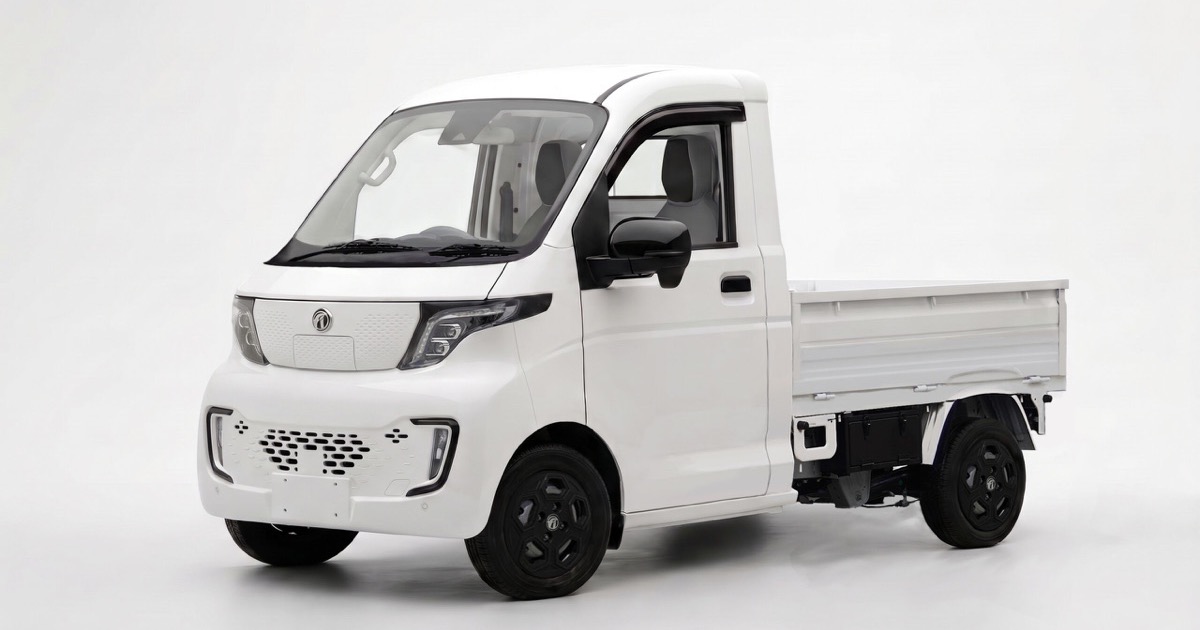
It came from Folofly, a Kyoto startup founded in August 2021 that doesn't own a factory. Its new FKT is a plain white two seat work truck with a drop side bed, and it's aimed squarely at the farmers, delivery outfits, and city works departments that have been driving gas Suzuki Carry and Daihatsu Hijet trucks for fifty years. Whether it actually wins any of them over is a different question.
What Folofly Actually Built
The spec sheet in Folofly's official FKT launch announcement reads like a normal kei truck right up until you get to the powertrain.
| Spec | Folofly FKT |
|---|---|
| Length x width x height | 3,395 x 1,475 x 1,980 mm (133.7 x 58.1 x 78 in) |
| Wheelbase | 2,430 mm (95.7 in) |
| Bed (L x W x H) | 1,669 x 1,380 x 370 mm (65.7 x 54.3 x 14.6 in) |
| Bed floor height | 660 mm (26 in) |
| Curb weight / payload | 1,080 kg / 350 kg (2,381 lb / 772 lb) |
| Motor | 30 kW (40 hp), 120 Nm (88 lb ft), rear wheel drive |
| Battery | 30 kWh lithium iron phosphate (LFP) |
| Range | 225 km (140 mi), company test, WLTC equivalent |
| Charging | 6 kW AC (J1772) about 5 hours; CHAdeMO DC about 1 hour |
| Tires | 145R12 LT 8PR |
| Turning radius | 4.4 m |
That 225 km range figure deserves an asterisk. It's Folofly's own test result run under "WLTC equivalent" conditions, not an official government rating, and it says nothing about a full bed in January. Still, 140 miles is more than double what the last factory electric kei truck managed, and for a truck that runs a fixed route and sleeps on a charger, it's plenty.
Safety kit is the part that would have been unthinkable on a kei truck a decade ago: automatic emergency braking front and rear, lane departure warning, stability control, front and rear parking sensors, a backup camera, hill start assist, and driver and passenger airbags. Inside you get a center touchscreen, push button start, power windows, and a heated driver's seat (bottom cushion only, because this is still a work truck).
Note what's missing from that list: four wheel drive. The FKT is rear drive only. In a market where 4WD kei trucks are a staple in snow country and on muddy orchards, that's going to cost it farm buyers.
The Bed Is the Catch
Here's where we stop being polite. The FKT's bed is 1,669 mm long. The standard cab Carry, Hijet, and Mitsubishi Minicab all carry a bed of roughly 78 inches. That makes the FKT bed about 12 inches shorter, and still about 6 inches shorter than the 72 inch bed on a Hijet Jumbo, the truck people already complain about for losing bed space.
Look at the photo and you can see why. The FKT has a stubby nose with the front wheels pushed out ahead of the doors, which is how it gets a 2,430 mm wheelbase and a calmer ride. Kei rules cap overall length at 3,400 mm, so every inch of nose comes straight out of the bed. Width is fine at 1,380 mm, and the 660 mm floor height matches what people are used to loading at, but a full sheet of plywood or a stack of 8 foot lumber is going to hang a lot further off the tailgate.
The bigger embarrassment is that Mitsubishi already solved this problem. When it launched the Minicab MiEV Truck, MONOist's 2012 launch report noted it kept the gas truck's full 1,940 x 1,415 mm bed by tucking the battery and motor under the bed floor. Thirteen years later, the new electric truck has less bed than the old one.
The torque comparison isn't flattering either. The 2013 Minicab MiEV Truck made 30 kW and 196 Nm. The FKT makes the same 30 kW and only 120 Nm. It also weighs 150 kg more (1,080 kg against 930 kg). We'd expect it to feel noticeably softer off the line with 350 kg in the back. That's our read of the numbers, not a test drive.
A Truck That Doubles as a Generator
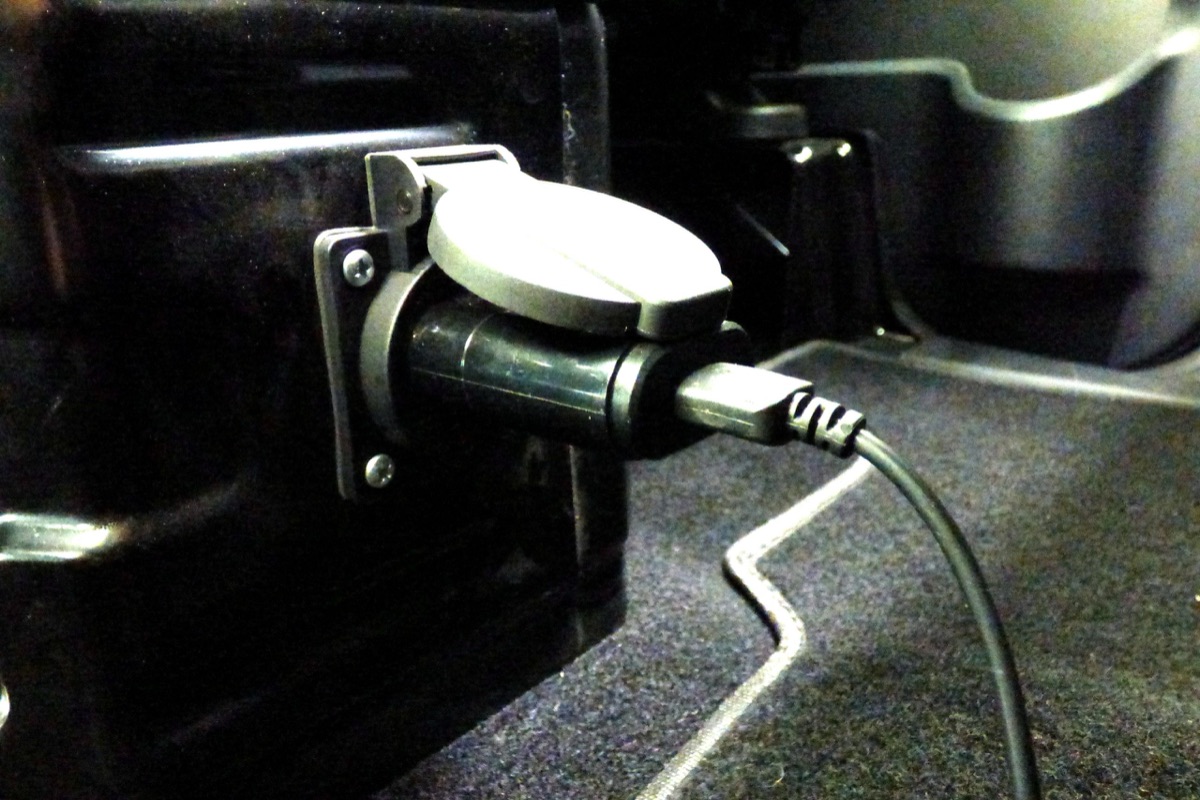
The feature that actually changes how you'd use the thing is the AC100V outlet in the cab, standard on every truck, plus two USB ports. Folofly's FKT product page pitches it as power for drills, saws, and work lights on site without hauling a generator or idling an engine, and as backup power during an outage.
It isn't unique. The rival ELEMO-K ships with a 2,000 watt 100V inverter. But for anyone who has ever run a contractor generator off the back of a kei truck, this is the good part. No noise, no fumes in a barn or greenhouse, no gas can rattling around the bed. The tradeoff is that whatever you draw comes out of your driving range, and the outlet may not work at all when the traction battery is low. Run a miter saw all morning and you'll drive home on less than 140 miles. Plan accordingly.
If you want the same trick on a gas kei truck here, a portable power station in the 1,000 watt hour range strapped into the bed gets you most of the way there for a few hundred bucks.
Who Is Folofly, and Where Is This Thing Built?
Folofly is a Kyoto University spinout run by CEO Hiroyasu Koma, and its whole business model is "fabless." Folofly designs and specs the vehicles in Japan and pays someone else to build them, the way most smartphone brands do. Its own English site describes this as a "horizontal division of labor" model. Asahi's small business outlet profiled Folofly's no factory approach and reported that it was handing production of its electric vans to Chinese manufacturers to hit gas van pricing.
The FKT was developed jointly with ASF, a Japanese EV startup Folofly has invested in. ASF's own kei van, the ASF2.0, was developed with input from Sagawa Express and is built in China by Liuzhou Wuling, according to multiple Japanese reports. Folofly's FKT announcement does not say where the truck itself is assembled. Given who built the company's earlier vans and who it developed this truck with, we'd bet on China, but that's an inference, not a fact Folofly has confirmed.
Why does that matter? Because it explains how a five year old startup beat Suzuki and Daihatsu to an electric kei truck. Suzuki, Daihatsu, and Toyota spent years and a three company alliance getting their electric vans to market. Folofly skipped building the factory entirely.
The Money: Subsidies, Running Costs, and a Price Nobody Will Say
Folofly lists the FKT at "open price," meaning you call and they quote you based on how many you're buying. That alone tells you who the customer is: fleets, not farmers walking into a dealership.
The only public reference point comes from Motorcars.jp, whose writer noted that the ASF2.0 van the FKT is built off starts around ¥2.37 million. That's the reporter's ballpark, not a Folofly number. At about 155 yen to the dollar, it works out to roughly $15,300.
Business buyers can take up to ¥873,000 (about $5,600) off through the LEVO commercial vehicle electrification subsidy. If the FKT lands near the van's price, a fleet buyer who qualifies for the full grant would pay something like ¥1.5 million, or about $9,700. For comparison, Suzuki's 2026 Carry lineup announcement starts the base gas Carry at ¥1,172,600, about $7,600. So even with a fat subsidy, the electric truck probably still costs more up front.
The fairer comparison is the other electric kei truck. HW Electro's ELEMO-K electric kei truck lists its pickup at ¥3,278,000 (about $21,100) with a 21.5 kWh battery and 188 km of WLTC range. If Folofly prices anywhere near the van reference, the FKT undercuts it by close to a million yen while carrying a bigger battery and a longer claimed range.
Folofly's pitch is that you win it back at the plug. Its math assumes ¥170.1 per liter gas (Japan's national average in August 2026), 16.5 km/L for a gas kei truck, ¥20 per kWh on a Kansai Electric overnight business rate, and 7.5 km per kWh for the FKT. That gives roughly ¥2.7 to ¥3 per km on electricity against about ¥10 per km on gas. In US terms, that's around 3 cents a mile versus 10. At 12,500 km a year (50 km a day, 250 working days), Folofly says you save more than ¥90,000 a year in fuel, about $580.
That's real money for a fleet running 50 trucks. For one farmer, $580 a year takes a very long time to pay off a few thousand dollars of extra purchase price. If you want to see how the gas side of that math looks with real world numbers instead of brochure figures, our kei truck MPG breakdown runs it at US gas prices.
Mitsubishi Tried This in 2013
The FKT isn't Japan's first electric kei truck, or even its only current one. Before HW Electro and Folofly, Mitsubishi launched the Minicab MiEV Truck on January 17, 2013, under the nickname "Den Tora" (electric truck). It used a Toshiba cell 10.5 kWh battery, got 110 km on the old JC08 cycle, and cost ¥1,858,000 before a ¥460,000 government subsidy. The gas Minicab truck it was built on started at ¥641,000. Mitsubishi targeted 300 sales a month.
It didn't get there. Production of the MiEV Truck ended in March 2016, after about three years. When Mitsubishi restarted general sales of the Minicab MiEV in November 2022, only the van came back, and Japan's Driver Web reported that Mitsubishi had no plans to revive the truck.
The lesson from the first attempt is that a kei truck buyer is about the most price sensitive vehicle buyer on earth. The MiEV Truck was a well engineered machine with a full size bed, and it still died because it cost roughly three times a gas truck before subsidies. Folofly is betting that subsidies, cheap LFP cells, 140 miles of range, and the work outlet close that gap. Fleet buyers might agree. Farmers mostly didn't last time.
Can You Get One in America?
No. A brand new FKT doesn't meet Federal Motor Vehicle Safety Standards, and NHTSA's vehicle import rules only exempt vehicles once they hit 25 years old. That's the same 25 year import rule that governs every kei truck in the country. The earliest FKT becomes legal to bring in around 2051, assuming any survive Japanese inspection cycles that long.
The more interesting date is closer. The first Minicab MiEV Trucks were built in January 2013, which means they cross the 25 year line starting in January 2038. Mark that date. Only about three years of production exist, so expect them to be rare and probably priced like it. Before buying any kei truck, gas or electric, check our state legality guide, because federal import rules and state road rules are two different fights.
If you want an electric kei truck in the US now, your only real option is building one. Our kei truck EV conversion guide walks through motors, batteries, and the real costs, and the builders on r/keitruck are the best place to see what's working in practice. Honestly, a DIY build with a full 78 inch bed beats the FKT's 65 inches for most American use.
The Bottom Line
The Folofly FKT matters less as a truck than as a signal. A startup with no factory just put an electric kei truck on sale in Japan before Suzuki, Daihatsu, or Toyota did, joining HW Electro's ELEMO-K, and the specs are real: 30 kWh, 140 claimed miles, the full 350 kg payload, modern safety gear, and a 100V outlet that turns the cab into a quiet generator. Motorcars.jp billed it as the first fabless electric kei truck developed for the Japanese market.
It also gives up a foot of bed, has less torque than Mitsubishi's 2013 attempt, skips 4WD, and won't tell you its price. That's a fleet delivery truck, not a farm truck. The big three still own the farm truck, and the pressure is on them now. If Daihatsu builds an electric Hijet truck off the e-Hijet Cargo platform with a full bed and 4WD, that's the electric kei truck that actually matters.
For American buyers, nothing changes today. Keep importing 25 year old gas trucks, keep them maintained, and put a reminder in your calendar for January 2038.
Advertisement


