Slate Truck vs Kei Truck: The $24,950 EV Against the $7,000 Import
Slate finally put a real price on its bare bones electric truck: $24,950, with deliveries starting late 2026. That is three clean kei trucks worth of money. Here is an honest breakdown of where the Slate wins, where the import embarrasses it, and which one you should actually buy.

Advertisement
TL;DR: The Slate Truck is real now: $24,950, 205 miles of range, 1,550 lbs of payload, deliveries starting late 2026. It is the most honest cheap truck Detroit money has produced in decades, and it still costs three times what a clean imported kei truck runs. The Slate wins on highway capability, crash structure, warranty, and 50 state legality. The kei truck wins on price, bed practicality, repair cost, and the small matter of existing today with 30 years of proof behind it. If you have one parking spot and need one legal do everything vehicle, put down the $300. If you need a work truck for real money, the import is still the play.
For a year and a half, the Slate Truck was the internet's favorite hypothetical. A two door electric pickup with crank windows, no paint, no touchscreen, backed by Jeff Bezos money, promised for "under $20,000." Kei truck people watched the hype with a raised eyebrow, because we have been driving the original minimalist truck all along.
On June 24, 2026, the hypothetical got a sticker. Slate announced final pricing: $24,950 for the pickup, $29,950 for the Squareback and Fastback SUV versions, with first deliveries starting in the fourth quarter of this year. The under $20,000 dream died with the federal EV tax credit, and what is left is a very interesting question. Because $24,950 is not kei truck money. It is three kei trucks worth of money. So does the shiniest new idea in cheap trucks actually beat a 30 year old Suzuki Carry at the job both were built for?
Let us run the numbers, now that both sides finally have real ones.
What the Slate Truck Actually Is Now That the Specs Are Final
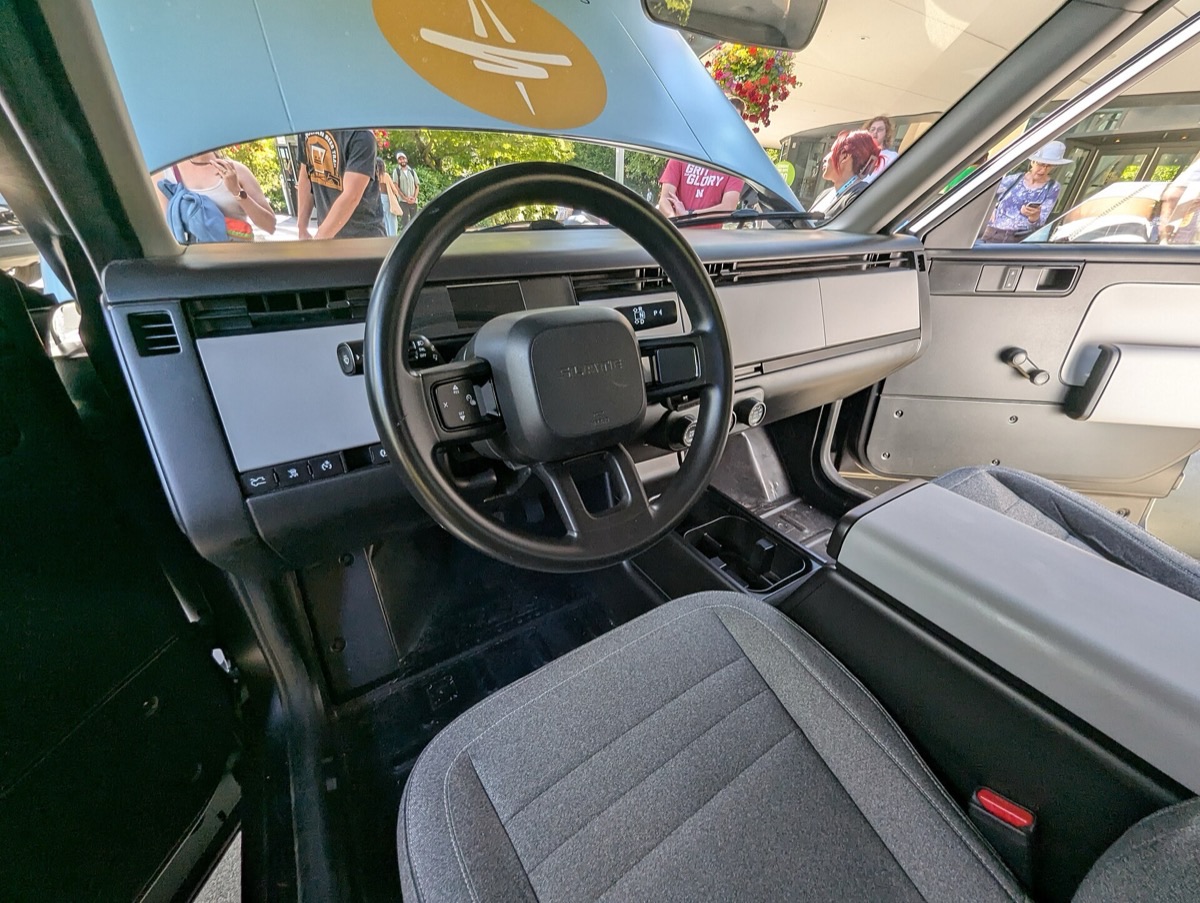
Strip away the hype and the Slate is a compact single cab electric pickup built in Warsaw, Indiana. The base truck ships unpainted in gray polypropylene body panels, with crank windows, physical HVAC knobs, and no infotainment screen at all. Your phone is the stereo and the nav. Slate sells wraps instead of paint, 54 of them under $500 at launch, and a $5,000 bolt on kit that converts the pickup into an SUV.
The final numbers moved around on the way to production, and mostly in the right direction. As The Drive reported, range jumped from the originally promised 150 miles to 205 miles out of a 65 kWh pack. Towing landed at 2,000 lbs and payload at a genuinely impressive 1,550 lbs. The trade: curb weight ballooned about 450 lbs to 4,048 lbs, power dropped from 201 to roughly 181 horsepower, and the previously floated second battery option quietly disappeared. Zero to sixty takes about 8 seconds and top speed is capped at 90 mph. None of that is exciting, and none of it needs to be. This is a work appliance, which is exactly the same design philosophy that produced the kei truck in the first place.
One number matters more than any spec: 180,000 reservations before the price was even announced. Whatever happens next, Slate proved the demand for a simple cheap truck is enormous. Kei truck importers could have told them that for free.
Price: $24,950 vs $7,000, and What Each Dollar Buys
Slate spent four years of engineering squeezing cost out of a new vehicle, and the result is legitimately the cheapest new electric truck in America. According to the Los Angeles Times, the average new EV in the US transacts at $55,000, so $24,950 is a real achievement, not marketing math. Preorders opened at $300, and the company says deliveries accelerate through 2027.
A clean, inspected kei truck lands in your driveway for $5,000 to $9,000 all in, shipping and the 25 percent Chicken Tax included. That is not a stripped base model price that balloons at the dealer; that is the whole truck. And the comparison gets worse for Slate once you spec one honestly. Add a wrap, the roof rack, a stereo, and power windows and you are past $27,000. The SUV kit takes you past $30,000. Meanwhile the kei truck already comes with paint.
| Category | Kei Truck | Slate Truck |
|---|---|---|
| Price | $5,000–$9,000 | $24,950 base |
| Payload | 770–880 lbs | 1,550 lbs |
| Max towing | 500–1,000 lbs | 2,000 lbs |
| Range | 350+ miles per tank | 205 miles EPA |
| Refuel time | 5 minutes | 30+ min DC / overnight AC |
| Top speed | 65–75 mph | 90 mph |
| Length | ~130 inches | ~175 inches |
| Street legal all 50 states | No | Yes |
| Available today | Yes | Q4 2026 at the earliest |
There is also the question of what you are buying into. A kei truck is a known quantity with three decades of service history in the harshest fleet duty Japan could throw at it. Slate is a startup with roughly 750 employees that has never delivered a vehicle. The concept is strong and the backing is serious, more than $700 million raised, but industry analysts quoted by the LA Times called the execution risk enormous, and startup truck history is a graveyard. We said the same thing about the REO Runabout in our Ameri-kei breakdown: the promise is not the product.
Payload, Bed, and Actual Work
Here is where it gets interesting, because on paper Slate wins the work argument.
That 1,550 lb payload rating is nearly double what a Daihatsu Hijet or Carry carries on its Japanese rating, and 2,000 lbs of towing beats anything a kei truck should honestly attempt. The MOTORWATT review of the platform notes the whole vehicle rides on a dedicated EV skateboard with the weight down low, which helps it haul without getting nervous. If your work involves regularly moving a half ton or dragging a small trailer at highway speed, the Slate is simply rated for jobs the kei truck is not.
But payload is only half of what makes a truck bed useful, and this is where seven decades of kei truck evolution show. The Slate has a conventional fixed side bed, five feet long, tailgate access only, with a bed floor sitting at typical pickup height. A kei truck bed is roughly six feet long with drop sides on all three edges that fold flat, and the deck sits around two feet off the ground. You load a kei truck from any direction, slide plywood straight across it, shovel mulch off the side, and your back thanks you at the end of the day. The cab over layout means the little truck fits that bigger bed into a footprint almost four feet shorter than the Slate. This is the same argument we made in the kei truck vs pickup comparison, and it holds against a 175 inch EV just as it holds against a 230 inch F-150.
The verdict on work depends entirely on your work. Heavy and highway: Slate. Frequent, awkward, hand loaded, on property or around town: the kei bed is still the best cargo box ever bolted to a small vehicle.
Range, Fuel, and the Cost of Keeping It Moving
The Slate's 205 mile EPA rating is respectable for the price, and NACS compatibility means it charges on the Tesla Supercharger network from day one. Charge at home overnight on a Level 2 circuit and your per mile energy cost will undercut any gas vehicle, kei trucks included.
But EV range math punishes trucks. Load the bed, run 70 mph, or drop below freezing and that 205 becomes 140 something real miles. NMC battery chemistry loses 20 to 30 percent of its range in hard winter. A kei truck with its 660cc three cylinder pulls 40 to 45 mpg, carries a 10 gallon tank, and refuels anywhere in five minutes. Nobody has ever planned a route around a Carry's fuel stops.
Maintenance is the sleeper category. EV powertrains need almost nothing, and Slate's whole pitch is DIY simplicity, down to published repair guides. That is genuinely refreshing from a new automaker. The kei truck counters with the deepest cheap parts bench in the business: consumables cost pocket change, parts supply is a solved problem, and there is no four figure battery pack waiting at the end of the depreciation curve. Owners on r/keitruck routinely keep these trucks running past 150,000 miles on hand tools and a service manual. Interestingly, the two philosophies converge: some kei owners are even converting their trucks to electric and beating Slate to the cheap electric truck punch for under $15,000 total.
Legality: The One Fight Slate Wins Before It Starts
No dancing around this one. The Slate Truck is a new, FMVSS compliant, crash tested vehicle you can register in all 50 states, drive on any interstate, insure without explanation, and finance at normal rates. It has airbags, stability control, and a federal warranty framework behind it.
A 25 year old import has none of that. Kei trucks are fully legal in most states, but the map is a patchwork: a handful of states still block or restrict registration, some impose speed or road class limits, and the rules change every legislative session. Our state legality guide tracks all 50, and the fine print matters before you wire money to an exporter. Crash protection is what you would expect from a 1,600 lb cab over truck designed around Japanese city speeds, which is to say: the crumple zone is your knees. Federal rules under the NHTSA 25 year exemption make the import legal; they do not make it a modern vehicle.
If you live in a restrictive state, commute on 70 mph roads, or carry your kids in the passenger seat daily, this section is the whole comparison. Buy the Slate, or at least read up on what daily driving a kei truck really involves before deciding.
So Which One Should You Buy?
Buy the Slate if you need one vehicle that does everything legally, everywhere, and you can wait a year or more for the reservation queue to reach you. At $24,950 it is the first new truck in a decade that respects the idea that a truck can be simple. It is also a bet on a factory that has not yet built anything at scale, so treat the $300 preorder as what it is: a cheap option, not a truck.
Buy the kei truck if the job is work and the budget is real. For a third of the money you get a proven machine, available this week from an importer like Duncan Imports or straight through the auctions, with a bed the Slate cannot match and running costs that round to zero. Our import guide covers the whole process, and if you want the middle path, buy the kei truck now, keep the Slate reservation, and decide when your delivery window actually opens. The kei truck will hold its value while you wait; it always does.
The quiet takeaway from Slate's 180,000 reservations is that the entire US market is finally coming around to what kei truck owners figured out years ago. Small, simple, and cheap is not a compromise. It is the point. Slate had to spend $700 million rediscovering it. Japan wrote it down in the 1950s.
The Bottom Line
The Slate Truck is the most credible cheap truck America has produced in a generation, and the kei truck is still cheaper by a factor of three with a better bed and a 30 year head start. The Slate Truck wins legality, safety, payload, towing, and highway manners. The kei truck wins price, footprint, load practicality, refuel time, and the fact that it exists. Different tools, same philosophy. If Slate actually delivers at $24,950, the cheap truck market finally gets a second honest option, and honestly, we are rooting for them. Competition for simple and affordable is good news for everyone, including the people who will keep buying the original kei truck anyway.
Advertisement


