Suzuki e Sky: Japan's Counterpunch to BYD Squeezes 193 Miles From a 26 kWh Battery
Suzuki announced the e Sky on August 24: its first electric passenger kei car, pulling 193 miles from a 26 kWh battery. BYD's Racco needs 38 percent more battery to go 6 miles farther. The kei EV war is officially on, and Suzuki is fighting with efficiency instead of cells.

Advertisement
TL;DR: On August 24, 2026, Suzuki revealed the production e Sky, its first electric passenger kei car, launching in Japan this autumn with European exports to follow in 2027. The headline number is 310 km (193 miles) of targeted range from a 26 kWh battery, which works out to 97 watt hours per kilometer. The BYD Racco needs a 35.84 kWh pack, nearly 38 percent more battery, to go just 10 km farther. BYD breached the kei fortress in July. Five weeks later, the company that owns the fortress fired back, and its weapon of choice is efficiency.
Suzuki does not rush. This is the company that kept the Suzuki Carry on the same platform for twelve years and counting, and when it finally updated the truck this spring, the big news was LED headlights. So when Suzuki moves fast, something has scared it, and the e Sky announcement landed with the timing of a company that got scared this summer.
The BYD Racco went on sale July 28 and became the first foreign kei car to actually sell in Japan, pulling over 1,000 orders in two weeks. Twenty seven days after the Racco hit showrooms, Suzuki published the production specs for its answer. That is not a coincidence. That is the market leader in a segment worth 40 percent of Japan's new car sales deciding it will not cede the electric slice of that segment to a Chinese automaker without a fight.
The Numbers Suzuki Just Put on the Board
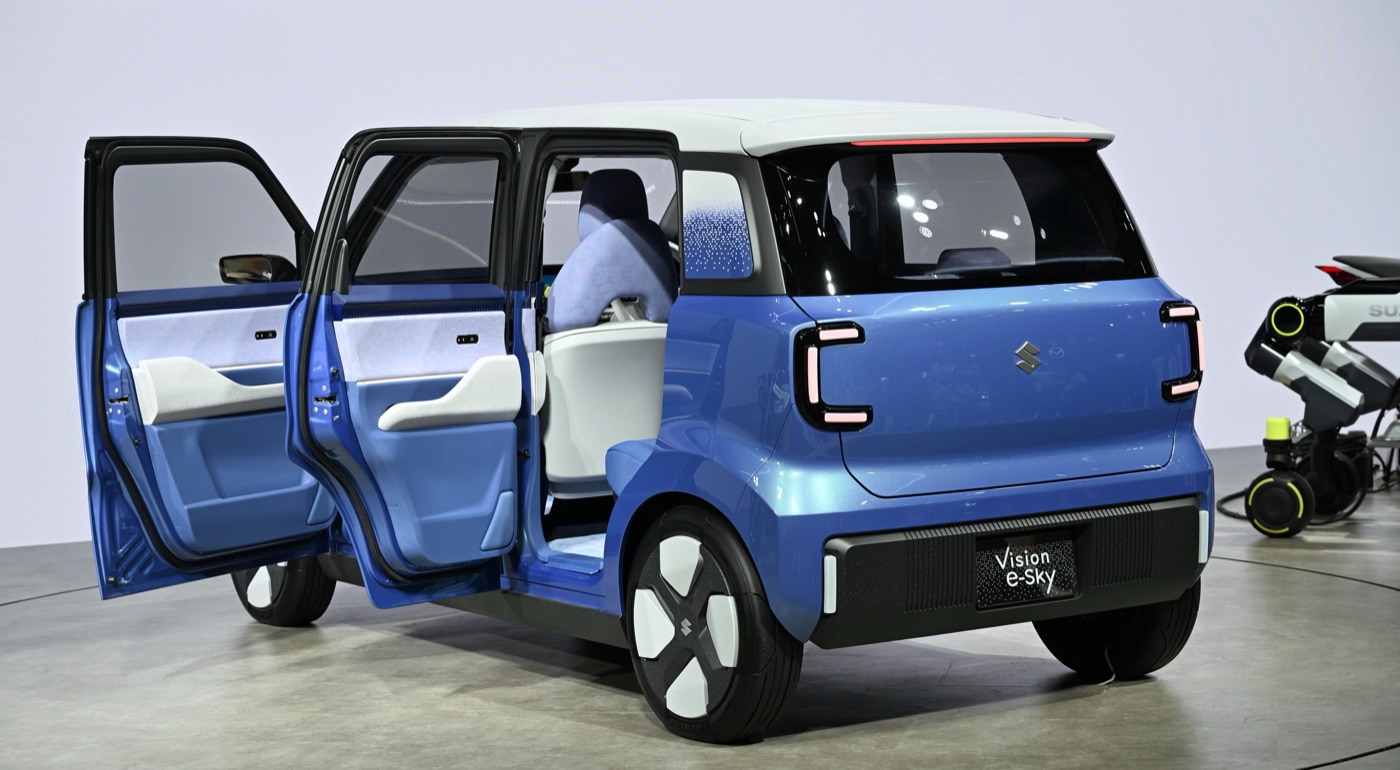
The e Sky is the production version of the Vision e-Sky concept from the 2025 Japan Mobility Show, and remarkably little got lost in translation. Same footprint, same tall hatchback proportions, same floating roof. The showpiece illuminated grille became a black trim panel and the wheels shrank, but as Carscoops noted in its coverage, the concept range figure actually went up on the way to production, from over 270 km to a targeted 310 km. Concept cars usually lose range when the accountants get involved. This one gained 40 km.
Here is the full spec sheet as it stands, with the caveat that Suzuki has not yet certified the range under Japan's WLTC test cycle or announced pricing:
| Spec | Suzuki e Sky |
|---|---|
| Battery | 26 kWh lithium iron phosphate |
| Targeted range | 310 km (193 miles) |
| Energy consumption | 97 Wh/km |
| Curb weight | 1,030 kg (2,271 lb) |
| Length x width x height | 3,395 x 1,475 x 1,625 mm |
| Wheelbase | 2,460 mm |
| Motor output | Not announced (kei cap is 47 kW / 63 hp) |
| DC fast charging | 50 kW, 80 percent in 25 minutes |
| AC charging | 4.5 hours at 6 kW, 8 hours at 3 kW |
| Layout | Front motor, front wheel drive |
| Seats | 4 |
The car rides on a new platform called HEARTECT e, built specifically for small EVs, with an e-Axle unit that packages the motor, inverter, and reduction gear into one assembly driving the front wheels. The battery sits under the floor. None of this is exotic. All of it is executed with the discipline of a company that has spent 70 years learning how to remove grams and yen from small cars.
97 Watt Hours per Kilometer Is the Whole Story
Skip the styling and the touchscreen. The number that matters is 97 Wh/km, because it reframes the entire kei EV competition.
The Racco's top trims carry a 35.84 kWh pack and deliver 320 km of WLTC range. The e Sky targets 310 km from 26 kWh. Run the math and the Suzuki extracts roughly 11.9 km from every kilowatt hour while the BYD manages about 8.9. That is a 34 percent efficiency advantage, and it comes from a 1,030 kg curb weight, cleaner aerodynamics including a worked underbody, and a drivetrain Suzuki has been quietly refining since the concept debuted. As CleanTechnica's analysis put it, Suzuki reduced the energy the car needs before increasing the energy it stores.
Why should you care which tiny Japanese hatchback wins a spreadsheet fight? Because batteries are the most expensive part of an EV. A company that needs 26 kWh instead of 36 kWh to deliver the same daily usability just cut its most expensive component by nearly a third. That flows straight into sticker price, and price is the entire game in the kei class. Suzuki has not announced what the e Sky will cost, but the battery math gives it room to undercut the Racco's ¥2.145 million starting price while matching its real world range. If Suzuki prices this car aggressively, the efficiency advantage becomes a margin advantage, and Suzuki knows more about thin margins on small cars than any automaker alive.
There is a fair counterargument: the Racco is a bigger box. It is a super tall wagon with power sliding doors aimed at families, while the e Sky is a conventional hatchback shape closer to an electric Alto. They will not cross shop perfectly. But they will both fight for the same subsidy checks and the same charging spots, and Japanese buyers proved this summer that they will pay up for range when the Racco test drive coverage showed 80 percent of orders going to the most expensive trim.
Why Suzuki Waited, and Why BYD Forced Its Hand
Suzuki, Daihatsu, and Honda control roughly 80 percent of Japan's minicar market, and for years none of them treated electric kei passenger cars as urgent. Nissan and Mitsubishi got there first with the Sakura and eK X EV back in 2022, Honda followed with the N-ONE e:, and Suzuki, the perennial number one or two in kei sales, sold exactly zero electric passenger kei cars. Its only production EVs were the e Vitara crossover and the e Every commercial van. The thinking was easy to reconstruct: kei buyers are the most price sensitive customers in Japan, batteries are expensive, and a 180 km Sakura was never going to threaten a ¥1 million Alto. The kei class rulebook that kept foreign automakers out for 77 years also let the incumbents electrify at whatever pace suited them.
Then BYD rewrote the timeline. The Racco topped 1,000 orders by August 9, per Nikkei figures reported by CnEVPost, with a buyer mix that should genuinely worry the incumbents: over 70 percent of Racco orders came from households adding or replacing a car, mainstream kei demand rather than early adopter novelty. BYD is targeting 10,000 orders by the end of 2026 and expanding its Japanese dealer network to 100 stores. A Chinese automaker is building distribution in the incumbents' home segment while offering more range than anything the locals sell.
Suzuki's August 24 announcement reads like a direct response, right down to the framing. The company built the e Sky around a philosophy it calls "Easy to Switch," pitching the car at existing gasoline kei owners doing commutes, school runs, and shopping trips. That is exactly the replacement demand BYD is harvesting. Suzuki is not trying to convert EV skeptics with this car. It is trying to make sure that when a Wagon R household finally goes electric, there is a Suzuki badge waiting for them.
Charging, V2H, and the Features That Actually Matter Daily
The spec sheet reveals a car designed around how kei vehicles actually get used. Full charge takes about 8 hours from a standard home connection or 4.5 hours from a 6 kW wallbox, which means the car charges overnight in a carport, no public infrastructure required. The 50 kW DC fast charging that tops the pack to 80 percent in 25 minutes exists for the occasional longer haul, not daily life. Details are on Suzuki's official site as they roll out toward the autumn launch.
The sleeper feature is the power outlet. The e Sky supports vehicle to home output plus a 100 volt, 1,500 watt AC socket, meaning the 26 kWh pack doubles as a backup battery for a Japanese house during an outage, or a power source for tools and camping gear anywhere the car can park. In a country that plans seriously for earthquakes and typhoons, a kei car that can run a refrigerator for two days is not a gimmick. American kei owners already know this logic from the other direction: half the appeal of a kei truck is that it does real work for pennies. An efficient EV with an outlet in the bed area is the same idea wearing a different body.
Inside, Suzuki clearly built to a price. The concept's ambient lighting and pale lounge materials gave way to a conventional dashboard with a 10.1 inch touchscreen, a digital cluster, physical climate controls, and an electronic parking brake. Heated seats, a heated steering wheel, and a heat pump handle Japanese winters without torching range. It seats four, like every kei passenger car, and the boot is small, like every kei passenger car. Nobody buying in this class will be surprised or disappointed.
What This Means for Americans (Patience Required)
Here is the cold water: you cannot have one. The e Sky launches in Japan this autumn and reaches Europe and the UK in 2027, and under the federal 25 year rule enforced by NHTSA's import regulations, the earliest an e Sky lands legally in a US driveway is 2051. Anyone telling you otherwise is selling something you should not buy. Our import guide walks through how the rule actually works, and it has no EV loophole.
So why should an American kei fan care? Three reasons.
First, the efficiency philosophy trickles down the whole lineup. The engineering that pulls 193 miles from 26 kWh, the light platform, the integrated e-Axle, the aero work, is the same toolkit Suzuki will eventually apply to electric versions of the Carry and Every, and the e Every van already exists. The 2026 Carry facelift proved Suzuki extends platforms for decades; when the electric kei truck era arrives, it will be built from these parts.
Second, the kei EV price war that the Racco started and the e Sky escalates will push Japan's used market. Every household that switches to an electric kei puts a gasoline kei on the used market, and Japanese used vehicle exports are where American import buyers shop. More supply at auction means better prices on the 2001 and 2002 trucks and vans becoming eligible right now. Browsing Goo-net Exchange today already shows how deep that gasoline inventory runs.
Third, the segment's center of gravity is shifting, and if you own or want a kei vehicle in the US, the conversation about their future is happening now. State legislatures keep moving on kei registration, our state legality guide tracks two states flipping to legal this summer alone, and the folks at r/keitruck have been debating whether kei EVs will ever make the import boat. The honest answer is 2051, but the vehicles crossing the Pacific between now and then will come from a Japanese market these EVs are reshaping.
The Bottom Line
Suzuki just demonstrated the difference between being slow and being deliberate. BYD needed a 35.84 kWh battery to crack 300 km in a kei car. Suzuki matched the milestone with 26 kWh, a 1,030 kg curb weight, and consumption of 97 Wh/km, then aimed the whole package at the exact replacement buyers BYD has been signing up since July. Pricing will decide the fight, and Suzuki has not shown that card yet; expect Japanese outlets like Response to have the number first as the autumn launch approaches. But the e Sky's math says Suzuki can build its range figure with two thirds of the battery cost, and in a segment where ¥100,000 swings purchase decisions, that is the strongest position on the board. The kei fortress got breached this summer. It did not fall. The garrison just returned fire.
Advertisement


