Kei Truck & Kei Car Laws in Ohio (2026)
RestrictedOhio HB 54 limits kei trucks to roads posted 35 mph or less where a local government has authorized them. No local ordinance means no legal road use.
Ohio used to be a gray area for kei vehicles. Not anymore. House Bill 54, the state transportation budget that took effect June 30, 2025, wrote mini trucks out of Ohio's definition of a motor vehicle and banned them from public roads except where a local government has specifically said yes. Kei trucks are now limited to roads posted 35 mph or less, and only in cities, villages, or townships that have passed an ordinance allowing them. The Ohio kei community calls it the June 30, 2025 kei truck ban, and that is not an exaggeration.
Disclaimer: Laws and regulations change frequently. Always verify current requirements with your local Ohio Bureau of Motor Vehicles (BMV) office or the Ohio BMV before purchasing or registering a kei vehicle. Be sure to review our pre-purchase inspection checklist.
Overview
Ohio's approach to kei vehicles changed hard with HB 54 (136th General Assembly), the transportation budget signed by Governor DeWine and effective June 30, 2025. The bill amended Ohio Revised Code 4501.01 so that mini trucks are excluded from the definition of "motor vehicle" entirely. Under 4501.01(BBB), a mini truck is a four wheel vehicle with an internal combustion engine of 660cc or less, a dry weight between 900 and 2,200 pounds, an enclosed cab, a body resembling a pickup or van, and no original FMVSS certification. That is a word for word description of an imported kei truck.
Because a mini truck is no longer a motor vehicle under Ohio law, a standard passenger registration is not on the table anymore. ORC 4511.214(B)(2) bars mini trucks from operating on any street or highway except roads posted 35 mph or less where a local authority has granted permission under Section 4511.215. Models like the Suzuki Carry and Subaru Sambar fall squarely inside the mini truck definition, so this applies to nearly every kei truck coming off the boat.
Kei cars are a murkier question. The mini truck definition targets vehicles that resemble a pickup or van, so a kei passenger car may fall outside it, but Ohio has not clarified how kei cars are treated after HB 54.
Registration Process and Requirements
Since June 30, 2025, the only lawful road use path for a kei truck runs through a local ordinance under Section 4511.215, with titling under Chapter 4505 and registration under Chapter 4503 through that channel. To title and register through the ordinance pathway, you will need:
- Title: A valid title from another U.S. state or, for first-time titling, the Japanese export certificate with certified English translation along with customs documentation. Ohio uses Form BMV 3774 for title applications.
- Bill of Sale: Showing the purchase price, vehicle details, and buyer/seller information.
- Customs Documentation: CBP Form 7501, EPA Form 3520-1, and DOT Form HS-7 demonstrating the 25-year exemption (for imported vehicles). For more details, check our complete guide to importing a kei truck from Japan.
- Law Enforcement Inspection: ORC 4511.215(A)(2) requires you to submit the mini truck to an inspection conducted by a local law enforcement agency, following Department of Public Safety standards, before it can be registered and operated under a local ordinance. This is not optional.
- Proof of Insurance: Ohio requires minimum liability insurance of 25/50/25 ($25,000 per person, $50,000 per accident for bodily injury, $25,000 for property damage).
- E-Check Emissions Test: Required in certain counties in the Cleveland and Akron metropolitan areas. Vehicles model year 1995 and older are exempt.
Step-by-Step Process
- Confirm your city, village, or township has passed an ordinance under Section 4511.215 authorizing mini truck operation. If it has not, that is the first fight, not the BMV.
- Gather all import and customs documentation.
- Obtain Ohio auto insurance meeting state minimums.
- Complete the law enforcement inspection required by 4511.215(A)(2).
- Submit the title application (Form BMV 3774) with supporting documents.
- Pay applicable fees and taxes.
- Receive your Ohio title, license plates, and registration valid on authorized roads posted 35 mph or less.
Restrictions
- Statutory Road Ban: ORC 4511.214(B)(2) bars mini truck operation on any street or highway except roads posted 35 mph or less where a local authority has granted permission under Section 4511.215. No local ordinance means no legal road use, period.
- Inspection Required for Road Use: Ohio has no annual safety inspection, but the ordinance pathway requires an inspection by a local law enforcement agency before your mini truck can be registered. Skip it and you are not getting plates.
- E-Check Emissions (Limited): Only applicable in certain Northeast Ohio counties. Older vehicles are generally exempt.
- Statutory Classification: HB 54 killed the old classification guesswork. If your vehicle meets the 4501.01(BBB) mini truck definition, it is not a motor vehicle in Ohio, and the restrictions above apply no matter which BMV office you walk into.
- Equipment Requirements: Kei vehicles must meet Ohio's standard vehicle equipment requirements, including headlights, taillights, turn signals, mirrors, seatbelts, and a horn. Non-compliant equipment must be replaced or upgraded.
- Slow-Moving Vehicle Concerns: If your kei truck cannot maintain the posted speed limit, you may be required to display a slow-moving vehicle (SMV) emblem and may be cited for impeding traffic on higher-speed roads.
Cost Breakdown
| Item | Estimated Cost |
|---|---|
| Title | $15.00 |
| Registration (annual) | $31.00 |
| License Plates | $10.50 - $22.00 |
| Sales Tax (5.75% state + local) | Varies by purchase price and county |
| E-Check (if applicable) | $19.50 |
| Insurance (annual) | $300 - $800 (varies) |
Total first-year costs excluding insurance and the purchase price typically range from $150 to $400, depending on the vehicle's declared value and your county's local sales tax rate. For more guidance, see our kei truck insurance guide.
Recent Legislative Changes
Everything on this page changed on June 30, 2025. House Bill 54, the 136th General Assembly's $11 billion transportation budget signed by Governor DeWine, amended ORC 4501.01, 4511.214, and 4519.401. The amended definition section excludes mini trucks from "motor vehicle" entirely, and 4511.214(B)(2) bans them from every street and highway except roads posted 35 mph or less where a local authority has granted permission. Ohio Revised Code Section 4511.215 is the mechanism: local cities, villages, or townships must pass an ordinance explicitly authorizing mini truck operation, and titling and registration flow through that channel. The farm exception under Section 4519.401 still covers agricultural use. The Ohio kei community calls this the June 30, 2025 kei truck ban, and repeal efforts organized almost immediately.
There is also active talk within the Ohio kei vehicle community about pushing for clearer statewide legislation, similar to efforts in Colorado and other states. Any future legislation that creates a workable statewide framework for mini trucks or kei vehicles could significantly improve the ownership experience in Ohio. See our complete state by state guide for details. If you're near the border, you may also want to check kei truck laws in Michigan, Indiana, Kentucky, West Virginia, and Pennsylvania.
Tips from Local Owners
- Check your local ordinance before you buy. Since June 30, 2025 the road use question is answered at city hall, not the BMV counter. If your city, village, or township has not passed a 4511.215 ordinance, your kei truck is limited to private property and the farm exception. Show up to a council meeting and make the case.
- Forget the old multi office strategy. The advice used to be visit multiple BMV offices until one gave you a standard registration. HB 54 ended that. A vehicle meeting the mini truck definition gets the same statutory treatment everywhere in the state.
- Know the definition before you buy. A vehicle with an engine over 660cc or a dry weight over 2,200 pounds falls outside the 4501.01(BBB) mini truck definition, and different rules apply. Most imported kei trucks, including the Daihatsu Hijet, land squarely inside it.
- Consider the practical limitations. An ordinance approved registration limits you to roads posted 35 mph or less, which may be perfectly adequate for short local trips, farm errands, or neighborhood use. See how they stack up in our kei truck vs UTV comparison.
- E-Check exemption is your friend. If you live in a county that requires E-Check emissions testing, the age exemption for vehicles model year 1995 and older means most kei vehicles imported under the 25-year rule will be exempt.
- Connect with Ohio kei owners. The Ohio kei vehicle community is smaller than in some Southern states but is growing. Facebook groups and forums are the best places to find Ohio-specific registration advice and BMV office recommendations.
- Insurance is straightforward. Most major insurance companies will write a policy for a kei vehicle in Ohio. Progressive, Hagerty, and State Farm are commonly used by Ohio kei owners.
What you can do in Ohio
Kei trucks are legal here under specific limits. Here are the three moves that matter.
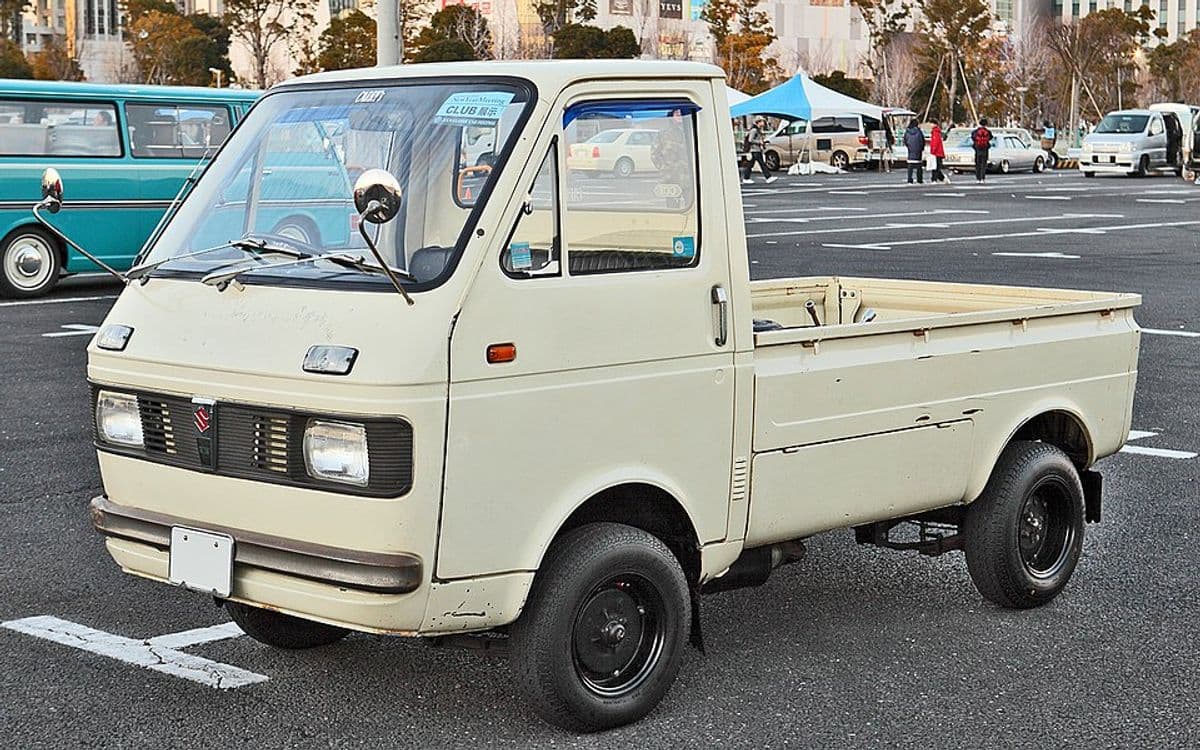
Suzuki Carry
1969-Present
Ohio now limits kei trucks to locally authorized roads posted 35 mph or less, so buy for utility, not the highway. The Carry has the longest US import history, the deepest dealer dataset, and the cheapest parts pipeline for farm use, private property, and ordinance approved local roads.