2026 Subaru Sambar Update: Smarter Safety, Same Hijet Under the Badge
Subaru updated the Sambar with expanded Smart Assist safety tech and a 9 inch infotainment screen. But it still skips the turbo the Hijet and Pixis get, and the real Sambars with the legendary EN07 four cylinder are just now becoming import eligible.

Advertisement
TL;DR: Subaru updated the Sambar kei truck for 2026 with an expanded Smart Assist safety suite, an available 9 inch infotainment screen, and adaptive LED headlights. The powertrain is unchanged: a 660cc three cylinder making 46 horsepower. Notably, Subaru still does not offer the turbocharged option that its sister trucks, the Daihatsu Hijet and Toyota Pixis, both get. Pricing starts at ¥1,094,500 ($6,800). For US buyers, the new Sambar is irrelevant since it cannot be imported. But the original Sambars with Subaru's legendary EN07 four cylinder engine are just now crossing the 25 year import threshold, and those are the ones worth paying attention to.
Subaru builds a pickup truck. Not a concept sketch, not a teaser rendering for social media engagement, not a "maybe someday" executive quote at an auto show press conference. An actual production pickup truck that you can walk into a Japanese dealership and buy today for less than $7,000.
The catch? You cannot have it. Not legally, anyway. The Subaru Sambar is a kei truck, which means it maxes out at 11 feet long, 4.9 feet wide, and 660cc of engine displacement. Those dimensions keep it firmly outside the FMVSS crash standards required for new vehicle sales in the United States. And the 2026 update that Subaru just rolled out in March does nothing to change that equation. What it does change is the safety and technology package on a truck that, badge aside, is functionally identical to the Daihatsu Hijet.
What Subaru Actually Changed for 2026
The meaningful updates sit behind the body panels. Subaru's "Smart Assist" safety system received a recalibration that expands the scenarios where it can intervene. The previous version could detect vehicles and pedestrians directly ahead of the truck. The 2026 system adds three new capabilities.
First, it now spots oncoming traffic when the driver is turning right at an intersection. In Japan's left hand traffic system, a right turn crosses oncoming lanes, making it the same geometry as an American left turn. The system uses its camera and radar combination to detect approaching vehicles and apply the brakes if the driver commits to a turn they should not.
Second, the sensors now pick up pedestrians crossing from the far side of the road during turns. This is a genuinely dangerous blind spot on any cab over truck, where the driver sits high and forward with limited sightlines through the A pillar. A pedestrian stepping off the far curb while the driver scans for traffic gaps is exactly the collision type that kills people.
Third, the system can now detect bicycles crossing the road ahead. In Japan, where bicycles share residential streets with commercial traffic in ways that would terrify most American drivers, this is a practical and overdue addition.
Beyond the Smart Assist expansion, Subaru added adaptive LED headlights with automatic high beam control on higher trims, along with side view lamps that illuminate the area next to the truck during low speed turns. There is also traffic sign recognition and lane departure prevention in the mix, features that would have been absurd to discuss on a kei truck even five years ago.
The interior gets one notable upgrade: an available 9 inch infotainment touchscreen with smartphone connectivity. It is only available on certain trims, though. Choose the base model and you get the same screen free dashboard that has been standard on kei trucks since the genre was invented. The rest of the cabin remains delightfully utilitarian: manual climate controls, hard plastics everywhere, deep dashboard trays, an overhead shelf, and adjustable cup holders positioned for someone who actually works in their truck.
No Turbo: The Sambar's Quiet Disadvantage
Here is where things get interesting. The Daihatsu Hijet, which is the truck that the Sambar is rebadged from, offers a turbocharged version of the KF engine that bumps output from 46 horsepower to 63 horsepower. The Toyota Pixis Truck gets the same turbo option. The Subaru Sambar does not.
That is a 37% power increase that Subaru simply chose not to offer under its badge. For a truck that weighs around 1,750 pounds, 17 extra horsepower is not trivial. It is the difference between merging onto a highway with confidence and merging with hope. It is the difference between climbing a loaded mountain grade in fourth gear and downshifting to third while traffic stacks up behind you.
Why does Subaru skip the turbo? The most likely explanation is market positioning. In Japan's kei truck segment, where margins are razor thin and dealer networks overlap, manufacturers differentiate through trim and option strategies rather than engineering. Subaru's dealer network is smaller than Daihatsu's, and the Sambar has always been positioned as the straightforward workhorse option. The Sambar's history as a farming and light commercial vehicle means most buyers are choosing on price, not performance. At ¥1,094,500 ($6,800) for the base model, every option that adds cost is an option that pushes a farmer toward the competition.
Still, if you want the turbo with this chassis, you buy the Hijet or the Pixis. They are the same truck. Our badge engineering breakdown covers exactly which kei trucks share platforms and where the differences actually matter.
Manual 4WD with Hi-Lo Range and Diff Lock
The Sambar's powertrain may lack a turbo, but the chassis underneath is still surprisingly capable. Buyers can choose between rear wheel drive and four wheel drive, paired with either a five speed manual or a CVT automatic.
The manual four wheel drive configuration is where the Sambar earns its keep on farms and rural properties. It comes with a proper Hi-Lo range selector, which means actual low range gearing for crawling through mud, snow, or steep terrain at walking speed. There is also a rear differential lock, which sends equal power to both rear wheels when traction gets marginal. These are features that plenty of full size American trucks charge thousands extra for, and the Sambar includes them on a vehicle that starts under $8,000 in four wheel drive form.
For context, the most affordable manual four wheel drive Sambar comes in at ¥1,226,500 ($7,700). The range tops out at ¥1,628,000 ($10,200) for the Gran Cab model with CVT and four wheel drive. The Gran Cab extends the cabin roof rearward to provide more headroom, a feature that matters quite a bit if you are taller than the average Japanese driver. Aftermarket accessories like bed racks, tool boxes, and tonneau covers are available through suppliers like Oiwa Garage, which stocks parts that cross reference between the Sambar, Hijet, and Pixis since they share the same underlying hardware.
How It Stacks Up Against Other 2026 Kei Trucks
The Sambar update arrives at the tail end of a 2026 refresh wave that hit every kei truck platform in Japan. The Suzuki Carry got its first facelift in 12 years back in January, bringing LED headlights, a full Dual Sensor Brake Support II safety suite, and a new X Limited trim aimed at lifestyle buyers. The Nissan Clipper and Mazda Scrum received matching updates as rebadged Carrys. The Mitsubishi Minicab added forward collision mitigation and lane departure prevention. And the Daihatsu Hijet got expanded Smart Assist with the exact same sensor upgrades now trickling down to the Sambar.
The common thread across every 2026 update is safety technology that would have been science fiction on a kei truck a decade ago. Automatic emergency braking with bicycle detection. Adaptive headlights. Road sign recognition. These trucks that used to ship without even ABS now have more active safety features than many full size pickups sold globally.
Where the Sambar sits in this competitive landscape depends entirely on your priorities. If you want the turbo, the Hijet offers it and the Sambar does not. If you want a bigger infotainment screen, the Nissan Clipper's optional 8 inch unit is smaller than the Sambar's 9 inch option. If you want the rugged lifestyle trim that comes with a skid plate and body cladding, the Suzuki Super Carry X Limited is the only game in town. If you just want the cheapest possible new four wheel drive truck with modern safety tech, the Sambar and Hijet are tied at ¥1,094,500.
The Real Sambar vs the Badge It Wears Now
This is the part that matters for the kei truck community in the US. The 2026 Sambar is fine. It is a competent, affordable, well equipped little workhorse. But it is not really a Sambar. Not in the way that name used to mean something.
The original Subaru Sambar ran through six generations of in house Subaru engineering from 1961 to 2012. Its defining characteristic was the EN07 engine: a 658cc inline four cylinder that made it the only kei truck ever built with four cylinders instead of three. That engine sat behind the rear axle, giving the Sambar a rear engine, rear wheel drive layout that earned it the nickname "the Porsche of kei trucks." The supercharged EN07Y variant made 58 horsepower and delivered a smoothness that no three cylinder kei truck could match.
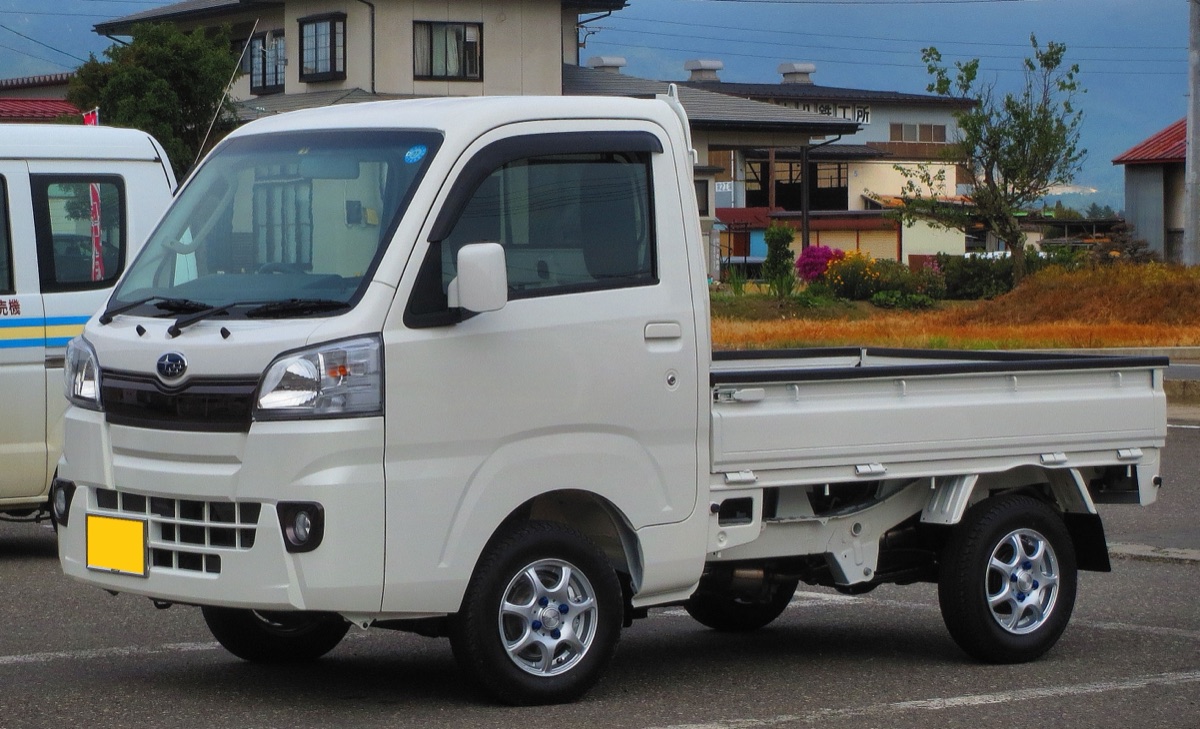
When Subaru exited kei vehicle manufacturing in 2012, the Sambar name survived but the engineering did not. The seventh generation Sambar is a Daihatsu Hijet with Subaru badges. Same three cylinder KF engine. Same front engine, rear wheel drive layout. Same chassis, same body panels, same interior. The only differences are the grille badge and, apparently, the absence of a turbo option.
For US importers, the generations that matter are the fifth generation (KS3/KS4, 1990 to 1998) and the sixth generation (TT1/TT2, 1999 to 2012). The fifth generation trucks have been import eligible for years and represent the bulk of Sambars on American roads today. The sixth generation TT1/TT2 trucks are just now crossing the 25 year import threshold, with 2001 build dates becoming eligible throughout 2026.
Those sixth generation Sambars are genuinely special. They still have the EN07 four cylinder, the rear engine layout, and available supercharging. They also have electronic fuel injection, better rust protection than the fifth generation, and available ECVT automatic transmissions. If you have been watching Japanese auction sites like Goo-net Exchange, you have probably noticed TT2 Sambars starting to appear in the eligible listings.
What This Means for US Buyers
The 2026 Sambar itself is a non factor for the American market. You cannot import a brand new kei truck under the 25 year rule, and there is no exemption pathway for vehicles that do not meet FMVSS crash standards. The Trump administration floated the idea of clearing a path for kei truck sales in the US late last year, but that would require regulatory changes that have not materialized.
What the 2026 update does signal is that Subaru intends to keep the Sambar nameplate alive in Japan. As long as the platform remains in production, parts availability remains strong. And since the current Sambar shares every major component with the Hijet and Pixis, that means three manufacturers are investing in the same parts catalog. If you own an older Sambar and need maintenance items that cross reference to the current KF engine platform, suppliers like Amayama make it straightforward to source genuine parts.
For buyers actively shopping for a Sambar to import, focus on the sixth generation TT2 trucks built from 1999 to 2012. The supercharged models with four wheel drive and five speed manual transmissions are the ones that hold their value and deliver the driving experience that makes the Sambar name mean something. Our best kei trucks to import in 2026 guide breaks down exactly which model codes to search for at auction and what to expect on pricing.
The Bottom Line
The 2026 Subaru Sambar is a perfectly competent kei truck update. Expanded safety tech, a modern infotainment option, and pricing that starts under $7,000 make it a solid workhorse for Japanese buyers who need a small truck and prefer their local Subaru dealer. The missing turbo is a real gap compared to the Hijet and Pixis, but for most Sambar buyers hauling produce on flat agricultural roads, 46 horsepower is enough.
For the US kei truck community, the real story is not the 2026 update. It is the sixth generation TT2 Sambars that are becoming import eligible right now. Those trucks, with their four cylinder EN07 engines, rear engine layouts, and supercharger options, are the last of their kind. Subaru will never build another kei truck from scratch. Once the TT2 generation ages past the auction sweet spot, the genuine Sambar experience will be gone for good. Check the listings on Duncan Imports or your local kei truck dealer. If you have been considering one, 2026 is the year to start looking.
Advertisement


