Kei Truck & Kei Car Laws in Wyoming (2026)
RestrictedWyoming classifies kei trucks as multipurpose vehicles with full title and registration access, but I-25, I-80, and I-90 stay off limits.
Are Kei Trucks Legal in Wyoming?
Yes, kei trucks are legal in Wyoming. The state classifies them as "multipurpose vehicles" and allows them to be titled and registered for on road use. However, there is one significant restriction: kei trucks cannot be operated on interstate highways.
This classification makes Wyoming considerably more permissive than states that ban kei trucks entirely or restrict them to low speed roads. You can legally drive your kei truck on U.S. routes, state highways, county roads, and city streets, just not on I-25, I-80, or I-90.
Wyoming also imposes a positioning requirement: if your kei truck cannot achieve the maximum speed allowed on a particular highway, you must operate it on the extreme right-hand edge of the roadway. This safety requirement acknowledges that kei trucks with their small 660cc engines may not keep pace with traffic on higher-speed roads. New to kei vehicles? Start with our beginner's guide to kei trucks.
The federal NHTSA 25-year import rule allows vehicles 25 years or older to be imported without meeting current Federal Motor Vehicle Safety Standards (FMVSS), which is why most kei trucks available in the U.S. fall into this age category. Once imported, Wyoming's state registration requirements apply.
How to Register a Kei Truck in Wyoming
Wyoming requires kei trucks to be registered as multipurpose vehicles. The registration process is straightforward but requires specific documentation, particularly for imported vehicles. Here's the complete step-by-step process:
Required Documents
- Application for Certificate of Title and Registration: Available at county treasurer's offices or the Wyoming DOT website
- Proof of ownership: Bill of sale, previous title, or Manufacturer's Certificate of Origin (MCO)
- U.S. Customs Entry Documents: Form 7501 showing legal importation
- Japanese export certificate: Original with certified English translation
- VIN inspection: Completed by Wyoming law enforcement officer (required for out-of-state vehicles)
- Valid driver's license: Wyoming driver's license or valid out-of-state license
- Proof of insurance: Policy meeting Wyoming minimum liability requirements
- Weight slip: From certified scales (determines fees and classification)
Step-by-Step Registration Process
-
VIN inspection: Have a Wyoming law enforcement officer complete a VIN inspection form to verify the vehicle identification number matches your documentation ($10 fee)
-
Obtain weight slip: Visit a certified scale facility (truck stops, recycling centers, grain elevators) to get an official weight slip for your kei truck
-
Secure insurance: Obtain liability insurance meeting Wyoming's minimum requirements before visiting the county treasurer
-
Gather all documents: Compile ownership documents, customs paperwork, VIN inspection, weight slip, and insurance proof
-
Visit county treasurer: Go to your county treasurer's office (Wyoming uses county treasurers for vehicle registration, not DMV offices)
-
Complete application: Fill out the title and registration application with the treasurer's assistance
-
Pay fees: Registration fees based on your vehicle's factory price and weight
-
Receive plates and registration: You'll get Wyoming license plates, registration certificate, and title
Registration Fees
Wyoming calculates registration fees based on the original factory price of the vehicle. For kei trucks (which typically had low original prices):
- Registration fee: Based on factory price schedule, typically $30-$60 annually for kei trucks
- Title fee: $35 for new titles
- County fee: Additional county fees vary by location (typically $5-$15)
- License plates: Included in registration fee
Total first-year registration typically ranges from $80-$150, depending on your county and the vehicle's age and factory price.
Timeline
If you have all required documentation, registration can be completed in one visit to your county treasurer's office. Processing is typically immediate. The VIN inspection and weight slip should be obtained before your treasurer visit to avoid multiple trips.
New Resident Registration
If you're moving to Wyoming with a kei truck already registered in another state, you must:
- Register the vehicle within 120 days of establishing Wyoming residency
- Follow the same process as above, including VIN inspection and weight slip
- Surrender your out-of-state plates and registration
Restrictions and Limitations
Wyoming's restrictions on kei trucks are more limited than many states, but they're important to understand:
Interstate Highway Ban
The primary restriction is clear and absolute: No multipurpose vehicles, including kei trucks, may be operated on interstate highways. This means:
- I-80: The major east-west interstate across southern Wyoming is off-limits
- I-25: The north-south interstate from Colorado through Cheyenne and Casper to Montana is prohibited
- I-90: The short segment in northeastern Wyoming is restricted
This restriction is significant because Wyoming is a large, sparsely populated state where interstates are often the fastest routes between cities. However, the state's extensive network of U.S. and state highways remains accessible.
Speed and Positioning Requirements
If your kei truck cannot achieve the maximum posted speed limit on a highway, Wyoming law requires you to:
- Operate on the extreme right-hand edge of the roadway
- Keep to the right-hand lane when possible
- Allow faster traffic to pass safely
Most kei trucks with 660cc engines can reach 50-60 mph, which is sufficient for many Wyoming roads but may be marginal on some 65-70 mph state highways.
Permitted Roads
You can legally operate your kei truck on:
- U.S. routes (US-14, US-16, US-20, US-26, etc.)
- State highways (WY-22, WY-28, WY-130, etc.)
- County roads
- City and town streets
- Rural routes
These roads provide access to most Wyoming communities, though travel times between distant cities will be longer without interstate access.
Equipment Requirements
Your kei truck must be equipped with:
- Headlights and tail lights
- Brake lights
- Turn signals (amber front, red or amber rear)
- At least one rearview mirror (two recommended)
- Windshield wipers (if equipped with windshield)
- Functional horn
- Seat belts for all seating positions
- Adequate tires with sufficient tread depth
Insurance Requirements
Wyoming requires all registered vehicles, including multipurpose vehicles like kei trucks, to carry liability insurance. The state's minimum coverage requirements are:
- $25,000 bodily injury per person
- $50,000 bodily injury per accident (two or more people)
- $20,000 property damage per accident
These minimums are slightly higher than some neighboring states, reflecting Wyoming's rural character and potential for more serious accidents on open roads.
Finding Insurance for Kei Trucks
Wyoming's rural nature and automotive-friendly culture mean some insurance companies are more familiar with unusual vehicles than in urban states. For more guidance, see our kei truck insurance guide. For a detailed comparison, see our kei truck vs UTV guide. Options include:
National carriers with Wyoming presence:
- State Farm - Some agents will write policies for kei trucks
- Progressive - Occasionally provides coverage
- Farmers Insurance - May offer coverage through local agents
Specialty insurers:
- Hagerty - Collector vehicle specialist, familiar with kei trucks
- Grundy - Classic vehicle insurance
- American Collectors Insurance - Covers vintage imports
Local and regional carriers:
- Independent insurance agents in Wyoming often have access to surplus lines carriers willing to insure unusual vehicles
- Farm Bureau (if you qualify through agricultural connection) may provide coverage
Insurance Application Tips
When seeking insurance, be prepared to explain:
- Your kei truck is legally registered as a multipurpose vehicle in Wyoming
- It's restricted from interstate highways
- You'll use it for local transportation, ranch work, or recreational purposes
- The vehicle is 25+ years old and meets federal import requirements
Insurance Costs
Liability insurance for kei trucks in Wyoming typically costs:
- Liability only: $300-$600 annually
- Comprehensive coverage: $400-$800 annually (if available)
Costs vary based on your location (rural areas typically cheaper), driving record, and the insurer's familiarity with kei trucks.
Inspection and Emissions
Wyoming has minimal vehicle inspection requirements, making it one of the more hassle-free states for kei truck owners:
No Periodic Safety Inspections
Wyoming does not require periodic safety inspections for registered vehicles. Once your kei truck is registered, you won't need to pass annual or biennial safety inspections.
This is a significant advantage compared to states with comprehensive inspection programs. You're responsible for maintaining your vehicle in safe operating condition, but there's no state-mandated inspection to pass.
VIN Inspection for Registration
The only inspection required is a one-time VIN verification when registering a vehicle:
- Required for all vehicles purchased out-of-state or imported
- Performed by Wyoming law enforcement officer
- Costs $10
- Verifies VIN matches your documentation
- Takes about 15 minutes
Most county sheriff's offices provide VIN inspections, as do many police departments. Call ahead to confirm availability and hours.
No Emissions Testing
Wyoming does not require smog checks or emissions testing for any vehicles registered in the state. This includes:
- No tailpipe emissions tests
- No OBD-II inspections
- No visual emissions equipment checks
This exemption applies statewide, regardless of county or city. Wyoming's lack of emissions testing makes it particularly friendly for older vehicles like kei trucks, which might struggle with modern emissions standards despite being exempt under federal import rules.
Maintaining Safety Equipment
While Wyoming doesn't inspect vehicles, you're still legally required to maintain functional safety equipment. Operating a vehicle with non-functional lights, brakes, or other safety equipment can result in citations if you're stopped by law enforcement.
Tips from Wyoming Kei Truck Owners
Wyoming's small but growing kei truck community offers practical insights for navigating the state's regulations and geography:
Best Areas for Kei Truck Ownership
- Small towns: Communities like Pinedale, Lander, Buffalo, and Thermopolis are perfectly suited to kei trucks
- Rural areas: Ranch and farm use where interstate access isn't needed
- Mountain towns: Jackson, Cody, and Sheridan have extensive local road networks
- University towns: Laramie (outside the interstate-dependent areas) has a supportive car culture
Areas with Interstate Dependencies
- Cheyenne: Heavily interstate-dependent for regional travel
- Casper: I-25 is critical for north-south travel
- Rock Springs/Green River: I-80 corridor cities with limited alternative routes
- Gillette: More isolated, interstate access useful for long-distance travel
Working Around the Interstate Ban
Wyoming's extensive U.S. and state highway network provides alternatives to interstates for most destinations:
- US-26/US-287: Connects eastern Wyoming communities without using I-25
- US-14/US-14A: Northern tier route across the state
- US-20/US-26: Southern alternatives to I-80 for portions of travel
- State highways: Wyoming maintains a good network of secondary roads
Travel times will be longer, but scenery is often better on non-interstate routes.
Seasonal Considerations
Wyoming winters are harsh. Kei truck owners recommend:
- Winter storage: Many owners store kei trucks November-March due to snow and cold
- Summer use: Ideal for seasonal recreational use, farm work, and local transportation
- Cold-weather challenges: Small engines and limited heating make winter driving uncomfortable
- Salt and corrosion: Wyoming uses road salt, which can accelerate rust on older vehicles
Ranch and Farm Use
Kei trucks are popular with Wyoming ranchers and farmers for:
- Property maintenance and inspection
- Moving tools and light materials
- Accessing remote areas not served by interstates
- Economical alternative to full size pickups for light-duty work
The 660cc engine and compact size are well-suited to ranch work within property boundaries or local area operations. Before buying, run through our pre-purchase checklist to avoid common import pitfalls.
Frequently Asked Questions
Q: Can I drive my kei truck from Cheyenne to Laramie without using I-80?
Yes. US-85 to WY-211 provides a legal route between Cheyenne and Laramie, though it takes longer than the interstate. Wyoming's highway network generally provides non-interstate alternatives, albeit with extended travel times.
Q: What happens if I'm caught on an interstate?
You could be cited for operating a vehicle in violation of its classification restrictions. Penalties may include fines and potential vehicle impoundment. The citation could also affect your insurance coverage and registration status.
Q: Do I need a special driver's license to operate a multipurpose vehicle?
No. A standard Wyoming Class C driver's license is sufficient for operating a kei truck registered as a multipurpose vehicle.
Q: Can I use my kei truck for commercial purposes?
Yes, but you'll need appropriate commercial insurance and business licensing. The interstate ban still applies, and commercial use doesn't override vehicle classification restrictions.
Q: Will Wyoming change its interstate restriction?
There's no pending legislation to change multipurpose vehicle regulations as of 2026. The interstate ban appears designed to address safety concerns about small-engine vehicles on high-speed roads, and changes seem unlikely in the near term.
Q: Can I tow a trailer with my kei truck?
Wyoming law doesn't specifically prohibit towing with multipurpose vehicles, but check your registration documentation and insurance policy. Many kei trucks have limited towing capacity, and insurance might not cover trailer accidents.
Q: How strictly is the right-hand lane requirement enforced?
Enforcement varies, but it's a safety requirement designed to let faster traffic pass. Most kei truck owners follow this rule as common sense rather than fear of citations. It's simply safer when you're moving slower than surrounding traffic.
Useful Links
- Wyoming Department of Transportation - Official WYDOT website
- Vehicle Registration Information - WYDOT registration page
- County Treasurers Listing - Find your county treasurer's office
- NHTSA Importing a Vehicle - Federal import regulations
- Wyoming VIN Inspection Info - VIN inspection requirements
- Hagerty Insurance - Specialty vehicle insurance
- r/keitruck Reddit Community - Owner discussions and advice
Conclusion
Wyoming's multipurpose vehicle classification provides a practical legal framework for kei truck ownership and operation. The single major restriction (no interstate highways) is significant in a large, sparsely populated state, but the extensive network of U.S. and state highways provides alternatives for most destinations.
Wyoming's lack of periodic inspections and emissions testing, combined with its straightforward registration process, makes it one of the more hassle-free states for kei truck owners. The interstate ban is a meaningful limitation, but if your lifestyle, work, or recreational activities don't require interstate travel, Wyoming offers an attractive regulatory environment.
Kei trucks are particularly well-suited to Wyoming ranch and farm operations, small-town living, and recreational use in mountain communities. If you're considering a Suzuki Carry, Honda Acty, Daihatsu Hijet, or Mitsubishi Minicab in Wyoming, the registration process is manageable and the operational restrictions are less onerous than in many other states.
For information about how Wyoming's kei truck laws compare to other states in the region or nationwide, explore our complete state-by-state guide. If you're near the border, you may also want to check kei truck laws in Montana, South Dakota, Nebraska, Colorado, Utah, and Idaho.
What you can do in Wyoming
Kei trucks are legal here under specific limits. Here are the three moves that matter.
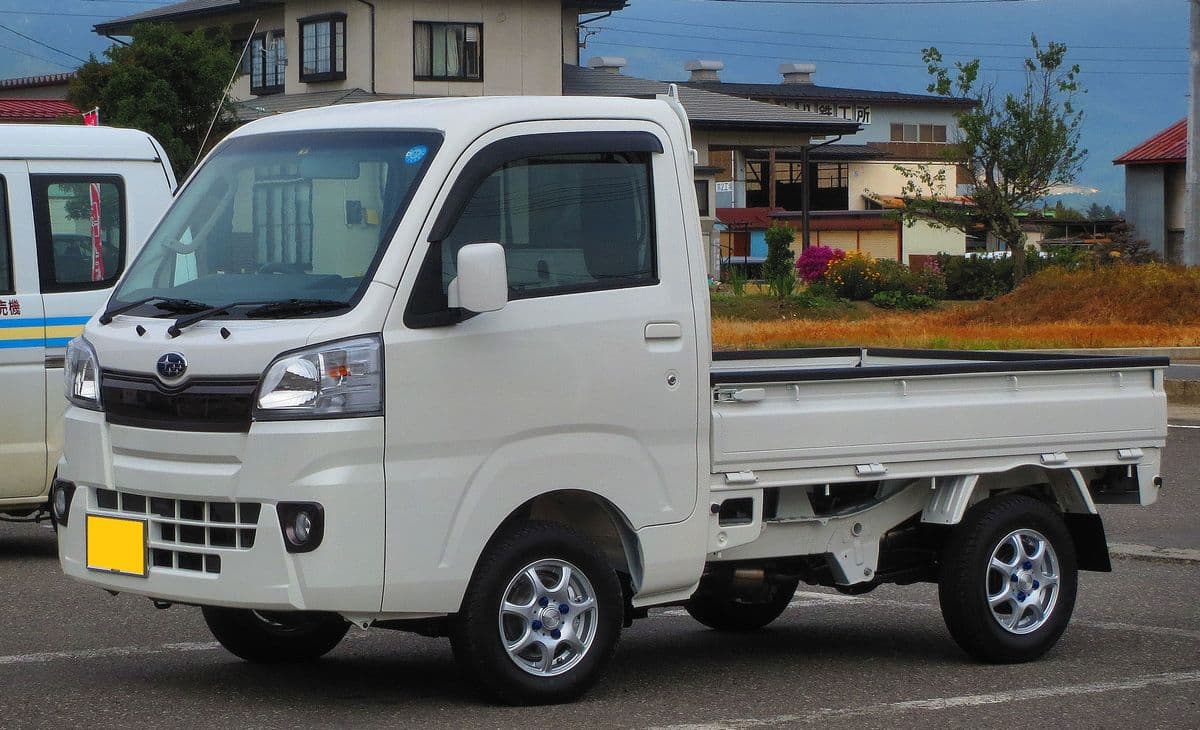
Subaru Sambar
1961-Present
Wyoming wind, Wyoming winter, and Wyoming distance between towns. The Sambar 4WD supercharged variant has the rear engine traction for Snowy Range snow and the climbing torque for South Pass grades. With interstates off limits anyway, the Sambar comfortable cruise on US 287 is what matters.