Kei Truck & Kei Car Laws in Tennessee (2026)
RestrictedTennessee Code 55-1-125 classifies kei trucks as medium speed vehicles, capped at 35 mph on roads posted 40 mph or less, with Class I off highway plates as a secondary path.
Tennessee allows kei trucks on public roads, but with meaningful restrictions. The state classifies mini trucks as "medium speed vehicles" under Tennessee Code 55-1-125, which caps them at 35 mph and limits them to roads with posted speed limits of 40 mph or less. Kei trucks can also be registered with Class I off highway vehicle plates for use on county roads. While not as permissive as some southern states, Tennessee's relatively simple registration process, no annual safety inspection in most counties, and low fees still make it a workable state for Suzuki Carry, Daihatsu Hijet, and other kei vehicle ownership.
Disclaimer: Laws and regulations change frequently. Always verify current requirements with your local Tennessee county clerk's office or the Tennessee Department of Revenue before purchasing or registering a kei vehicle. Be sure to review our pre-purchase inspection checklist.
Overview
Tennessee allows kei trucks and kei cars to be titled and registered, but classifies them as medium speed vehicles under state law. That means a 35 mph maximum operating speed, and under TCA 55-8-191(b) you can only run them on streets where the posted speed limit is 40 mph or less. The 35 mph number is the cap on the vehicle, not the road. The statute even spells out that you can cross a road with a higher speed limit at an intersection, and it requires the operator to hold a valid Class D driver license. That wording dates to the 2016 amendment (SB2143). For more details on importing, check our complete guide to importing a kei truck from Japan. Tennessee Code 55-1-125 defines a "medium speed vehicle" as any four wheeled electric or gasoline vehicle whose top speed is greater than 30 mph but not greater than 35 mph, and explicitly includes mini trucks. Kei trucks can also qualify for Class I off highway vehicle plates, defined in TCA 55-3-101 with on road operation governed by TCA 55-8-185 and 55-8-203, which allows operation on county roads. See our complete state-by-state guide for how Tennessee compares to other states.
The state's lack of a mandatory safety inspection in most counties is a significant advantage, as it eliminates one of the biggest hurdles kei vehicle owners face in other states. Only a handful of Tennessee counties require emissions testing, and older vehicles are generally exempt.
Tennessee's relatively low registration fees and taxes further enhance its appeal for kei vehicle owners despite the road restrictions.
Registration Process and Requirements
To register a kei vehicle in Tennessee, you will need:
- Title: A valid title from another U.S. state or, for first-time titling, the Japanese export certificate with certified English translation along with customs documentation.
- Bill of Sale: Showing the purchase price, buyer/seller details, and vehicle identification.
- Customs Documentation: CBP Form 7501, EPA Form 3520-1, and DOT Form HS-7 demonstrating the 25-year exemption (for imported vehicles).
- Proof of Insurance: Tennessee requires minimum liability insurance of 25/50/15 ($25,000 per person, $50,000 per accident for bodily injury, $15,000 for property damage). Starting in 2027, SB1667/HB1690 (passed by the 114th General Assembly in 2026) requires insurance verification at registration, so the county clerk will confirm coverage before issuing your plate. The same law jacks the fines for lapsed coverage from $25 to $500 on the first notice, $100 to $1,000 on the second, and adds a $1,500 repeat offender fine. Details are in the legislative fiscal memo.
- VIN Verification: May be required for vehicles not previously titled in the U.S. Contact your county clerk's office for specific requirements.
- Emissions Test: Required only in Davidson (Nashville), Hamilton (Chattanooga), Rutherford, Sumner, Williamson, and Wilson counties. Vehicles model year 1975 and older are exempt.
- Proof of Citizenship or Lawful Presence (starting January 1, 2027): SB1889/HB1708, enacted in 2026 as Public Chapter 954, requires proof of US citizenship or lawful presence (a REAL ID, Tennessee driver license or ID, or other approved documents) before an initial vehicle registration can be issued. Renewals are exempt, so this only hits your first registration. The Department of Revenue notice has the approved document list.
Step-by-Step Registration
- Gather all import and customs documentation.
- Obtain Tennessee auto insurance meeting state minimums.
- Visit your local county clerk's office with all documents.
- Complete a VIN verification if required.
- Submit the title and registration application.
- Pay applicable fees and taxes.
- Receive your Tennessee title and license plate.
Restrictions
- 40 mph Road Limit, 35 mph Vehicle Cap: Kei trucks registered as medium speed vehicles top out at 35 mph and can only operate on streets with posted speed limits of 40 mph or less under TCA 55-8-191(b). Interstates and highways are off the table, but the statute explicitly allows crossing a road with a higher speed limit at an intersection.
- Class D License Required: TCA 55-8-191 requires the operator of a medium speed vehicle to hold a valid Class D driver license. No special endorsement, just a regular Tennessee license.
- Class I OHV Alternative: Kei trucks can alternatively receive Class I off highway vehicle plates, which allow operation on county roads. Class I vehicles must have a top speed greater than 35 mph, weigh no more than 3,500 lbs dry, be 80 inches or less in width, and seat two to four passengers.
- No Annual Safety Inspection: Tennessee does not require an annual safety inspection for private vehicles in most counties, which is a significant advantage for kei vehicle owners.
- Emissions Testing (Limited): Only required in select counties around Nashville and Chattanooga. Most kei vehicles eligible under the 25-year rule will be exempt due to their age.
- Standard Traffic Laws: Kei vehicles must comply with all Tennessee traffic laws, including equipment requirements for lights, signals, mirrors, and other safety equipment.
Cost Breakdown
| Item | Estimated Cost |
|---|---|
| Title | $11.00 |
| Registration (annual) | $26.50 - $36.50 (varies by county) |
| License Plate | Included in registration |
| State Sales Tax (7%) | Varies by purchase price |
| Local Sales Tax (up to 2.75%) | Varies by county |
| Emissions Test (if applicable) | $9.00 |
| Insurance (annual) | $300 - $700 (varies) |
Tennessee's combined state and local sales tax rate can reach up to 9.75%, which is among the highest in the nation. However, the base registration and title fees are quite low. First-year costs excluding insurance and the purchase price typically range from $100 to $400.
Legislative Timeline
Legislative Timeline
- Restricted
Medium Speed Vehicle Law Enacted (SB 2857)
Tennessee enacted Public Law Chapter 959 (SB 2857), creating the "medium speed vehicle" classification. Mini trucks were explicitly included in the definition, restricting them to roads with 35 mph speed limits.
- Restricted
MSV Road Limit Set at 40 mph Posted (SB2143)
SB2143 (Chapter 982) amended the medium speed vehicle rules so MSVs run at a maximum of 35 mph on streets with posted speed limits of 40 mph or less, with crossings of higher speed roads permitted at intersections. This is the wording still on the books in TCA 55-8-191(b).
- Restricted
Class I OHV Plates Authorized (HB 2288)
Tennessee authorized Class I off highway vehicle plates for vehicles with top speeds greater than 35 mph, including mini trucks. This provided an alternative registration path allowing county road use.
- Restricted
OHV State Highway Bill Dies (SB0090/HB0006)
A bill to let Class I off highway vehicles, mini trucks included, operate on state highways posted 45 mph or less died in the House Transportation Subcommittee. Class I OHV plates remain limited to county roads.
- Pending
Insurance Verification at Registration Passed (SB1667/HB1690)
The 114th General Assembly passed SB1667/HB1690, requiring insurance verification at vehicle registration and raising uninsured fines from $25 to $500 (first notice) and $100 to $1,000 (second), plus a new $1,500 repeat offender fine. Not kei specific, but it changes how every Tennessee registration works starting in 2027.
Recent Legislative Changes
Tennessee has not enacted new legislation targeting kei vehicles specifically, and the medium speed vehicle and Class I OHV frameworks remain the two registration pathways. The federal 25-year import rule remains the primary enabler for legal importation. But the 114th General Assembly, which adjourned in spring 2026, passed a registration law that hits every kei owner in the state. SB1667/HB1690 requires insurance verification at vehicle registration starting in 2027, and it raises the fines for lapsed coverage from $25 to $500 on the first notice and $100 to $1,000 on the second, with a $1,500 fine for repeat offenders. Keep your policy active year round, because a lapse now costs real money instead of parking meter change.
Worth remembering: kei advocates already took a swing at expanding road access. The 2023 attempt (SB0090/HB0006) to let Class I off highway vehicles run state highways posted 45 mph or less died in the House Transportation Subcommittee, so county roads are still the ceiling for that plate. Tennessee's vehicle registration system has otherwise been stable, and the state's county clerk offices have become increasingly familiar with kei vehicle registrations as their popularity has grown. While some states like Illinois and Georgia have cracked down on kei trucks, Tennessee has shown no signs of moving in that direction. If you're near the border, you may also want to check kei truck laws in Kentucky, Virginia, North Carolina, Georgia, Alabama, Mississippi, Arkansas, and Missouri.
Tips from Local Owners
- Tennessee is workable but restricted. The 35 mph vehicle cap on roads posted 40 mph or less and the Class I OHV county road option are meaningful constraints, but the no inspection requirement, easy registration, and low fees still make Tennessee a decent state for kei vehicle ownership.
- County clerks are generally helpful. Most county clerks in Tennessee have processed kei vehicle titles before or are willing to work through the process. Bring all your documentation organized and clearly labeled.
- Insurance is straightforward. Several national insurance companies (Progressive, State Farm, Hagerty) write policies for kei vehicles in Tennessee without significant difficulty. For more tips, see our kei truck insurance guide. Wondering how they compare to a side-by-side? Read our kei truck vs UTV comparison. Call ahead to confirm coverage availability and get quotes.
- Watch the sales tax. Tennessee's high combined sales tax can add a meaningful amount to your total cost. Factor this into your purchase budget.
- Great for farm and rural use. Tennessee's rural landscape makes kei trucks like the Subaru Sambar especially popular for farm work, property maintenance, and short-distance hauling. Many owners use them as both utility vehicles and road legal transportation.
- Nashville and Knoxville have active communities. Both cities have growing kei vehicle communities with regular meetups, group drives, and knowledge-sharing events. Connecting with local owners is the fastest way to get up to speed on Tennessee-specific tips and resources.
- Transferring from another state is easy. If you have a kei vehicle titled in another state, transferring the title to Tennessee is generally a smooth process. Bring the existing title and proof of insurance to your county clerk.
What you can do in Tennessee
Kei trucks are legal here under specific limits. Here are the three moves that matter.
Where you can drive
Posted 35 mph or under. No interstates, no high speed arterials.
Read the rule →Find a nationwide dealer
No verified dealers in state yet. Browse importers who ship nationwide.
Browse dealers →When the rules change
Restrictions shift. We email you when Tennessee updates.
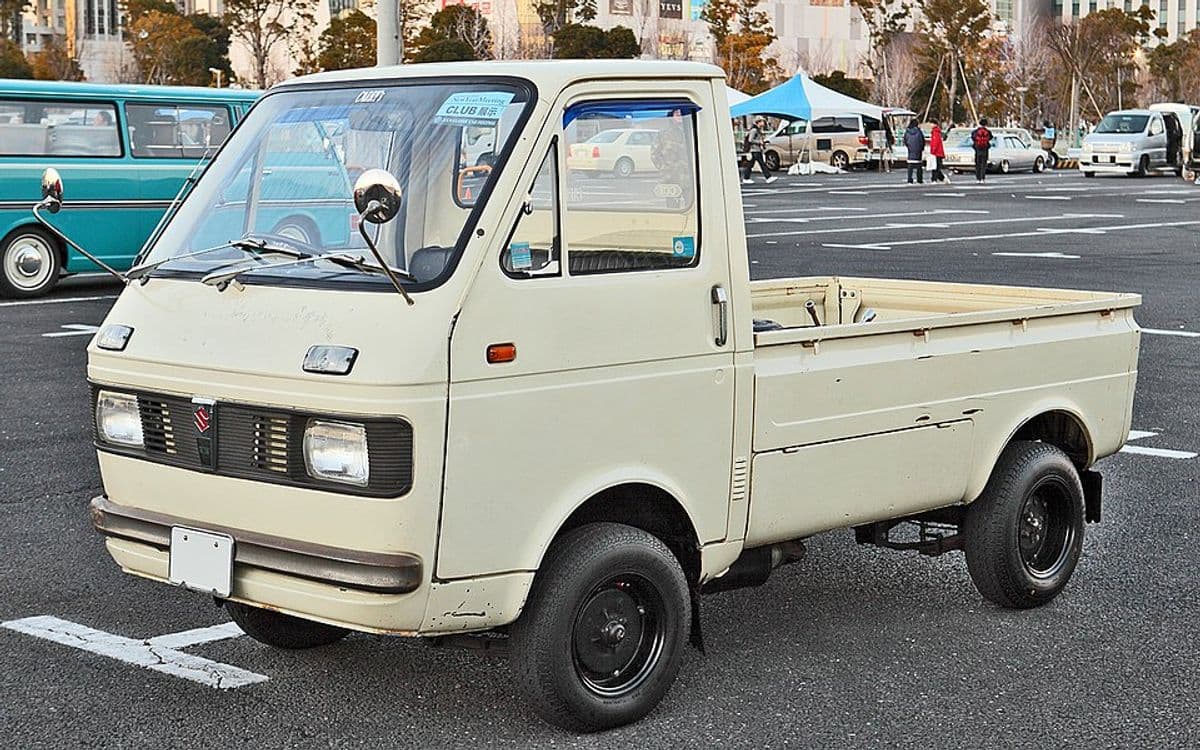
Suzuki Carry
1969-Present
East Tennessee hollers, Middle Tennessee farms, and the 35 mph cap make the Carry a strong fit. Cheapest factory dump bed, deepest parts pipeline, and the 4WD variant handles the dirt roads off TN-25 better than any kei competitor. Easy ownership for a state where the truck does short loops anyway.