Trump Wants Kei Trucks in America: What Actually Has to Happen
Trump told the Secretary of Transportation to 'clear the deck' for kei trucks. But executive enthusiasm does not rewrite crash safety standards. Here is what actually stands between mini trucks and US showrooms.

Advertisement
TL;DR: Trump said he "approved" kei trucks for the US, but presidents cannot unilaterally rewrite FMVSS crash safety standards. What actually needs to happen: NHTSA rulemaking (12-24 months), EPA exemptions, and new state registration frameworks. The 25-year import rule remains the only viable path for now. Do not hold off buying an imported kei truck waiting for new ones to hit dealers.
In December 2025, President Trump stood next to automotive executives and dropped a bombshell that sent kei truck forums into overdrive: he had "authorized" the Secretary of Transportation to "immediately approve the production of" kei trucks and cars in the United States. Days later, he posted on social media that he had "just approved TINY CARS to be built in America." The kei truck community collectively lost its mind.
There was one problem. The president cannot unilaterally rewrite Federal Motor Vehicle Safety Standards with a press conference. And those standards, not presidential preferences, are the reason you cannot walk into a dealership today and buy a brand new Suzuki Carry or Honda Acty.
So what actually happened, what still has to happen, and should you start saving for a factory fresh kei truck? Let us break it down.
What Trump Actually Said (and Did Not Say)
During a December 3, 2025 press conference announcing changes to federal emissions standards, Trump called kei vehicles "cute" and said current regulations prohibiting their sale were "silly." He directed Secretary of Transportation Sean Duffy to clear the regulatory path, and Duffy stated that the Department of Transportation had "cleared the deck" of regulations blocking kei truck production. According to Car and Driver, the announcement appeared to catch even the Secretary off guard.
What Trump did not do: sign an executive order, modify the Federal Motor Vehicle Safety Standards, change the 25 year import rule, or direct NHTSA to create a new vehicle classification. The announcement was a statement of intent, not a regulatory action. And in the automotive industry, intent without rulemaking is just a press release with better cameras.
A detailed legal analysis from Covington & Burling, one of Washington's top regulatory law firms, confirmed that "despite these executive branch pronouncements, legal barriers limit the sale and use of Kei trucks in the U.S."
The FMVSS Problem Nobody Wants to Talk About
Here is the fundamental issue. Every new vehicle sold in the United States must comply with Federal Motor Vehicle Safety Standards, administered by NHTSA. These standards cover everything from crash test performance to headlight height to airbag deployment characteristics. They were designed around American size vehicles, and kei trucks are not American size vehicles.
A kei truck maxes out at 3.4 meters (134 inches) long and 1.48 meters (58 inches) wide. For context, that is shorter than a Honda Civic's wheelbase. The Smart Fortwo, which Americans already considered dangerously tiny, is actually too big and too powerful to qualify as a kei vehicle in Japan. Getting a vehicle this small to pass US frontal offset crash tests, side impact tests, and roof crush standards designed for 4,000 pound crossovers is not a simple engineering tweak. It is a fundamental physics problem.
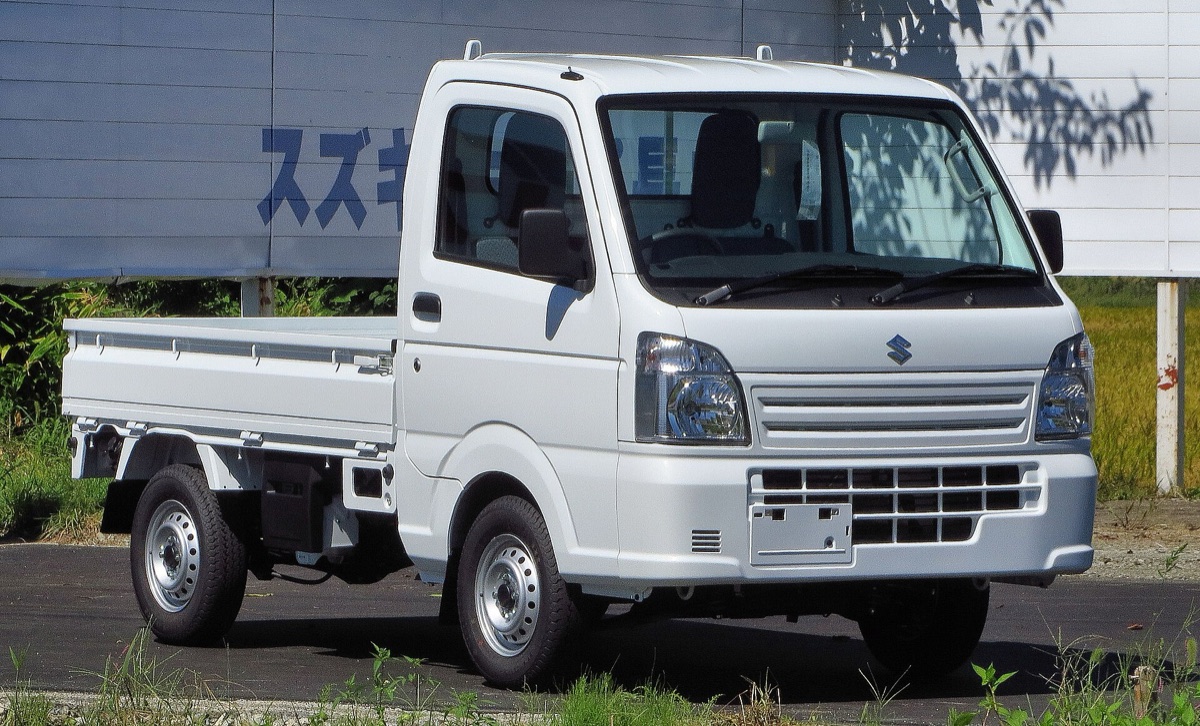
The existing pathway for kei trucks into the US relies entirely on the 25 year import rule, which exempts vehicles older than 25 years from FMVSS compliance. That is why the sweet spot for imported kei trucks right now is the 1999 and 2000 model years, vehicles from an era when the Daihatsu Hijet and Suzuki Carry had about as much crash protection as a riding lawnmower. Ironically, those are the ones that are legal. The 2026 models with autonomous emergency braking, lane departure warning, and pedestrian detection? Banned from US roads.
Three Paths Forward (and Their Odds)
There are realistically three ways new kei trucks could become street legal in the United States. Each has significant tradeoffs, and none of them is fast.
Path 1: NHTSA Creates a New Vehicle Class
The most elegant solution would be for NHTSA to create a dedicated regulatory framework for kei class vehicles, similar to what it did for Low Speed Vehicles (LSVs) under 49 CFR 571. LSVs (think golf carts and neighborhood electric vehicles) comply with a reduced set of safety standards because they are limited to 25 mph and restricted to certain roads.
NHTSA could theoretically do the same for kei trucks: define a new class with speed and road type limitations, then apply a tailored subset of FMVSS that accounts for the vehicles' smaller dimensions and lower mass. This is what the Covington analysis suggests as the most plausible regulatory pathway.
The problem is timing. Federal rulemaking under the Administrative Procedure Act requires a Notice of Proposed Rulemaking, a public comment period, review of comments, and a final rule. Even in a deregulatory administration, this process takes 18 to 36 months at a minimum. And that assumes NHTSA makes it a priority, which brings us to the reality that the agency is simultaneously dealing with autonomous vehicle regulations, updated crash test standards, and EPA coordination on emissions.
Odds: Possible but unlikely before 2028 at the earliest.
Path 2: Manufacturer Exemptions
Federal law allows manufacturers to petition NHTSA for temporary exemptions from specific FMVSS. The exemption pathway exists, but it is narrow. Exemptions are capped at 2,500 vehicles per year, subject to time limitations, and require the manufacturer to demonstrate that the exemption is in the public interest and consistent with motor vehicle safety.
NHTSA has historically been conservative with exemptions. The agency recently granted one to Zoox for autonomous vehicle demonstration purposes, but has not approved any petition for full scale commercialization of a non compliant vehicle class. A Japanese manufacturer petitioning to sell a 660cc truck that would share highways with Chevy Suburbans faces an uphill battle on the safety argument alone.
Odds: Low for meaningful volume. Maybe a handful of demonstration vehicles.
Path 3: State by State Legalization
This is where the real momentum is. While federal standards govern manufacturing and initial sale, states control vehicle registration. And states are moving fast.
Colorado and Texas both enacted kei vehicle laws in 2025, creating frameworks for registering and titling imported kei trucks for road use. Georgia passed a similar bill that was ultimately vetoed. Bills were introduced in Massachusetts, Nevada, Oregon, and Pennsylvania. Vermont's S.326 passed the Senate and is advancing through the House with provisions that would create one of the cleanest legal frameworks in the country. As MotorTrend reported, kei trucks have become one of the most popular niche vehicle categories in the country, and state legislators are responding to constituent demand.
The state by state approach does not solve the federal manufacturing problem. You still cannot buy a new kei truck, because no manufacturer can certify one to FMVSS. But it does expand the market for 25 year old imports, which is the segment that actually matters to most kei truck buyers right now. If your state is not on the list yet, check our state by state legality guide for the latest status.
Odds: High. Expect five to ten more states to pass kei vehicle legislation by the end of 2027. Our 2026 state law audit found new bills pending in Massachusetts and Pennsylvania, a Maine working group study, plus major enforcement changes in Illinois.
The Manufacturing Catch 22
Trump's announcement included a critical stipulation that most enthusiasts glossed over: kei trucks would need to be manufactured in the United States. On its face, this aligns with the administration's broader push for domestic production. In practice, it creates a chicken and egg problem that could stall the entire effort.
No Japanese automaker currently has US manufacturing capacity for kei class vehicles. Building a new production line, or retooling an existing one, requires billions in capital investment. As TFLtruck noted, automakers are not going to make that investment without regulatory certainty, and regulators are not going to finalize new rules without industry commitment to build.
There is also a demand question that the enthusiast community does not want to hear. Americans do not buy small vehicles. The Honda Fit is dead. The Ford Fiesta is dead. The Chevy Spark is dead. The Smart Fortwo is dead. These were all considerably larger and more powerful than a kei truck, and they all failed in the US market. The Bring a Trailer crowd bidding up clean Acty Vans does not represent mass market demand.
The kei truck community on r/keitruck is passionate, vocal, and growing. The import boom that tripled annual volumes to 7,500 units proves real demand exists. But passionate and vocal is not the same as commercially viable at scale. A manufacturer looking at the numbers would see a niche product with thin margins, massive regulatory uncertainty, and a customer base that currently pays $5,000 to $15,000 for 25 year old imports. Convincing a boardroom to invest in US production on that basis is a tough sell.
What This Means for You Right Now
If you are shopping for a kei truck today, here is the practical takeaway: nothing has changed yet. The import process remains exactly the same. The 25 year rule still governs what you can legally bring in. State registration requirements are still a patchwork. And the things you need to check before buying a used Japanese import have not changed one bit.
What has changed is the political visibility of kei trucks. A sitting president calling them "cute" on national television is marketing that money cannot buy. Import volumes were already climbing before Trump's announcement, and dealers across the country report strong demand for Subaru Sambars, Carrys, and Hijets, and the media cycle around the announcement has introduced kei trucks to millions of Americans who had never heard of them. By mid 2026 that visibility had matured into something bigger: the legalization argument went fully mainstream, with national think tanks and off road industry brands publishing the economic case within the same week.
For the insurance and parts markets, increased visibility means increased supply chain investment. More eyeballs on kei trucks means more aftermarket manufacturers developing accessories, more mechanics learning the platforms, and more insurers creating policies tailored to mini trucks. Importers like Duncan Imports and Japanese Classics have reported surging inquiry volumes since the announcement. The tide is rising even if the regulatory dam has not broken.
The Realistic Timeline
Based on everything we know (the executive pronouncements, the legal analysis, the state level momentum, and the manufacturing realities), here is a realistic timeline for kei trucks in America:
2026 to 2027: More states legalize registration of 25 year old imports, though the fight is far from easy. NHTSA may begin exploratory rulemaking on a kei vehicle classification. Import volumes continue to increase.
2027 to 2028: If NHTSA publishes a Notice of Proposed Rulemaking, the earliest a final rule could take effect. Manufacturers begin feasibility studies for US production.
2029 and beyond: The earliest realistic date for new, US manufactured kei trucks to appear in showrooms, assuming every regulatory and business hurdle falls in sequence. And even then, an American built "kei" will not actually be a kei — the size, price, and Japanese tax bracket that define the category do not transplant across the Pacific.
That is a four year minimum, and it assumes sustained political will across at least one more election cycle. The more likely scenario is that the 25 year import pipeline remains the primary channel for American kei truck ownership for the foreseeable future. The 2001 model year trucks, including the final generation Mitsubishi Minicab and some of the best Carry variants ever made, become eligible in 2026, and that is where the real action is. Hagerty has been tracking kei truck values for years, and auction prices for clean examples continue to climb as supply of eligible vehicles grows.
The Bottom Line
Trump's kei truck announcement was a genuine moment for the community. Forged 4x4's breakdown of what actually changed has racked up over 740,000 views, and the comment section captures the split perfectly: half the audience is ready to buy, half is pointing out that nothing legally moved. Presidential attention means political capital, and political capital means regulatory movement is at least possible in a way it was not before. And with the 2026 kei truck safety tech revolution giving every model autonomous emergency braking and pedestrian detection, the argument that these trucks are too dangerous for American roads gets weaker by the year. But the gap between "the president thinks these are cute" and "you can buy one at a dealership" is measured in years of rulemaking, billions in manufacturing investment, and a fundamental shift in American buying habits.
The smart play has not changed. Import a 25 year old truck from a reputable dealer. Register it in a state that allows it. Maintain it with quality parts. And enjoy driving a vehicle that turns more heads than a Lamborghini at a gas station, because whether or not new kei trucks ever hit US showrooms, the ones already here are not going anywhere.
Advertisement


